
Precautions When Using AI-Generated TextImportant Notes on AI-generated Text
AI-generated text is useful, but using it as-is carries risks
In recent years, the spread of generative AI such as ChatGPT has significantly changed the way people write reports, academic papers, essays, statements of purpose, and other documents. Because it can produce a starting draft in a short time, many people now use AI-generated text. However, convenience alone does not mean thatAI-generated text should be used as-isinvolves significant risks.AI-generated text may contain factual errors, leaps in logic, vague wording, unnatural phrasing, or bibliographic information for sources that do not actually exist. In academic papers and university reports in particular, polished-looking prose can still receive a poor evaluation if the content is inaccurate. AI-generated text should therefore be treated only as a supporting draft, andfinal verification and revision must always be performed by the writer。
Point 1: Do not use it without fact-checking
The most important step when using AI-generated text is to verify the facts in the output. Generative AI is good at producing plausible prose, but its content is not always correct. It may contain incorrect explanations of system names, dates, laws, statistics, researchers, definitions of concepts, and similar details.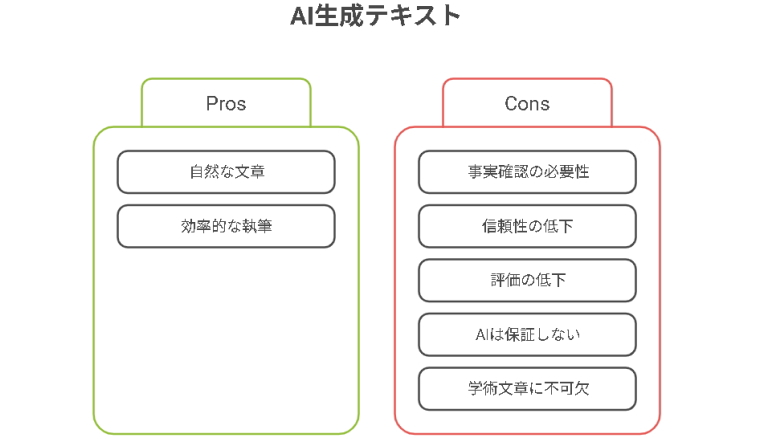
In reports and papers especially, even one factual error can reduce the credibility of the entire document. Natural prose will not be evaluated well if cited material or prior research is misunderstood. For this reason, information provided by AI shouldalways be corroborated with official materials, primary sources, and reliable literatureis necessary.
AI does not guarantee facts on behalf of the researcher or writer. Determining whether information is accurate is itself an essential part of academic writing.
Point 2: Watch for nonexistent references and fabricated quotations
One of the most common problems in AI-generated text is inaccurate reference information. Generative AI may present plausible combinations of author names, paper titles, journal names, publication years, volume and issue numbers, even when the cited work does not actually exist.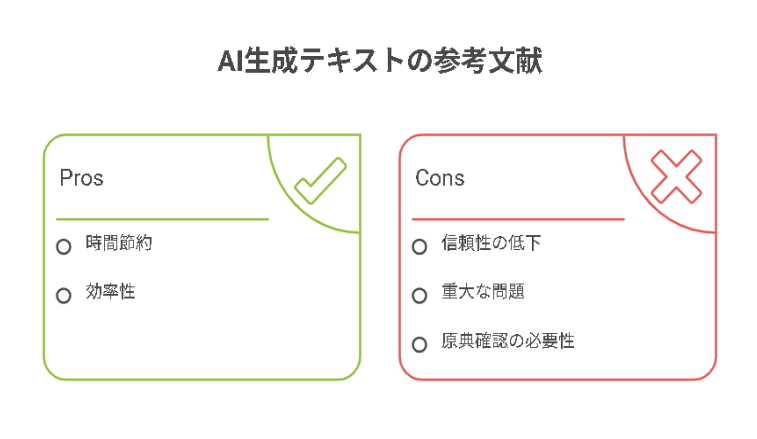
Putting such sources directly into a reference list can seriously damage the credibility of a report or paper. If quotations are also generated by AI, text that was never actually written may be presented as a “quotation,” creating a serious problem.
Accordingly, any references or quoted passages appearing in AI-generated text mustbe used only after you have personally checked the original sourceThis is essential. A quotation should not be treated as reliable because “AI wrote it”; it should be used because you have read and verified the original source yourself.
Point 3: Do not submit text you do not understand, even if it reads naturally
AI-generated text is often grammatically polished and may appear highly complete at first glance. However, natural-looking prose and the writer’s own understanding are separate matters. In academic papers and university reports in particular, it is important that the writer understands the content and can explain it in their own words.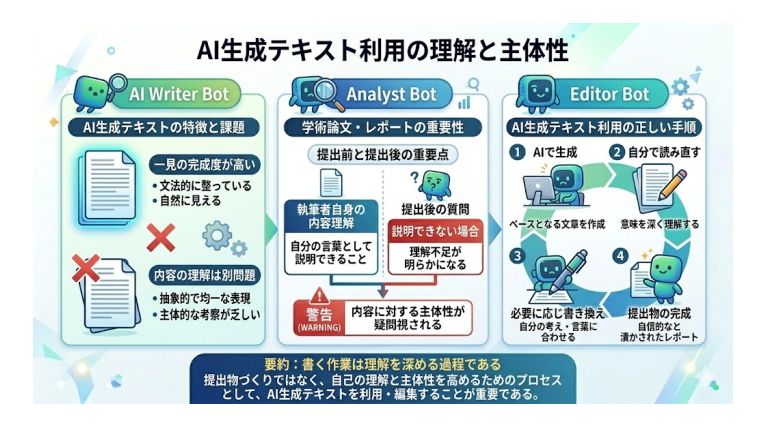
If you cannot explain what you submitted when questioned afterward, a lack of understanding may become apparent. In addition, repeated use of abstract and uniform wording typical of AI can make a paper appear to lack independent analysis of its subject.
Therefore, even when using AI-generated text,read it again yourself, understand its meaning, and rewrite it as necessary to reflect your own thinkingWriting is not merely the production of something to submit; it is also a process for deepening understanding.
Point 4: Check the rules of your university or academic society
Policies on AI-generated text may differ among universities, faculties, instructors, academic societies, and research institutions. Some prohibit generative AI entirely, while others permit only limited auxiliary use. In some cases, users are required to disclose that AI was used.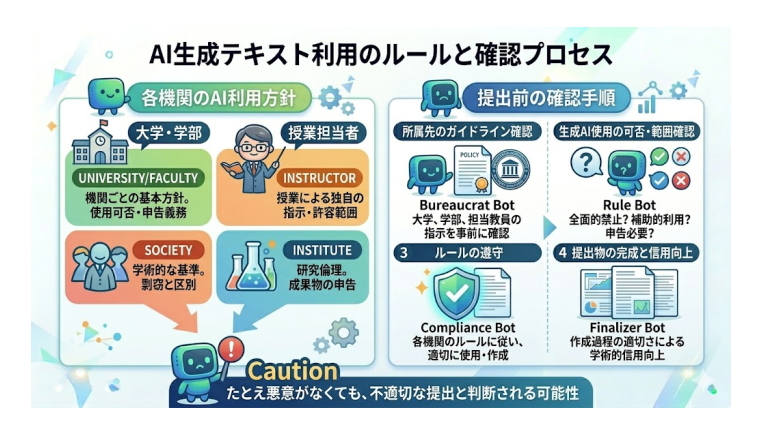
If AI-generated text is used without checking these rules, the submission may be judged inappropriate even without malicious intent. For university assignments and research papers in particular,check your institution’s guidelines and your instructor’s directions in advanceis important.
Generative AI is a useful tool, but whether and how it may be used should follow the rules of the relevant institution. Academic trust depends not only on the quality of the prose, but also on the appropriateness of the process used to create it.
Point 5: Do not enter personal information or unpublished data
When using AI-generated text, careful information management is also essential. Entering research participants’ personal information, raw survey data, unpublished research plans, confidential company materials, patient information, or internal corporate information directly into AI systems may be risky.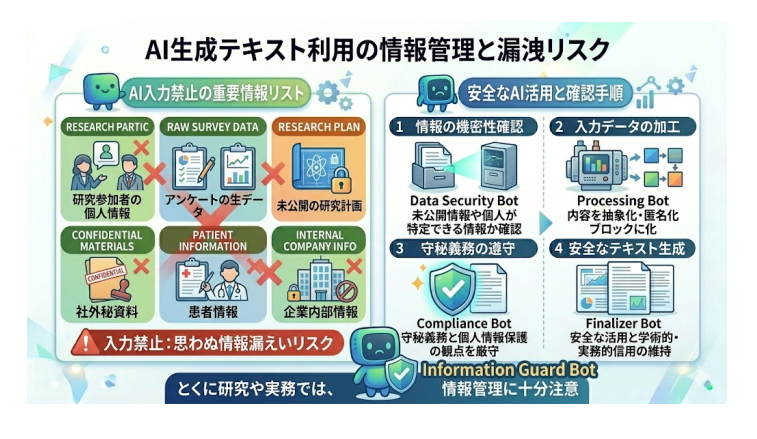
Confidentiality obligations and personal-information protection are particularly important in research and professional writing. Entering information simply because the tool is convenient can create an unexpected risk of information leakage.
Therefore, when using AI-generated text,do not enter personally identifiable information or unpublished informationThis should be the basic rule; when necessary, information should be abstracted or anonymized before it is used.
Basic Principles for Using AI-Generated Text Safely
AI-generated text can be very useful for organizing themes, creating outlines, rephrasing, summarizing, and assisting with revision. Its value, however, is realized only when the writer uses it actively and critically. Rather than delegating the entire writing process to AI,position it as a tool that supports your own thinkingis important.In practical terms, the basic process is to fact-check AI output, verify original sources, edit the wording yourself, add your own analysis, and check that no rules are being violated.
Used appropriately, AI-generated text can improve writing efficiency. If verification and judgment are neglected, however, it may instead damage evaluation and trust. That is why it is important touse AI with both an awareness of its convenience and appropriate cautionis required.
Summary
AI-generated text can be useful as support for academic papers and reports, but using it as-is involves many risks. The basics are to verify facts, check references and quotations against original sources, revise the text only after understanding it yourself, comply with the rules of your institution, and avoid entering confidential information.What truly matters in writing is not polished prose that merely looks as though it could have been written by AI, butaccuracy of content, consistency of logic, and the writer’s own understandingAI-generated text should be used skillfully as support, while the writer ultimately takes responsibility for completing the work.
Contact
To date, we have supported clients throughout Japan and overseas.over 10,000 casesWe have supported a wide range of requests, including academic-paper support, report and paper support, structural consultation, writing improvement, and research support. Our experienced consultants listen carefully to your needs and make proposals appropriate to your objectives.
* We also accept consultations on reviewing AI-generated text, improving writing, and organizing document structure.
If you are concerned about writing reports or papers in the age of generative AI, please feel free to contact us.
0476-85-7930
* When order volume is high, it may be difficult to reach us by phone.
If your matter is urgent, please contact us by email.
* When order volume is high, it may be difficult to reach us by phone.
If your matter is urgent, please contact us by email.
