
Academic Writing with Generative AIAI-assisted Academic Writing
What Is Academic Writing with Generative AI?
In recent years, the spread of generative AI such as ChatGPT has significantly changed how academic papers and university reports are produced. Traditionally, writers had to proceed step by step through topic selection, formulation of the research question, review of prior research, outlining, drafting, and revision. With generative AI, however,organizing issues, creating outlines, summarizing, and improving expressioncan often be made more efficient.Generative AI is not all-powerful. Although useful, it also carries the risk ofPossibility of Containing Incorrect Informationproviding inaccurate information or citing sources that do not exist. Generative AI should therefore be used not as a tool for producing a finished work to submit unchanged, but as a support tool for the process of academic writing.
Point 1: It can help organize research topics and issues
One major advantage of generative AI is its usefulness for organizing the topic at the starting point of research. For example, entering broad themes such as “educational inequality,” “regional revitalization,” “nursing practice,” or “consumer behavior” can produce a wide range of related subtopics and analytical perspectives. This can make it easier toclarify the direction of the research objective and research questions。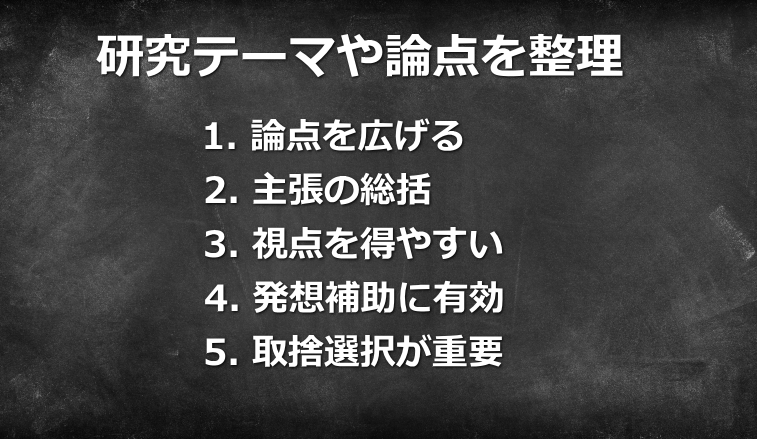
Even when a research topic is still vague, asking questions such as “What research questions could be developed from this topic?” or “What perspectives are common in prior research?” may reveal viewpoints you had not considered. Generative AI can be particularly useful for generating ideas at the early stages of paper writing, where many people become stuck.
Even at this stage, however, it is important not to adopt AI suggestions wholesale, but toselect among them in light of your own research objectiveGenerative AI is good at expanding the range of possible ideas, but the writer must make the final judgment about academic appropriateness.
Point 2: It can help create a preliminary outline and chapter structure
Generative AI can also help when planning the overall structure of a paper or report. In addition to the basic introduction-body-conclusion format, it can suggest sections such as “research background,” “prior research,” “methods,” “results,” and “discussion” according to the topic. This makes it easier togain an early overview of the entire paper。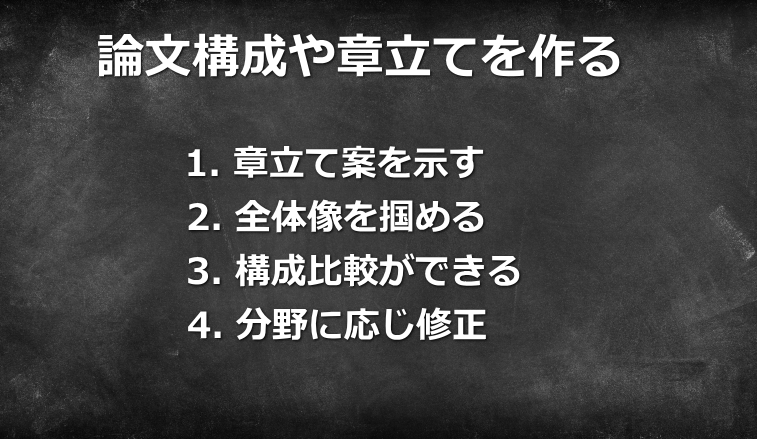
One difficulty in writing a long document is establishing the framework before drafting the text. If writing begins while the structure is still vague, the argument can drift and repetitive material can accumulate. Generative AI can help by producing several possible outlines that can be compared so that the writer can choose the structure best suited to the objective.
Caution is still necessary. An AI-generated outline may look plausible while differing from conventions in a particular research field. Therefore,revise it to match the conventions of your field and the instructions of your supervisoris essential.
Point 3: It can help with summaries and improving written expression
Generative AI is useful for organizing the key points of prior research and rephrasing text you have written yourself. For example, it can suggest alternative wording when a passage has become too long or when repeated expressions make it awkward. This can help make the textmore readable and better organized。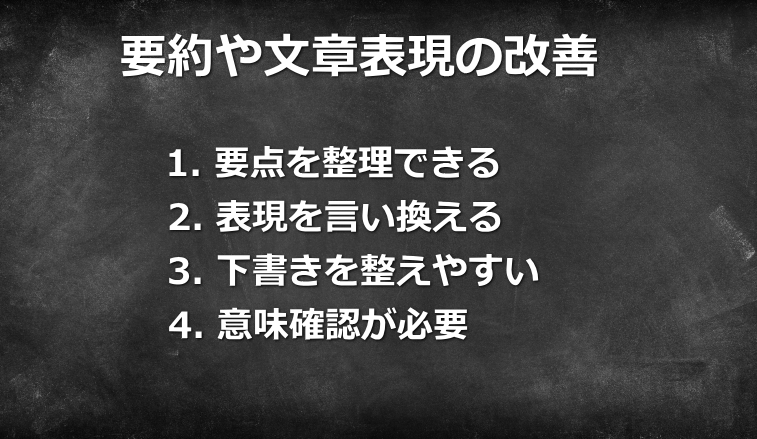
Even fragmented research notes or an initial rough draft can be used as material for assistance in shaping an explanatory passage. This can be especially useful when considering how to express the discussion or when summarizing the research background concisely in the introduction.
However, AI summaries and paraphrases can subtly change meaning. Therefore,you must personally verify the meaning of technical terms, the accuracy of quotations, and consistency with the contextAcademic writing places greater importance on conceptual precision than on smooth paraphrasing.
Point 4: Precautions when using generative AI
When using generative AI for academic writing, you need to understand not only its convenience but also its limitations. Particular care is required because AI output may containincorrect facts, vague explanations, or bibliographic information for sources that do not existIf such content is incorporated into a paper without verification, the credibility of the entire paper may be damaged.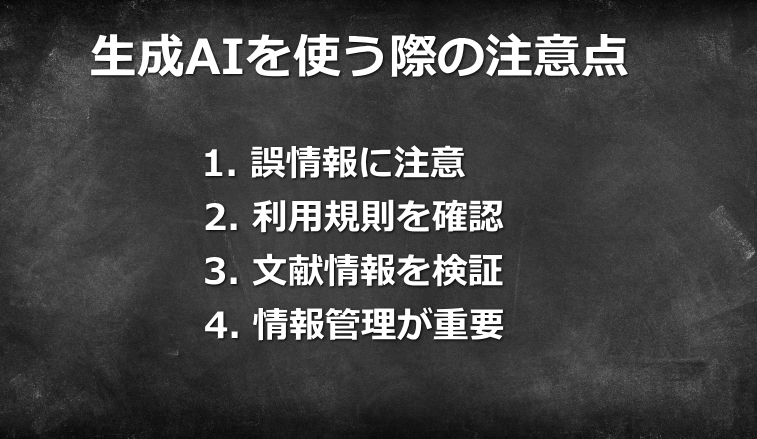
Universities and academic societies may also establish rules concerning generative AI. You should check your institution’s policy in advance to determine what forms of auxiliary use are permitted and whether citation or disclosure of AI use is required.
Entering personal information or unpublished data directly into an AI system also creates information-management risks. When handling participant attributes, survey data, raw data, or unpublished research plans,give sufficient attention to confidentiality and securityis important.
Point 5: The basic approach to using generative AI effectively
The most important point in using generative AI for academic writing is not simply to have AI write the text, but touse it as a tool for organizing your own thinking and assisting your writingUsed for limited purposes such as topic development, outlining, summarization, wording improvement, and revision support, generative AI can be a highly effective aid.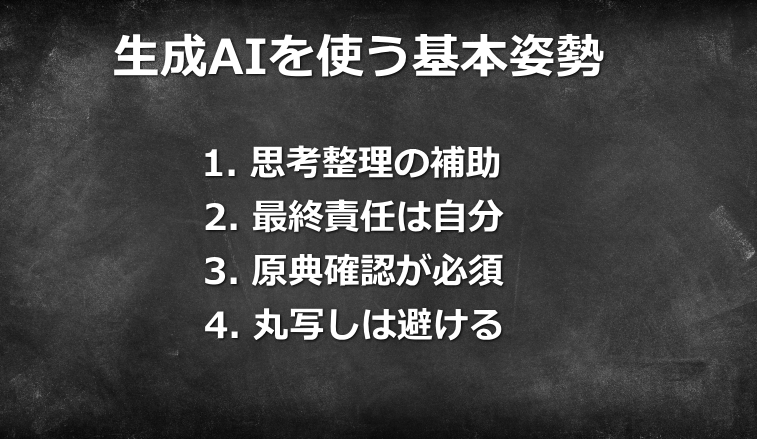
The key point is that final responsibility always remains with the writer. Defining the research objective, checking the literature, interpreting analysis results, and handling citations properly are all the writer’s responsibilities. Generative AI can make those processes more efficient, but it cannot replace academic judgment itself.
Accordingly, when using generative AI,thoroughly fact-check the content, always consult original sources for references, and never submit AI output unchangedThese basic practices can make generative AI a useful tool for improving both the quality and efficiency of academic writing.
Summary
Generative AI can assist with many aspects of academic writing, including organizing the research topic, creating outlines, summarizing, and improving prose. At the same time, it carries risks such as misinformation, inaccurate references, and information-management problems. It should therefore be used not merely because it is convenient, but only afterclearly defining which tasks it will be used to supportis important.Academic papers and reports ultimately require the writer’s own understanding, judgment, and logical organization. When generative AI is positioned appropriately, it can reduce the burden of writing while helping produce a better-organized document.
Contact
To date, we have supported clients throughout Japan and overseas.over 10,000 casesWe have supported a wide range of requests, including academic-paper support, report and paper support, structural consultation, writing improvement, and research support. Our experienced consultants listen carefully to your needs and make proposals appropriate to your objectives.
* Depending on your needs, we also provide consultation on paper structure and written expression.
If you have concerns about writing papers and reports in the age of generative AI, please feel free to contact us.
0476-85-7930
* When order volume is high, it may be difficult to reach us by phone.
If your matter is urgent, please contact us by email.
* When order volume is high, it may be difficult to reach us by phone.
If your matter is urgent, please contact us by email.
