
Is It Risky to Write Papers With ChatGPT?blog
Is It Risky to Write Papers With ChatGPT?
Is It Risky to Write Papers With ChatGPT?
Graduation Theses × AI: A Summary of the Real Risks | Essential Reading Before Use
—A graduation thesis that cannot demonstrate accountability is not ready to be evaluated.
1 | Institutional Perspective: A Graduation Thesis Must Make Final Responsibility Visible
AI cannot be an author, and final responsibility belongs to humans—this is an internationally recognized position reflected in COPE guidance. Major publishers such as Elsevier and Springer Nature also require disclosure of AI use and place responsibility for the text, interpretation, and conclusions on human authors. A graduation thesis is a culmination of training in and demonstration of accountability. If AI dependence substitutes for core work such as formulating questions, reading prior research, validating methods, and recognizing limitations, the very object of evaluation is undermined. Universities also strictly require degree-related work to be the student’s own achievement; for example, Nihon University states that work created solely by generative AI is not regarded as the student’s original output. This direction is consistent with considerations published by Japan’s Ministry of Education, Culture, Sports, Science and Technology, and students are obliged to follow their institution’s policies.
Examples of sources: publicationethics.org / www.elsevier.com / springer.com / Nihon University “Independent Creativity” / Ministry of Education, Culture, Sports, Science and Technology
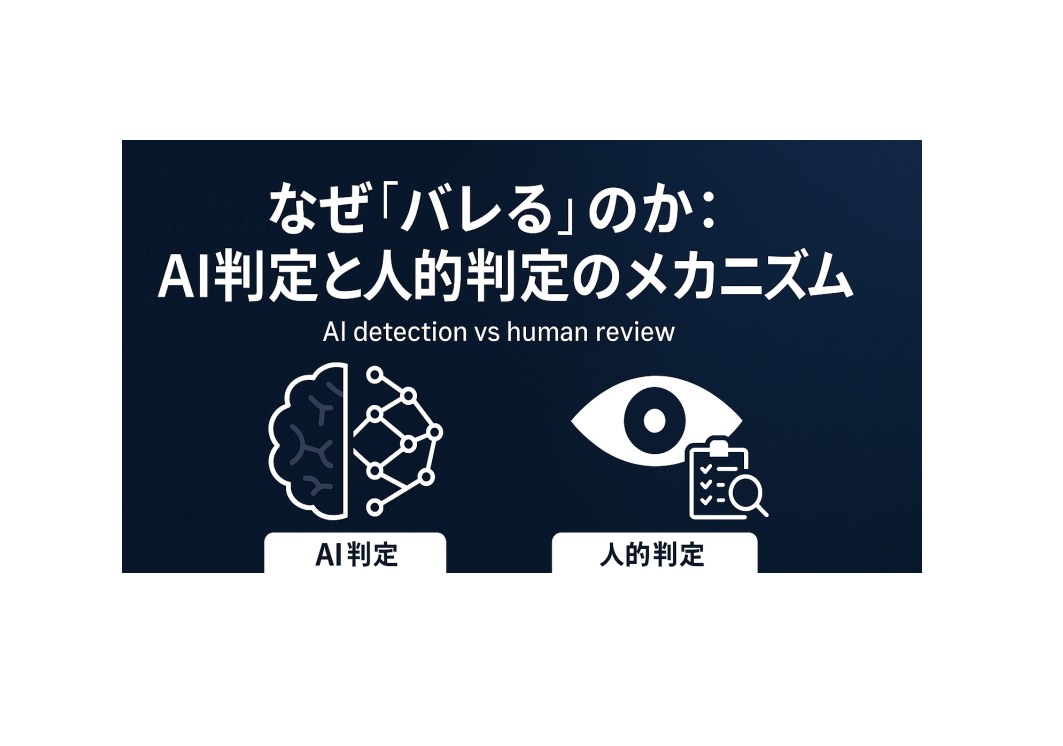
2 | Evaluation Perspective: Detection Tools Are Dangerous Precisely Because They Are Not Infallible
Generative-AI detection still faces false positives and false negatives. Turnitin itself has disclosed limitations, and universities warn that “detected = guilty” and “not detected = innocent” are not valid conclusions. A graduation thesis is evaluated as a unique piece of work; once doubt arises, the disadvantage can be substantial if the student cannot rebut it with research notes, raw data, analysis logs, draft history, and similar records. This creates an asymmetric risk: casual use can increase suspicion while making innocence difficult to demonstrate.
Examples of sources: turnitin.com / Vanderbilt University / lawlibguides.sandiego.edu / The Times
3 | Practical Perspective: Because a Graduation Thesis Is Evaluated as a Process, It Is Particularly Incompatible with Heavy AI Reliance
The process itself—topic selection, literature review, methodological design, data collection and analysis, and discussion—is central to learning. AI use beyond summarization or language polishing can sharply increase the risks of (1) inaccurate summaries and fabricated citations (hallucinations), (2) failure to independently validate research design, (3) rights and ethical problems associated with generated or altered figures and images, and (4) plagiarism concerns when sources are not disclosed in translation or paraphrasing. At undergraduate level, close reading of original sources and reconstruction in one’s own words are central to evaluation, and plausible-sounding AI output can obscure genuine ability. Publishers and academic societies are also increasingly demanding transparency around AI use, with expanding rules restricting AI-generated images and use of AI in peer review.
Examples of sources: vascular.org / springer.com / Springer Nature
4 | Minimum Requirements If AI Must Be Used Nevertheless (Still Not Recommended)
Use should be limited to expression-level assistance such as rephrasing, grammar correction, or suggesting table-of-contents ideas; AI should not replace substantive content generation or the literature review. AI use should be disclosed in accordance with institutional policies, including the tool, version, purpose, and extent of human verification. Keep summaries of prompts, changes, and reasons for accepting or rejecting outputs in research notes. Citations, data, and figures should be checked by a human against original sources. Obtain prior approval from the supervisor and share the operating plan. Even so, non-use remains the safest option.
Example of source: www.elsevier.com
5 | The Role of iBooks Academic Support: Making Risks Visible and Reducing Them
The first priority is to avoid casual dependence on AI. At the same time, it is important to establish explainability that can withstand questions. iBooks Academic Support provides
(a) cross-checking institutional rules against publisher standards (organizing requirements from MEXT guidance, university rules, COPE, Elsevier, and Springer),
(b) original-source verification and citation auditing (checking by DOI and edition and eliminating fabricated references),
(c) process-evidence packages (organizing draft history, analysis logs, and research notes),
(d) disclosure-text templates compliant with submission rules and institutional formats
to support graduation-thesis work that is less likely to raise doubts and can be explained. The consistent policy is to avoid reliance on AI for substantive content generation, while prioritizing the student’s own reading and formation of logic.
Examples of sources: Ministry of Education, Culture, Sports, Science and Technology / publicationethics.org / www.elsevier.com / springer.com
Note: This service is not ghostwriting. It provides support for research processes and editing, as well as coaching to improve literacy, in accordance with ethics and compliance requirements.
— Conclusion —
Casual use of generative AI is particularly risky because it can undermine the essence of a graduation thesis—independent understanding and accountability—while imperfect detection creates risks for both innocent and improper use. Non-use is safest. If minimal use is unavoidable, it should be conditioned on strict disclosure, verification against original sources, retention of process evidence, and prior permission from the supervisor. iBooks Academic Support supports transparency that can withstand degree review by helping design and audit a safe process.
#GraduationThesis #GenerativeAI #ResearchEthics #AcademicWriting #COPE #Elsevier #SpringerNature #MEXT #ResearchIntegrity #ResearchLiteracy #Turnitin
Reference-domain examples: publicationethics.org / elsevier.com / springer.com / turnitin.com / mext.go.jp / Nihon University “Independent Creativity” website
Points to Check to Improve the Reliability of This Article
When using “Is It Wrong to Write Papers with AI Such as ChatGPT?” for reports, papers, or assignments, do not copy the explanation verbatim. Verify the basis with primary sources, official materials, and academic literature, and reorganize the content to fit the requirements of your own assignment.
| ConfirmItem | What to Check | How to Use It in a Report |
|---|---|---|
| Accuracy of Information | Check whether the concepts, figures, systems, and cited sources in the text actually exist and are consistent with the latest information. | Add references and footnotes so that the relationship between claims and supporting evidence is clear. |
| Consistency with Assignment Requirements | Check that the work complies with the course topic, word count, required readings, writing style, citation format, and submission format. | Use a structure in which the introduction presents the question, the body develops the evidence, and the conclusion answers the question. |
| Originality / Discussion | Check that the discussion goes beyond general explanation and connects to the course content or your own research question. | Add, in your own words, why you think so and what limitations remain. |
| Transparency About AI Use | Be able to explain what parts involved generative AI, how sources were checked, and whether the text was rewritten. | Treat AI output not as a finished product but as assistance for research, structuring, and revision. |
Reference Materials / Verification Sources
The following are public, academic, and official sources worth checking when using the content of this article in a report or paper. If you cite them, format the citation according to the requirements of the institution where you will submit the work.
- Ministry of Education, Culture, Sports, Science and Technology: “Handling of Generative AI in Teaching and Learning at Universities and Colleges of Technology”: provides basic guidance on handling generative AI in university and college classes, reports, examinations, and related educational settings.
- Agency for Cultural Affairs: “AI and Copyright”: a public source for considering risks involving AI-generated content, copyright, plagiarism, and similar wording.
- OpenAI「A Student's Guide to Writing with ChatGPT」: provides guidance on using ChatGPT as a learning aid and for improving writing.
- Google NotebookLM Official Website: official information on an AI research tool that summarizes and answers questions based on materials provided by the user.
- Elicit Official Website: official information on an AI research-support tool used to search, summarize, and extract information from academic papers.
- Zotero Official Website: official information on a reference-management tool used to collect, organize, cite, and share references.
Related Services / Internal Links
In academic writing, not only appearance but also citations, evidence, logic, and compliance with submission requirements directly affect evaluation. Please review the related pages as well.
AI Report / Paper ConsultationUniversity Report SupportGraduation Thesis / Master's Thesis Writing SupportAcademic Paper and Literature SearchFree Quote / Consultation
FAQ
Can I submit a report generated with generative AI as it is?
Submitting it unchanged is not recommended. Check the rules of your university and course, treat AI output as an outline or draft, verify sources, and reconstruct the content in your own words.
Can references generated by AI be trusted?
It is risky to trust them without verification. AI may produce nonexistent references or incorrect bibliographic details, so confirm both existence and content using sources such as CiNii, J-STAGE, Google Scholar, PubMed, and publisher websites.
What matters if I want to avoid problems or suspicion regarding AI use?
The important point is not to evade AI detection, but to keep records of how AI was used, check applicable rules, verify evidence, connect the writing to course content, and add your own analysis.
Contact
To date, we have supported clients throughout Japan and overseas.over 10,000 casesof academic support requests. Experienced consultants carefully listen to your needs and provide prompt, appropriate support at reasonable fees.
Ibooks members across Japan will support you responsibly.
We send the profile of the responsible staff member when you apply.
When orders are busy, phone lines may be difficult to connect. We will reply in order, so urgent inquiries should be sent by
