
How to Use Generative AI in Reports and Papersblog
How to Use Generative AI in Reports and Papers
How to Use Generative AI in Academic Writing
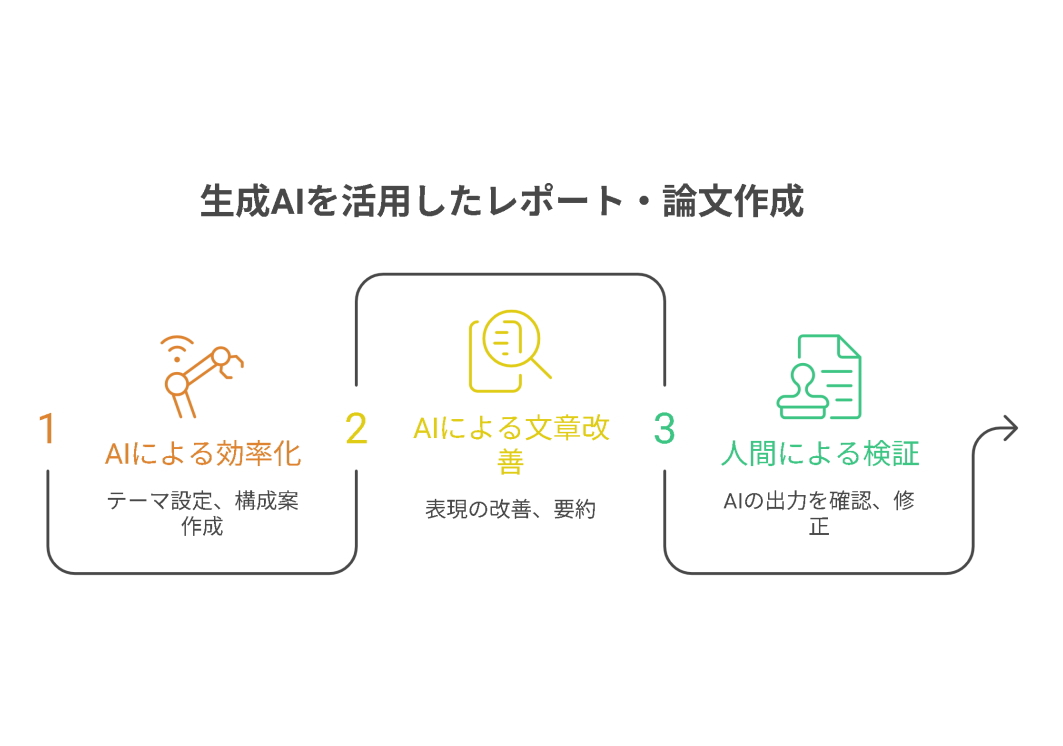
How to Use Generative AI in Reports and Papers
In recent years, the spread of generative AI such as ChatGPT has significantly changed the environment for writing reports and papers. Traditionally, writing required building the work step by step: reading materials, planning the structure, creating a draft, and polishing the expression. Today, generative AI can make multiple stages more efficient, including topic development, outline creation, organizing prior research, improving wording, summarizing, and revising.
However, generative AI is not infallible. Although convenient, it can contain misinformation and may produce wording that implies a source was checked even when it was not. Therefore, when using generative AI for reports or papers, the essential stance is not to “have AI write it” but to “use AI as an auxiliary tool.” The important point is to use generative AI appropriately while keeping one’s own thinking and verification at the center.
Where Can Generative AI Help in Report and Paper Writing?
Generative AI is often most useful during the initial and organizational stages of writing. If you do not know what to write and become stuck, asking it to identify relevant issues or suggest several possible structures can help you grasp the overall picture early. In preparing university reports or graduation theses, students often struggle with organizing headings such as “research background,” “research purpose,” “statement of the problem,” and “difference from prior research.” Generative AI can be useful as support for building this framework.
It can also be effective to provide your own draft and ask the AI to suggest improvements from perspectives such as “Where are there logical leaps?”, “Which parts need more explanation?”, or “How could this be expressed in a more academic style?” This is not automatic authorship but a way to view one’s own writing more objectively. Writers often fail to notice gaps or repetition, and using generative AI as revision support can improve readability and logical coherence.
Generative AI can also assist with summarizing long materials and organizing points across multiple sources. After reading the literature yourself, you can ask it to summarize or to “organize this paper’s argument and limitations” as support for comprehension. Even then, it is risky to rely only on an AI summary without checking the original source. A summary is only an entry point; final understanding and judgment must remain your own.
Basic Steps for Writing Reports and Papers with Generative AI
Even when generative AI is used, the basic workflow does not change greatly. The first task is to understand the assignment conditions accurately: word count, submission format, citation rules, reference style, required theme, theories, materials, and so forth. If these conditions remain vague when AI is used, the output may look polished while still failing to meet the actual requirements.
Next, the theme needs to be narrowed. A vague theme such as “write about population aging and declining birthrates” is too broad to sustain a focused argument. Asking, for example, “If I focus on shortages of long-term-care workers within population aging, what issues could be examined?” can help narrow the topic. At this stage, the goal is not to have AI create the answer but to generate candidates for comparison and consideration.
After that, create an outline. Using the basic introduction–main body–conclusion structure, clarify the sections: problem awareness and purpose in the introduction; current-situation analysis, theoretical examination, and case analysis in the main body; and overall summary and remaining issues in the conclusion. Asking AI for “an outline for a 3,000-character report on this topic” can quickly produce a starting point, but the structure should not be adopted unchanged; it must be revised to fit your own argument.
Once the structure is set, collect and read materials. The most important caution is not to trust source titles or research content suggested by generative AI without verification. It can plausibly provide nonexistent paper titles, incorrect author names, or claims that the sources do not actually make. Bibliographic information must therefore always be verified independently. A preferable workflow is to read papers and books, take your own notes, and then ask AI questions such as “Is this summary accurate?” or “What points are missing from this organization of the argument?”
At the drafting stage, it is preferable to use your own writing as the base and ask generative AI for expression improvements or logical organization where needed. If the entire text is delegated to AI from the outset, the prose may be polished but empty because it is not grounded in your own understanding. What matters most in reports and papers is the thought process: what problem you identify, what evidence or materials you use, and what conclusion you reach. Generative AI must support rather than replace that process.
The Quality of Instructions Given to Generative AI Affects the Quality of the Output
When generative AI fails to produce the expected writing, a common cause is vague instructions. Simply asking “write a report” tends to produce superficial generalities. Better results require specifying the topic, purpose, intended reader, length, style, points that must be included, and expressions to avoid.
For example, rather than saying “write about educational inequality,” a more precise instruction would be: “Write approximately 3,000 Japanese characters for a university sociology report on educational inequality in Japan, focusing on its relationship with household economic inequality, using the da/de aru style and organizing the discussion in the order of current situation, causes, and issues.” The clearer the conditions, the easier it is for generative AI to align the direction of the output.
It is also important not to demand a finished result in one step but to use AI incrementally: first organize issues, then create an outline, then summarize each section, and finally improve wording. Dividing the process in this way makes it easier to improve accuracy. This mirrors the way humans write and makes staged AI assistance more natural.
Precautions When Using Generative AI
The greatest caution when using generative AI is hallucination—the generation of plausible but false information. Errors are particularly likely in paper titles, author names, publication years, statistical figures, and descriptions of legal systems. Information produced by AI must therefore be checked against original sources. Failing to do so can immediately undermine the reliability of a report or paper.
Another issue is plagiarism or improper authorship. Submitting AI-generated writing unchanged may be regarded as misconduct depending on the rules and circumstances. Universities and research institutions may have guidelines governing generative AI use; they may permit some uses while prohibiting undisclosed generation of substantive text. It is therefore important to check institutional rules in advance and disclose the scope and method of use where required.
AI-generated writing may look polished yet lack originality and drift toward abstract phrasing. Because it can become a collection of generic points, it is necessary to add your own problem awareness, concepts covered in class, concrete examples, and personal analytical perspective. The aim of a report or paper is not to produce text that merely sounds correct, but to present your own position and analysis with supporting grounds.
Common Traits of People Who Use Generative AI Effectively
People who use generative AI effectively tend to share one feature: they use it not as a machine that supplies answers but as a dialogue partner for deepening thought. Questions such as “What is the counterargument to this claim?”, “What are the weaknesses of this structure?”, and “Does this paragraph drift away from the main issue?” can help refine one’s own ideas. In other words, effective users do not depend on AI; they use it to train their own thinking.
Skilled users also make sure to shape the final text in their own words. They may use AI output as material, but they revise it to fit their own writing style and research context, unify expressions, and check logical relationships. This allows them to benefit from AI’s convenience without losing authorship and intellectual agency.
Summary
Generative AI can be a very useful support tool in report and paper writing. It can improve efficiency across many stages, including topic selection, outlining, summarizing, revision, and expression improvement. At the same time, it carries risks such as misinformation, plagiarism concerns, and hollow content. When using generative AI, it is therefore necessary always to keep three points in mind: checking original sources, maintaining one’s own thinking, and confirming the rules of the relevant institution.
Ultimately, what is necessary for writing a good report or paper is not generative AI itself but the attitude with which it is used. If AI is used as a supporting aid for deepening one’s own analysis rather than as a substitute for thinking, it can become a powerful ally in learning and research. The key skill for the coming era is not simply “whether to use AI,” but how to use it appropriately and connect it to one’s own intellectual work.
Points to Check to Improve the Reliability of This Article
When using “How to Write Reports and Papers Using Generative AI” for reports, papers, or assignments, do not copy the explanation verbatim. Verify the basis with primary sources, official materials, and academic literature, and reorganize the content to fit the requirements of your own assignment.
| ConfirmItem | What to Check | How to Use It in a Report |
|---|---|---|
| Accuracy of Information | Check whether the concepts, figures, systems, and cited sources in the text actually exist and are consistent with the latest information. | Add references and footnotes so that the relationship between claims and supporting evidence is clear. |
| Consistency with Assignment Requirements | Check that the work complies with the course topic, word count, required readings, writing style, citation format, and submission format. | Use a structure in which the introduction presents the question, the body develops the evidence, and the conclusion answers the question. |
| Originality / Discussion | Check that the discussion goes beyond general explanation and connects to the course content or your own research question. | Add, in your own words, why you think so and what limitations remain. |
| Transparency About AI Use | Be able to explain what parts involved generative AI, how sources were checked, and whether the text was rewritten. | Treat AI output not as a finished product but as assistance for research, structuring, and revision. |
Reference Materials / Verification Sources
The following are public, academic, and official sources worth checking when using the content of this article in a report or paper. If you cite them, format the citation according to the requirements of the institution where you will submit the work.
- Ministry of Education, Culture, Sports, Science and Technology: “Handling of Generative AI in Teaching and Learning at Universities and Colleges of Technology”: provides basic guidance on handling generative AI in university and college classes, reports, examinations, and related educational settings.
- Agency for Cultural Affairs: “AI and Copyright”: a public source for considering risks involving AI-generated content, copyright, plagiarism, and similar wording.
- OpenAI「A Student's Guide to Writing with ChatGPT」: provides guidance on using ChatGPT as a learning aid and for improving writing.
- Google NotebookLM Official Website: official information on an AI research tool that summarizes and answers questions based on materials provided by the user.
- Elicit Official Website: official information on an AI research-support tool used to search, summarize, and extract information from academic papers.
- Zotero Official Website: official information on a reference-management tool used to collect, organize, cite, and share references.
Related Services / Internal Links
In academic writing, not only appearance but also citations, evidence, logic, and compliance with submission requirements directly affect evaluation. Please review the related pages as well.
AI Report / Paper ConsultationUniversity Report SupportGraduation Thesis / Master's Thesis Writing SupportAcademic Paper and Literature SearchFree Quote / Consultation
FAQ
Can I submit a report generated with generative AI as it is?
Submitting it unchanged is not recommended. Check the rules of your university and course, treat AI output as an outline or draft, verify sources, and reconstruct the content in your own words.
Can references generated by AI be trusted?
It is risky to trust them without verification. AI may produce nonexistent references or incorrect bibliographic details, so confirm both existence and content using sources such as CiNii, J-STAGE, Google Scholar, PubMed, and publisher websites.
What matters if I want to avoid problems or suspicion regarding AI use?
The important point is not to evade AI detection, but to keep records of how AI was used, check applicable rules, verify evidence, connect the writing to course content, and add your own analysis.
Contact
To date, we have supported clients throughout Japan and overseas.over 10,000 casesof academic support requests. Experienced consultants carefully listen to your needs and provide prompt, appropriate support at reasonable fees.
Ibooks members across Japan will support you responsibly.
We send the profile of the responsible staff member when you apply.
When orders are busy, phone lines may be difficult to connect. We will reply in order, so urgent inquiries should be sent by
