
Will AI Use in Reports Be Detected? | Five Problems That Commonly Arise at Universitiesblog
Will AI Use in Reports Be Detected? | Five Problems That Commonly Arise at Universities
Risks of Generative-AI Reports, Features That Raise Suspicion, and Safer Ways to Use AI
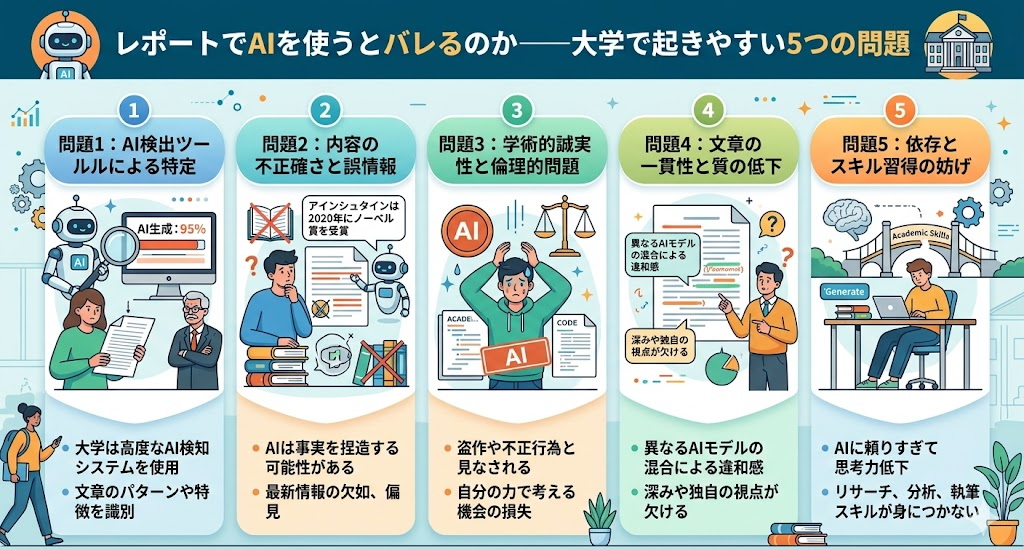
Will AI Use in Reports Be Detected? | Five Problems That Commonly Arise at Universities
「Will AI Use in Reports Be Detected?」「Can a University Tell That a Report Was Created with ChatGPT?Many students worry about whether reports created with ChatGPT will be recognized as AI-assisted. In recent years, AI in University Reportsthis issue has rapidly attracted attention. Generative AI is convenient, but it also increases the likelihood of problems after submission.
In short, using AI does not automatically mean that it will be detected with 100% certainty. However, but if the writing contains AI-like unnaturalness, inadequate fact-checking, or poor alignment with the course content, instructors are likely to notice that something is wrong. The issue is not only whether AI was used. Multiple features within the writing can lower the evaluation.
This article AI Reports at Universityexamines risks that commonly arise in the context of Will an AI-Written Report Be Detected?AI-assisted university reports and explains five issues that people searching for information on “will an AI report be detected?” should understand. It also introduces points to check before submission and safer ways to approach generative AI.
Why Do AI-Generated Reports Often Feel Unnatural?
A university report is not evaluated simply on whether it is written in polished Japanese. Instructors consider whether the student understands the concepts covered in class, relies on required readings, and shows an identifiable thought process. For this reason, even an apparently plausible AI-generated text can raise concern if weak connection to the course, excessive abstraction, or unnatural examplesit shows these characteristics.
In particular, if a student's writing style or apparent level of understanding changes suddenly compared with classroom participation, previous assignments, or examination answers, the inconsistency may stand out even more than the content itself. Therefore, instead of worrying only about whether an AI-detection tool will flag the text, whether the writing as a whole is consistent with the student's learning history.it is important to consider
Common University Problem 1 | The Writing Looks Polished but the Content Is Shallow
Generative AI often produces text that looks highly polished. Transitions may be smooth, headings neatly organized, and the result may appear to be a high-quality report. At the same time, it often has the discussion tends to remain general, with insufficient analysis grounded in course-specific issues or assigned materialsthis weakness.
For example, an education report may require concrete issues from practice, a law report may require precise distinctions among concepts and institutions, and a literature report may require close attention to wording in the primary text. AI output often misses these disciplinary cores and settles into safe but shallow generalities. As a result, “the writing is polished, but it does not show an understanding of the course.”it may receive the evaluation that
Common University Problem 2 | Nonexistent References or Inaccurate Citations Are Included
Will a ChatGPT Report Be Detected?One of the greatest risks when asking whether a ChatGPT-generated report will be detected concerns references. Generative AI can fabricate plausible-looking book titles, author names, publication years, and page numbers. Because such information may look natural, using it without verification can lead to serious problems after submission.
If a reference list contains nonexistent sources, incorrect author names or publication years, or page numbers that do not exist, the issue may go beyond an ordinary mistake. At universities in particular, a report whose sources cannot be verified is likely to be judged academically unreliable regardless of its other content.。
It may be acceptable to use AI to suggest possible references, but copying those suggestions directly is risky. Always verify that the source actually exists using the original material, library OPAC, publisher information, or academic databases, and read the cited passage before using it.
Common University Problem 3 | Terms or Perspectives Not Covered in Class Suddenly Appear
Because AI-generated reports are assembled from broad general knowledge, theories or concepts not covered in the course may naturally enter the text. This is not automatically wrong, but if the content departs from the course objectives or assignment intent, the evaluation may suffer.
For example, if an instructor emphasizes a specific textbook or framework but a submitted report is written entirely from another scholarly perspective, the mismatch will be noticeable. If the student is then unable to explain the content orally, “the student did not understand and write this independently.”the instructor may suspect that
In university reports, it is more important to discuss the assignment appropriately than simply to collect statements that sound correct. Even when using AI output, return to lecture notes, handouts, and assigned readings and revise the writing so that it fits what was actually studied.
Common University Problem 4 | The Style and Level of Understanding Differ Sharply from the Student's Usual Work
Instructors do not necessarily judge a student from a single submitted report alone. They often have some sense of the student's writing tendencies and depth of understanding based on reaction papers, previous assignments, emails, and classroom responses. A sudden submission of writing that is far more advanced than usual may therefore appear unnatural.
In particular, if a student who previously wrote concise prose suddenly submits highly abstract academic writing but cannot answer detailed questions about it, suspicion is more likely. The problem is not that the writing is “too good,” but that there is a discontinuity between the submitted work and the student's actual understanding.is.
If AI is used as assistance, the text still needs to be brought back into the student's own voice. Rephrasing it with one's usual vocabulary and explicitly adding points from the course and one's own thinking creates the consistency expected of the student's own report.
Common University Problem 5 | The Work May Violate AI-Use Policies
In recent years, many universities, departments, and instructors have begun to state rules for generative AI explicitly. Even when AI is not completely prohibited, detailed conditions may apply, such as “brainstorming allowed,” “summarization allowed,” “generating the body text prohibited,” or “AI use must be disclosed.”
For that reason, regardless of how well the content is written, violation of course rulesthere is a risk that it may be treated as a rule violation. This point is easy to overlook but extremely important. Even a well-written report may be treated as misconduct or excluded from evaluation if it violates the syllabus or assignment instructions.
Therefore, before thinking about how to make AI-written text “not detectable,” how much AI use is permitted in that course.it is necessary to check
Features That Often Make Instructors Suspicious of AI Reports
When instructors suspect AI use, specialized detection tools are not necessarily the main basis for concern. In practice, accumulated human impressions—unnatural writing, weak logic, mismatch with materials, and similar issues—often matter more. Features such as not answering the question directly, having a polished conclusion but weak evidence, vague citations, abstract examples, or almost no terminology from the course are especially conspicuous.
Writing that repeats the same point in different words to make the text longer, or that sounds smooth but leaves key terms undefined, may also appear AI-like. Will Using AI for a Report Be Detected?People who worry that AI use will be detected should understand these writing patterns before thinking about detection avoidance.
Minimum Checks Before Submission
If generative AI was used at all, the points to check before submission are clear. First, review whether the report directly answers the assignment. Next, check whether important terms from lectures and handouts are appropriately reflected. Then verify citations and references, factual claims, proper nouns, dates, system names, author names, and similar details one by one.
Particularly important is whether the content is something you can explain orally in your own wordsthis point. If you cannot answer when asked, “What does this sentence mean?”, the report is not yet truly your own work.
How Should You Approach AI If You Use It for a Report?
AI should not necessarily be treated as something that must be eliminated entirely, but as a tool whose risks increase when it is used poorly. It can be useful for limited support tasks such as organizing issues, producing a rough outline, suggesting rephrasings, breaking down questions, or identifying search keywords. By contrast, having AI generate an entire paper and submitting it without sufficient verification is highly risky.
In a university report, the process of thinking itself is part of what is evaluated. Even when using AI, you ultimately need to read, investigate, revise, and explain the work yourself. Use AI as a tool to support thinking, not as a ghostwriter.This attitude is essential.
Summary | Think About “Is This Safe and Appropriate to Submit?” Rather Than “Will It Be Detected?”
The question “Will AI Use in Reports Be Detected?” cannot be answered with a simple yes or no. A machine may not always identify AI use conclusively, but instructors may still notice inconsistencies through writing style, shallow content, inaccurate references, mismatch with the course, or insufficient understanding by the student.
What really matters, therefore, is whether it will be detectednot whether the report is academically honest, meets the course requirements, and contains content for which you can take responsibilitywhether it will be detected, but whether the report is academically honest, fits the course requirements, and contains content for which the student can take responsibility. Universities do not evaluate polished Japanese alone. Writing that shows evidence of the student's own understanding, research, and thinking is ultimately more trustworthy.
Points to Check to Improve the Reliability of This Article
When applying “Will AI Use in Reports Be Detected? | Five Problems That Commonly Arise at Universities” to a report, paper, or assignment, do not simply copy the article's explanations. Verify the basis of your statements using primary sources, public materials, and academic literature, and reconstruct the content to fit the requirements of your own assignment.
| ConfirmItem | What to Check | How to Use It in a Report |
|---|---|---|
| Accuracy of Information | Check whether the concepts, figures, systems, and cited sources in the text actually exist and are consistent with the latest information. | Add references and footnotes so that the relationship between claims and supporting evidence is clear. |
| Consistency with Assignment Requirements | Check that the work complies with the course topic, word count, required readings, writing style, citation format, and submission format. | Use a structure in which the introduction presents the question, the body develops the evidence, and the conclusion answers the question. |
| Originality / Discussion | Check that the discussion goes beyond general explanation and connects to the course content or your own research question. | Add, in your own words, why you think so and what limitations remain. |
| Transparency About AI Use | Be able to explain what parts involved generative AI, how sources were checked, and whether the text was rewritten. | Treat AI output not as a finished product but as assistance for research, structuring, and revision. |
Reference Materials / Verification Sources
The following are public, academic, and official sources worth checking when using the content of this article in a report or paper. If you cite them, format the citation according to the requirements of the institution where you will submit the work.
- Ministry of Education, Culture, Sports, Science and Technology: “Handling of Generative AI in Teaching and Learning at Universities and Colleges of Technology”: provides basic guidance on handling generative AI in university and college classes, reports, examinations, and related educational settings.
- Agency for Cultural Affairs: “AI and Copyright”: a public source for considering risks involving AI-generated content, copyright, plagiarism, and similar wording.
- OpenAI「A Student's Guide to Writing with ChatGPT」: provides guidance on using ChatGPT as a learning aid and for improving writing.
- Google NotebookLM Official Website: official information on an AI research tool that summarizes and answers questions based on materials provided by the user.
- Elicit Official Website: official information on an AI research-support tool used to search, summarize, and extract information from academic papers.
- Zotero Official Website: official information on a reference-management tool used to collect, organize, cite, and share references.
Related Services / Internal Links
In academic writing, not only appearance but also citations, evidence, logic, and compliance with submission requirements directly affect evaluation. Please review the related pages as well.
AI Report / Paper ConsultationUniversity Report SupportGraduation Thesis / Master's Thesis Writing SupportAcademic Paper and Literature SearchFree Quote / Consultation
FAQ
Can I submit a report generated with generative AI as it is?
Submitting it unchanged is not recommended. Check the rules of your university and course, treat AI output as an outline or draft, verify sources, and reconstruct the content in your own words.
Can references generated by AI be trusted?
It is risky to trust them without verification. AI may produce nonexistent references or incorrect bibliographic details, so confirm both existence and content using sources such as CiNii, J-STAGE, Google Scholar, PubMed, and publisher websites.
What matters if I want to avoid problems or suspicion regarding AI use?
The important point is not to evade AI detection, but to keep records of how AI was used, check applicable rules, verify evidence, connect the writing to course content, and add your own analysis.
Contact
To date, we have supported clients throughout Japan and overseas.over 10,000 casesof academic support requests. Experienced consultants carefully listen to your needs and provide prompt, appropriate support at reasonable fees.
Ibooks members across Japan will support you responsibly.
We send the profile of the responsible staff member when you apply.
When orders are busy, phone lines may be difficult to connect. We will reply in order, so urgent inquiries should be sent by
