
AI-Generated References Are Dangerous | Verification Steps to Prevent Nonexistent Sourcesblog
AI-Generated References Are Dangerous | Verification Steps to Prevent Nonexistent Sources
Common Reference Errors in Reports and Papers and How to Verify That Sources Actually Exist
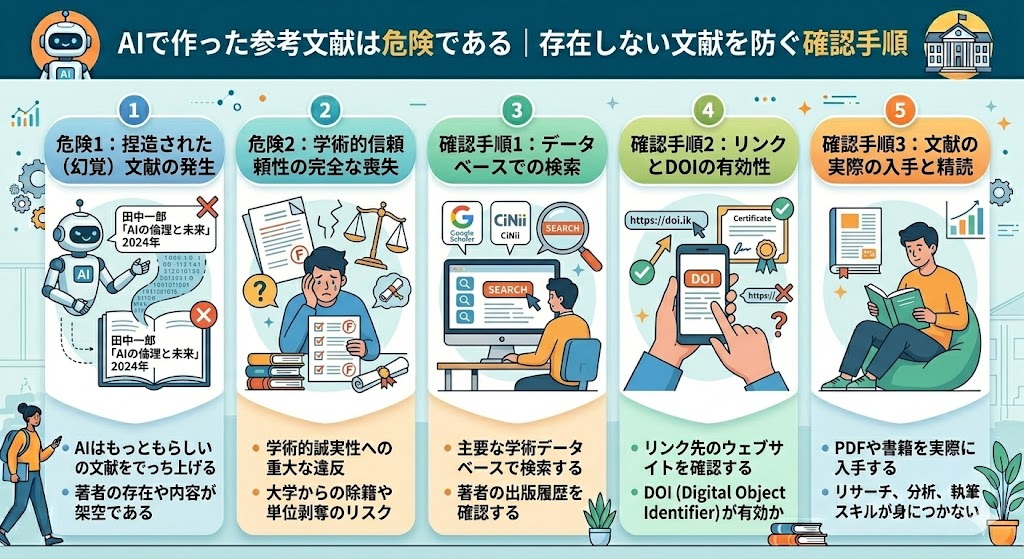
AI-Generated References Are Dangerous | Verification Steps to Prevent Nonexistent Sources
In recent years, the number of people using generative AI to prepare reports and papers has increased rapidly. Using AI to organize a structure or assist with rephrasing is no longer unusual, but a serious problem arises when references generated by AIAI-generated references are used without verification. They may look plausible and well formatted while actually containing nonexistent books or papers, incorrect author names, or wrong publication years.
In particular, AI may generate reference information that looks authentic, making errors difficult to detect by appearance alone.AI may generate bibliographic information that looks convincing enough that errors are difficult to notice from appearance alone. In university reports, graduation theses, and academic papers, however, inaccurate references are not merely minor mistakes. They can seriously damage the credibility of the entire work and may even raise questions about academic integrity.
This article Risks of AI-Generated ReferencesThis article focuses on the problem of dangerous AI-generated references, explaining why they are risky, what kinds of errors commonly occur, andNonexistent Sourceswhat verification steps should be followed to prevent nonexistent sources from being used.
Why Are AI-Generated References Dangerous?
Generative AI works by producing strings that are statistically plausible based on large amounts of language data. It can therefore imitate common reference formats such as “author, year, book title, publisher” or “author, year, article title, journal title, volume/issue, pages.” But formatting a reference plausibly and identifying a real source accurately are two different tasks.
For example, AI may combine names similar to those of real researchers, generate plausible article titles, or place a nonexistent article in a real journal. As a result, the reference list looks natural, but the source cannot be found when searchedthis kind of situation can occur.
This is extremely risky for the person submitting the report because instructors or reviewers may verify the references. If a nonexistent source is discovered during that process, the credibility of the main text may also be questioned. The problem with AI-generated references is therefore not just a bibliographic error but a loss of credibility for the entire document.leads to this issue.
What Types of Reference Errors Commonly Occur with AI?
AI-generated references have several typical error patterns. First, the source itself may not exist. This is particularly dangerous because the author name, title, and journal name may all look natural, making the error easy to overlook if no verification is performed.
Second, even when the source exists, the author name may be written incorrectly or a coauthor may be omitted. Third, the publication year, volume/issue, or page range may be wrong. Fourth, AI may confuse books with papers, translations with original editions, or revised editions with earlier editions. For web sources, URLs, access dates, and website names may also be handled vaguely and fail to constitute accurate citations.
Individually, these errors may look small, but together they can become a serious problem. In particular, the cited page number does not exist, or the statement attributed to the source is not actually written therethis condition is serious because it concerns the accuracy of the citation itself, not merely insufficient checking.
What Happens If Nonexistent Sources Are Included?
In reports and papers, references form the foundation supporting the claims in the text. If that foundation includes nonexistent sources, the validity of the argument itself is undermined. Readers ask what evidence supports a statement, so writing quickly loses credibility when its source cannot be verified.
Some university instructors may not inspect every reference in detail, while others place substantial emphasis on bibliographic accuracy. The more formal the document becomes—such as a graduation thesis, research proposal, conference manuscript, or journal submission—the more important reference verification becomes. Therefore, Incorrect ChatGPT Referencesthe problem of incorrect ChatGPT-generated references is not merely an online talking point; it is a practical and academic risk.
Using a nonexistent source can also create problems later for the writer. In a presentation, oral examination, or meeting, the writer may be asked, “Where did you read this source?” or “What was written on this page?” and may be unable to answer. In other words, unverified references cannot withstand the responsibility of explaining the work after submission.This is the issue.
Why AI-Generated References Should Not Be Used Without Verification
AI is useful and can serve as a starting point for research. However, when dealing with references, one must distinguish between a tool that suggests candidates and a source that can be cited directly. A list produced by AI is only a provisional lead, not a completed reference list.
If it is copied and submitted unchanged, the writer is taking responsibility for information that was never verified. A report or paper is ultimately submitted under the writer's own name. Therefore, once a source appears in the reference list, the writer is expected to have confirmed that the source exists and, where necessary, actually read it.this responsibility follows.
Relying on AI while leaving this point ambiguous may appear efficient on the surface but creates substantial risk. In papers and research documents, bibliographic accuracy is an even more fundamental requirement than polished writing.
Verification Step 1 | First Confirm That the Source Actually Exists
When AI suggests a reference, the first step is to verify that the source actually exists. For books, check university library OPAC systems, the National Diet Library Search, publisher websites, or bookseller databases. For papers, search CiNii, J-STAGE, Google Scholar, PubMed, or other academic databases.
What matters here is not to trust the title alone, but to author name, title, publication year, and journal namesearch through multiple routes using combinations of bibliographic details. If no matching source can be found anywhere, there is a strong possibility that the reference does not exist. A natural-looking title should never be used if it cannot be verified through search.
Verification Step 2 | Cross-Check the Author, Publication Year, Volume/Issue, and Page Numbers
Even if the source exists, verification is not finished. Next, cross-check the bibliographic details. Compare the author's name and romanization, publication year, publisher, journal title, volume/issue, and page range with an authoritative database or the source itself.
AI may get only the details wrong even for a real source. It might list a 2019 publication as 2020, identify a second edition as the first edition, or shift the page range by several pages. These discrepancies may look minor, but they make the reference inaccurate. Bibliographic details should be checked with almost character-by-character care.is necessary.
Verification Step 3 | Check the Actual Source to Confirm That the Cited Passage Really Appears There
The most important step is not merely confirming that the source exists but verifying that the content you intend to cite is actually present in it. Even a real source becomes an inaccurate citation if the statement in your paper does not match what the source says.
Do not rely on an AI-generated summary or explanation. Open the original source and read the relevant passage yourself. For a direct quotation, confirm the exact wording; for a paraphrase, confirm the meaning. Also verify the page number. Omitting this step creates “the source exists, but the cited content is incorrect”a different kind of problem.
Verification Step 4 | Standardize the Reference Style
Even after the source and its content have been verified, the references still need to be formatted. Required styles differ by submission destination—APA, MLA, SIST, or a university-specific style. AI-generated references often mix formats and may look organized while lacking consistency.
For this reason, adjust the order of author names, placement of the publication year, presentation of titles and journal names, page notation, and other details to the required style. Verifying That References ExistOnly after verifying that the sources exist and standardizing the final format does the reference list become suitable for submission.
Verification Step 5 | Limit AI to Suggesting Candidates
Using AI itself is not necessarily the problem. The danger lies in treating unverified AI output as a finished product. If AI is used for references, its role should be limited to identifying search terms, organizing issues, understanding related fields, or creating a preliminary list of possible sources.
After that, the writer must personally verify the existence of the sources, check the originals, verify citations, and correct the formatting. In other words, AI should not act as an “agent” that creates the final reference list; instead, use AI only as an auxiliary tool for literature searchingthis limited use is important.
Final Checks Before Submitting a Report or Paper
Before submission, verify again that every item in the reference list has been confirmed to exist. Also check that all sources cited or referred to in the text appear in the list and that the list does not contain sources that are never used in the body.
Review cited page numbers, author names, publication years, inconsistent notation, punctuation, full-width/half-width characters, and italicization as well. This may seem like mundane work, but the reference list is the final safeguard supporting the document's credibility. After finishing the body text is precisely when it is worth spending time on reference verification.。
Summary | AI-Generated References Must Always Be Verified by a Human
AI-generated references may look convenient, but using them unchanged is dangerous. They can contain nonexistent sources, incorrect author names, wrong publication years or page numbers, or citations that do not match the source content. In reports and papers, reference accuracy is directly connected to academic integrity.
What matters, therefore, is not trusting AI output completely but personally complete the steps of verifying existence, checking the original source, verifying the citation, and standardizing the formatpersonally following the verification process. AI can be a starting point, but it cannot be the final verifier. Responsibility for the document ultimately rests with the person submitting it. Remembering this principle is fundamental to preventing nonexistent sources and producing trustworthy reports and papers.
Points to Check to Improve the Reliability of This Article
When applying “AI-Generated References Are Dangerous | Verification Steps to Prevent Nonexistent Sources” to a report, paper, or assignment, do not simply copy the article's explanations. Verify the basis of your statements using primary sources, public materials, and academic literature, and reconstruct the content to fit the requirements of your own assignment.
| ConfirmItem | What to Check | How to Use It in a Report |
|---|---|---|
| Accuracy of Information | Check whether the concepts, figures, systems, and cited sources in the text actually exist and are consistent with the latest information. | Add references and footnotes so that the relationship between claims and supporting evidence is clear. |
| Consistency with Assignment Requirements | Check that the work complies with the course topic, word count, required readings, writing style, citation format, and submission format. | Use a structure in which the introduction presents the question, the body develops the evidence, and the conclusion answers the question. |
| Originality / Discussion | Check that the discussion goes beyond general explanation and connects to the course content or your own research question. | Add, in your own words, why you think so and what limitations remain. |
| Transparency About AI Use | Be able to explain what parts involved generative AI, how sources were checked, and whether the text was rewritten. | Treat AI output not as a finished product but as assistance for research, structuring, and revision. |
Reference Materials / Verification Sources
The following are public, academic, and official sources worth checking when using the content of this article in a report or paper. If you cite them, format the citation according to the requirements of the institution where you will submit the work.
- Ministry of Education, Culture, Sports, Science and Technology: “Handling of Generative AI in Teaching and Learning at Universities and Colleges of Technology”: provides basic guidance on handling generative AI in university and college classes, reports, examinations, and related educational settings.
- Agency for Cultural Affairs: “AI and Copyright”: a public source for considering risks involving AI-generated content, copyright, plagiarism, and similar wording.
- OpenAI「A Student's Guide to Writing with ChatGPT」: provides guidance on using ChatGPT as a learning aid and for improving writing.
- Google NotebookLM Official Website: official information on an AI research tool that summarizes and answers questions based on materials provided by the user.
- Elicit Official Website: official information on an AI research-support tool used to search, summarize, and extract information from academic papers.
- Zotero Official Website: official information on a reference-management tool used to collect, organize, cite, and share references.
Related Services / Internal Links
In academic writing, not only appearance but also citations, evidence, logic, and compliance with submission requirements directly affect evaluation. Please review the related pages as well.
AI Report / Paper ConsultationUniversity Report SupportGraduation Thesis / Master's Thesis Writing SupportAcademic Paper and Literature SearchFree Quote / Consultation
FAQ
Can I submit a report generated with generative AI as it is?
Submitting it unchanged is not recommended. Check the rules of your university and course, treat AI output as an outline or draft, verify sources, and reconstruct the content in your own words.
Can references generated by AI be trusted?
It is risky to trust them without verification. AI may produce nonexistent references or incorrect bibliographic details, so confirm both existence and content using sources such as CiNii, J-STAGE, Google Scholar, PubMed, and publisher websites.
What matters if I want to avoid problems or suspicion regarding AI use?
The important point is not to evade AI detection, but to keep records of how AI was used, check applicable rules, verify evidence, connect the writing to course content, and add your own analysis.
Contact
To date, we have supported clients throughout Japan and overseas.over 10,000 casesof academic support requests. Experienced consultants carefully listen to your needs and provide prompt, appropriate support at reasonable fees.
Ibooks members across Japan will support you responsibly.
We send the profile of the responsible staff member when you apply.
When orders are busy, phone lines may be difficult to connect. We will reply in order, so urgent inquiries should be sent by
