
Paper Checklist Before Showing It to a University Instructor | Minimum Items to Checkblog
Paper Checklist Before Showing It to a University Instructor | Minimum Items to Check
Basic Points to Review Before Submitting a Graduation Thesis, Report, or Research Proposal
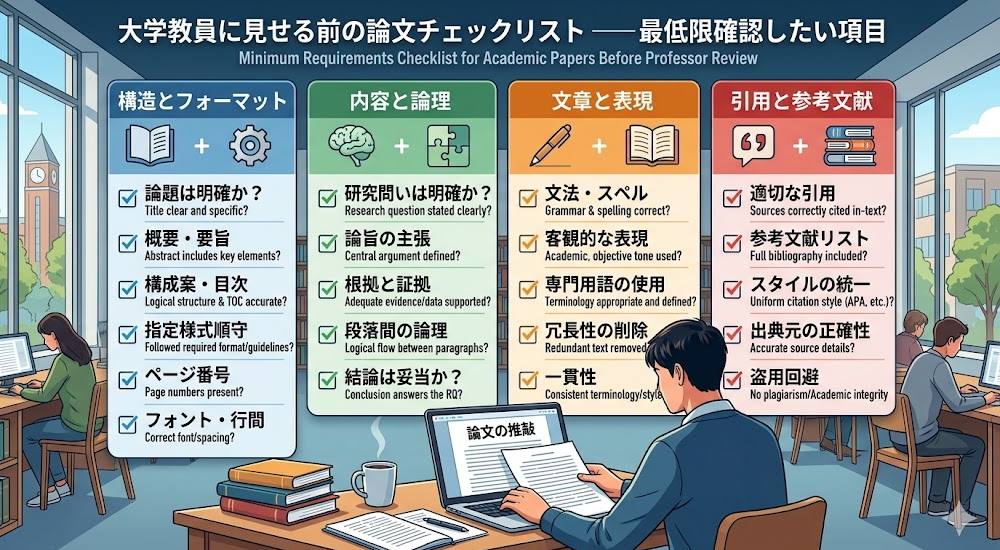
Paper Checklist Before Showing It to a University Instructor | Minimum Items to Check
Before showing a graduation thesis, report, research proposal, seminar paper, or similar work to a university instructor, review not only the content but also the format and logical structure. In practice, students sometimes send a draft immediately after finishing the text because they feel relieved to be done. Yet insufficient review before submission can lower the evaluation before the substance is even considered.
In particular, University-Instructor Paper ChecklistFrom the perspective of a university-instructor paper checklist, instructors initially consider both whether the student has thought carefully about the content and whether basic academic writing conventions are being followed. Therefore, checking the minimum items before submission is a prerequisite for communicating the quality of the content.is.
This article Paper ChecklistThis article organizes the minimum points to check before showing work to a university instructor and explains how to improve the quality of graduation theses and reports. Checking only for typographical errors is not enough; structure, logic, citations, references, formatting, and readability all need to be reviewed.
Why Is a Pre-Submission Check Important?
University instructors read many reports and papers. Writing with poorly prepared details can therefore create an impression of insufficient preparation. Content is ultimately most important, but if the structure is disorganized, citations are unclear, or basic errors are frequent, the reader may become fatigued before reaching the core argument.
A draft shown to an instructor does not have to be a final manuscript, but at minimumcheck everything you can reasonably check yourself before bringing the draft to the instructorit is important to take this approach. When a student does so, the instructor can focus more easily on the argument and substantive guidance. If a draft contains many basic errors, valuable supervision time may be spent only on correcting format.
Check 1 | Does the Title Accurately Represent the Content?
The title of a paper or report is not merely a label. It indicates what the paper addresses and the scope of the discussion. If the title is too vague or overly broad, it can become inconsistent with the actual content. For example, if the body examines only a limited set of cases while the title makes a sweeping general claim, the mismatch will be apparent to the reader.
Before submission, check whether the title alone conveys the topic, subject, and perspective to some extent. In a graduation thesis in particular, check whether the title reflects both “what” is being discussed and “from what perspective.”is important.
Check 2 | Are the Research Problem and Conclusion Connected?
A common problem in papers is that the question raised in the introduction does not match the content of the conclusion. The focus can gradually shift while writing until the conclusion addresses a different issue. Before submission, confirm that the problem statement in the introduction, the analysis in the body, and the answer in the conclusion form one continuous line of reasoning.
A useful method is to restate in one sentence what the paper ultimately clarified. If that sentence does not answer the question posed in the introduction, the structure needs revision. Graduation-Thesis ChecklistFor a graduation-thesis checklist, this consistency check should be a top priority.
Check 3 | Is the Heading Structure Logical?
Headings form the skeleton of a paper. If the organization of chapters, sections, and subsections is unnatural, the logic becomes difficult to follow even when individual passages are strong. Common problems include one chapter being disproportionately long, headings operating at inconsistent levels of abstraction, or Chapters 2 and 3 covering essentially the same material.
Before submission, try reading only the headings. Check whether the argument's progression can be understood from the headings alone. If the development is unclear without the body text, the overall structure may also be ambiguous. a state in which the path of the paper is visible from the headings alone.The goal should be
Check 4 | Does Each Paragraph Have One Central Idea?
In a paper, packing too many topics into one paragraph makes the argument unclear. Conversely, paragraphs that are too short and fragmented can make the structure of thought difficult to see. Check whether each paragraph has one central idea.
A practical test is whether you can briefly restate what each paragraph claims. If you cannot, several topics may be mixed together. The functions of the beginning and end of the paragraph are also important, state the main point first, then follow with explanation and evidenceand keeping this structure in mind improves readability.
Check 5 | Are Claims Supported Rather Than Merely Asserted?
Expressing your own opinion is important in university papers and reports, but an unsupported impression is not enough. Whenever the text states that something “is important,” “is problematic,” or “has a major impact,” check whether evidence accompanies that claim.
Evidence may include previous studies, statistical data, primary texts, institutional descriptions, or case analysis. If unsupported assertions are frequent, the paper loses persuasiveness. Before submission, ask of each important claim, “What is the evidence for this?”
Check 6 | Is the Distinction Between Quotations and Your Own Writing Clear?
Citation problems can become serious issues of academic practice. Avoid direct quotations without quotation marks, paraphrases without sources, and passages in which cited material is mixed indistinguishably with your own analysis. Before showing the paper to an instructor, confirm that the reader can clearly tell which views belong to others and which explanations or interpretations are your own.
Particular care is needed for passages written with reference to online information or AI output. Even when you believe you have rewritten the material in your own words, the phrasing may still depend heavily on the source. Therefore, Can the reader clearly distinguish quoted passages, summarized passages, and your own discussion?it is important to review the paper from this perspective.
Check 7 | Is the Reference Information Accurate?
Many writers prepare the reference list only at the end, but it requires careful attention. Check the author names, publication years, book titles, publishers, journal titles, volume/issue numbers, page ranges, URLs, and other details. Also confirm that every source cited in the text appears in the reference list and that the list does not contain unused sources.
Consistency of style is also important. Whether you use APA, MLA, SIST, or a university-specific format, the references should follow one consistent system. A disorganized reference list can damage the credibility of the entire paper.For this reason, it should not be treated lightly.
Check 8 | Are There Any Typos or Inconsistent Spellings?
Checking for typographical errors may seem obvious, but such errors often survive until the end, especially in long papers where the writer becomes too familiar with the text to notice them. Inconsistent notation is also common—for example, different spellings of the same technical term. Accumulated inconsistencies reduce readability.
Before submission, review proper nouns, technical terms, dates, number formats, and punctuation. If possible, print the document and read it on paper or leave some time before rereading it; changing the conditions of review makes overlooked errors easier to notice.
Check 9 | Is the Writing Style Consistent?
Check that polite Japanese style and plain academic style are not mixed. University reports and graduation theses often require a consistent plain academic style, although course requirements may differ. Whatever style is required, inconsistency across the paper creates an impression of insufficient revision.
Overly conversational or vague expressions should also be revised. Expressions equivalent to “really,” “quite,” or “somehow” are usually inappropriate in academic writing. an academic style that communicates the intended meaning clearly.The writing should be revised into
Check 10 | Can You Explain What You Want the Instructor to Focus On?
When showing a draft to an instructor, do not simply hand it over and say, “Please look at this.” Organize what you are unsure about. For example, clarify whether you are concerned about structure, insufficient review of previous studies, or how to summarize the conclusion. This makes supervision more productive.
This differs somewhat from checking the body itself, but it is highly practical. After completing the basic review, being able to say, “I would particularly like feedback on this point,” makes communication with the instructor more constructive. Before Showing a Paper to an InstructorIn situations where you show a paper to an instructor, this preparation can make a surprisingly large difference.
Recommended Final Review Methods Before Submission
When revising a paper, looking at the same screen for too long makes errors easier to miss. Changing the review method can therefore help. Effective methods include reading only the headings, reading the body aloud, printing the document and marking it with a pen, reading the introduction and conclusion first, extracting only quotations, or reviewing the reference list separately.
Accuracy also improves when review is divided into stages—for example, checking content, then structure, then notation—instead of trying to do everything at once. Rather than correcting everything at once, review the paper from separate perspectives.This approach leads to efficient revision.
Summary | The Quality of a Paper Can Change Greatly Through Review After Writing Is Finished
A Paper Checklist Before Showing It to a University Instructor involves far more than typographical errors. The title must match the content; the research problem and conclusion must connect; headings and paragraphs must be well structured; evidence must support claims; quotations must be clear; references must be accurate; and the writing style must be consistent.
Simply checking these points in advance can substantially improve the paper. In particular, correct the basic points you can fix yourself before showing the paper to the instructorpreparing the basic aspects you can correct yourself before meeting the instructor is important for receiving more substantive guidance. A paper is not complete the moment writing ends. It becomes communicable to the reader only after final checking and revision.
Points to Check to Improve the Reliability of This Article
When applying “Paper Checklist Before Showing It to a University Instructor | Minimum Items to Check” to a report, paper, or assignment, do not simply copy the article's explanations. Verify the basis of your statements using primary sources, public materials, and academic literature, and reconstruct the content to fit the requirements of your own assignment.
| ConfirmItem | What to Check | How to Use It in a Report |
|---|---|---|
| Accuracy of Information | Check whether the concepts, figures, systems, and cited sources in the text actually exist and are consistent with the latest information. | Add references and footnotes so that the relationship between claims and supporting evidence is clear. |
| Consistency with Assignment Requirements | Check that the work complies with the course topic, word count, required readings, writing style, citation format, and submission format. | Use a structure in which the introduction presents the question, the body develops the evidence, and the conclusion answers the question. |
| Originality / Discussion | Check that the discussion goes beyond general explanation and connects to the course content or your own research question. | Add, in your own words, why you think so and what limitations remain. |
Reference Materials / Verification Sources
The following are public, academic, and official sources worth checking when using the content of this article in a report or paper. If you cite them, format the citation according to the requirements of the institution where you will submit the work.
- CiNii Research: a major search service for finding Japanese papers, doctoral dissertations, research data, and related academic materials across multiple databases.
- J-STAGE: a platform useful for checking journals and academic papers published by Japanese academic societies.
- APA Style「Reference examples」: provides examples of how to format references in APA style.
- Zotero Official Website: an official tool useful for reference management, citation organization, and PDF management.
- Ministry of Education, Culture, Sports, Science and Technology: “Information on the Use of Generative AI”: an entry point to public information on the use of generative AI in education.
- Google Search Central「SEO Starter Guide」: basic guidelines for communicating page content correctly to search engines.
Related Services / Internal Links
In academic writing, not only appearance but also citations, evidence, logic, and compliance with submission requirements directly affect evaluation. Please review the related pages as well.
AI Report / Paper ConsultationUniversity Report SupportGraduation Thesis / Master's Thesis Writing SupportAcademic Paper and Literature SearchFree Quote / Consultation
Contact
To date, we have supported clients throughout Japan and overseas.over 10,000 casesof academic support requests. Experienced consultants carefully listen to your needs and provide prompt, appropriate support at reasonable fees.
Ibooks members across Japan will support you responsibly.
We send the profile of the responsible staff member when you apply.
When orders are busy, phone lines may be difficult to connect. We will reply in order, so urgent inquiries should be sent by
