
For New Students Who Cannot Write University Reports | Where to Startblog
For New Students Who Cannot Write University Reports | Where to Start
A clear explanation of the basic process for writing university reports, designed for first-year students.
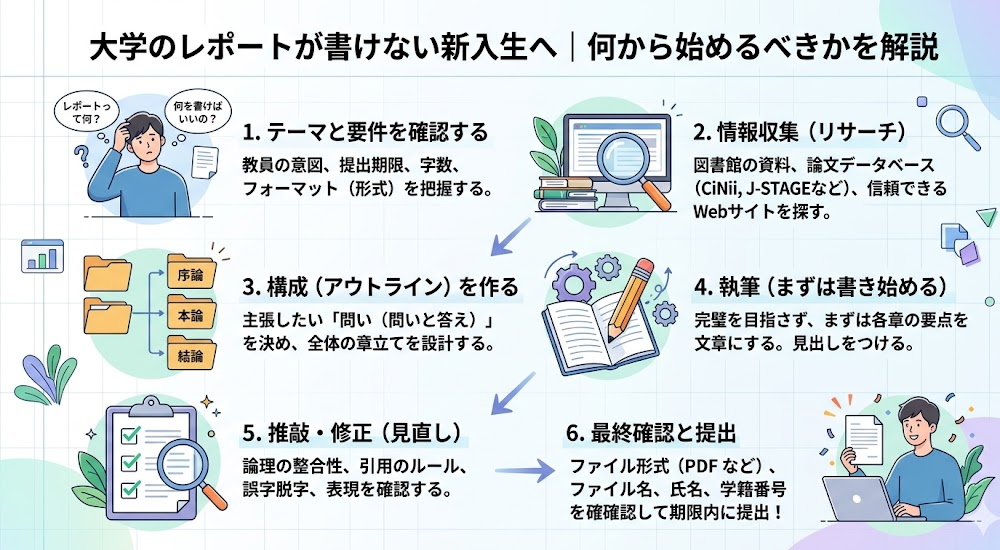
For New Students Who Cannot Write University Reports | Where to Start
Many students who have just entered university struggle with questions such as, “I was told to write a report, but I do not know where to start,” or “I do not understand how a university report differs from the essays I wrote in high school.” In fact, a university report differs from a personal-response essay because it is a piece of writing that answers a question logically while presenting supporting evidenceFor this reason, it can be confusing at first.
However, many students struggle to write university reports not because they lack writing ability, but because they do not know how to begin the processthey do not yet know the correct process. If you follow the sequence of confirming the topic, gathering materials, and planning the structure, you can make progress without immediately trying to write the body. Students who feel weak at report writing should first understand the overall workflow.
This article unable to write a university report、how first-year students should write reports、where to start a university reportThis article is for students with these concerns and clearly explains the basic steps of report writing. The process is organized in practical order so that even students who get stuck at the opening sentence can proceed more easily.
Why Many First-Year Students Struggle to Write University Reports
First-year students do not struggle with reports because they lack ability. In many cases, they simply do not yet know the standard form of a university report. In high school, many assignments may have focused on personal impressions and reactions. At university, however, you are expected to construct your own argument based on course content, literature, data, previous studies, and other evidence.
As a result, students who try to write without knowing this process often get stuck trying to produce the first sentence immediately. In reality, report writing does not begin with drafting prose. It begins by accurately understanding the assignment, gathering the material you need, deciding on the structure, and only then drafting the bodyFollowing this sequence alone can substantially improve the feeling that you “cannot write.”
The First Thing to Do | Read the Assignment Prompt Carefully
When you cannot write a report, the first thing to check is the assignment prompt. This may seem obvious, but students who struggle often skim the prompt and proceed without a clear understanding of what they are expected to write. For example, “discuss,” “compare,” and “analyze” require different kinds of responses.
First, check the topic, word count, submission format, deadline, reference requirements, citation requirements, and other conditions one by one. If these remain unclear, your report can drift away from the assignment even if you write a great deal.The starting point of report writing is not “writing well,” but accurately grasping the purpose of the assignment..
The Next Step | Decide on a Tentative Direction for Your Conclusion
After checking the assignment prompt, think about what you ultimately want to say, even if only tentatively. You do not need a final conclusion yet. For example, you might decide on a provisional direction such as, “When A and B are compared, A appears to be more effective,” or “This system has important benefits but also significant problems.”
Doing this gives you a perspective from which to read sources and makes it easier to identify the information you need. By contrast, if you begin collecting sources with no idea of your possible conclusion, the information can become harder to organize as it accumulates.You do not need a perfect conclusion from the start; what matters is forming a provisional hypothesis..
If You Are Unsure How to Gather Sources | Prioritize Course Materials and Assigned Readings
Students sometimes stop because they do not know what sources to consult for a university report. In that case, begin with course handouts, lecture slides, assigned textbooks, and references recommended by the instructor. Especially in your first year, it is safer to begin with materials directly connected to the course rather than conducting a broad web search immediately.
The internet contains useful information, but it also includes material with unclear sources or limited academic reliability. In a university report, use sources for which you can clearly explain where the information came fromthis distinction is important. Use course materials as your foundation, and then expand to library databases and specialist books as necessary.
Before You Start Writing | Create a Structural Outline
Many students who struggle with reports try to begin by writing the body immediately. If you start drafting complete sentences without a plan, your argument may drift or you may repeat the same points. A simple structural outline made in advance can prevent this.
For example, create broad sections such as “Introduction,” “Main Section 1,” “Main Section 2,” and “Summary,” and add a one-line note about what each section will contain. Even this simple step can make your ideas much easier to organize.When writing feels difficult, create a “blueprint” before drafting sentences.is an effective approach.
Basic University Report Structure | What to Include
A typical university report follows the sequence of introduction, main discussion, and summary. The introduction presents the issue or purpose, the main discussion develops the argument using sources and evidence, and the summary states the conclusion based on the discussion. Understanding this flow makes the whole paper easier to visualize.
For example, the introduction should explain “what this report will address,” the main discussion should develop “how the report answers the question,” and the summary should concisely organize “what can ultimately be concluded.”A report should not be written in the order ideas occur to you; it should be structured so that the question and answer connect logically.is important.
How to Think When You Do Not Know How to Begin
“I cannot write the first sentence” is an extremely common concern. However, the opening does not need to be elegant. It is enough to state the assignment topic and what you will address. For example, you can begin with, “This report examines X,” or “This paper organizes the characteristics and challenges of X.”
The important role of the opening is to show the reader the topic and direction of the report. There is no need to force an impressive expression. Rather, a sentence that clearly tells the reader what the paper will addressthis approach is more appropriate for a university report.
What to Keep in Mind in the Body | Write from Evidence, Not Impressions
One of the most important principles of university reports is not to stop at personal impressions. Simply writing “I found it interesting” or “I think it is important” is usually too weak for a university assignment. You need to explain why your claim is justified and which source or evidence supports it.
For example, if you argue that a system has problems, you should explain them using evidence such as how the system works, actual cases, statistical data, or researchers' views.Write “the evidence suggests that...” rather than merely “I think...”is a basic principle of university report writing.
Minimum Points to Check for Citations and References
When using another person's words or ideas in a university report, you must follow citation rules. A direct quotation should be placed in quotation marks and accompanied by source information. Even when paraphrasing or summarizing, you should indicate what source you used. Failing to do so may be regarded as plagiarism.
Sources used in the body should also be listed in the references section. Author names, titles, publication years, publishers, and other bibliographic details should be formatted according to the required style.Organizing citations and references is a basic task that supports the credibility of a report..
A Common First-Year Mistake | Getting Stuck Trying to Write Perfectly
A common problem among first-year students is getting stuck because they try to write perfect prose from the beginning. Your first draft does not need to be polished. The important thing is to complete a full draft first. Wording and structure can be revised later, but a blank page cannot be improved.
Follow your structural outline and write each paragraph, even if the first version is brief. It is natural not to write perfectly at the outset, and A university report is something you refine as you write.thinking this way can reduce the psychological burden.
Points to Review Before Submission
Once you finish a report, do not submit it immediately. Review whether it answers the assignment question, whether the conclusion follows from the body, whether there are typographical errors, whether the writing style is consistent, and whether any citations are missing. Careful review can significantly improve the quality of the paper.
Most importantly, return to the assignment prompt and check whether your report actually meets the requested content and conditions. Even a carefully written report may receive a weak evaluation if it does not answer the assigned task.After finishing the draft, set aside time to check its alignment with the assignment..
Summary | When You Cannot Write a University Report, Focus on the Correct Sequence
For first-year students who struggle to write university reports, the key is not to start with the body immediately. Read the assignment prompt, decide on a provisional direction for the conclusion, gather information primarily from course materials, create a simple outline, and then begin drafting. This makes the work much easier to manage.
Report writing is not a skill reserved for people with special talent. If you follow the correct sequence, you can gradually shape your ideas into a complete report. Especially in your first year, Focus more on “proceeding correctly” than on “writing beautifully.”this mindset is important. Once you know the first step, your anxiety about university reports will gradually decrease.
Points to Check to Improve the Reliability of This Article
When applying “For New Students Who Cannot Write University Reports | Where to Start” to a report, paper, or assignment, do not copy the article text. Verify the supporting evidence using primary sources, official materials, and academic literature, and reconstruct the content to fit your own assignment requirements.
| ConfirmItem | What to Check | How to Use It in a Report |
|---|---|---|
| Accuracy of Information | Check whether the concepts, figures, systems, and cited sources in the text actually exist and are consistent with the latest information. | Add references and footnotes so that the relationship between claims and supporting evidence is clear. |
| Consistency with Assignment Requirements | Check that the work complies with the course topic, word count, required readings, writing style, citation format, and submission format. | Use a structure in which the introduction presents the question, the body develops the evidence, and the conclusion answers the question. |
| Originality / Discussion | Check that the discussion goes beyond general explanation and connects to the course content or your own research question. | Add, in your own words, why you think so and what limitations remain. |
Reference Materials / Verification Sources
The following are public, academic, and official sources worth checking when using the content of this article in a report or paper. If you cite them, format the citation according to the requirements of the institution where you will submit the work.
- CiNii Research: a major search service for finding Japanese papers, doctoral dissertations, research data, and related academic materials across multiple databases.
- J-STAGE: a platform useful for checking journals and academic papers published by Japanese academic societies.
- APA Style「Reference examples」: provides examples of how to format references in APA style.
- Zotero Official Website: an official tool useful for reference management, citation organization, and PDF management.
- Ministry of Education, Culture, Sports, Science and Technology: “Information on the Use of Generative AI”: an entry point to public information on the use of generative AI in education.
- Google Search Central「SEO Starter Guide」: basic guidelines for communicating page content correctly to search engines.
Related Services / Internal Links
In academic writing, not only appearance but also citations, evidence, logic, and compliance with submission requirements directly affect evaluation. Please review the related pages as well.
AI Report / Paper ConsultationUniversity Report SupportGraduation Thesis / Master's Thesis Writing SupportAcademic Paper and Literature SearchFree Quote / Consultation
Contact
To date, we have supported clients throughout Japan and overseas.over 10,000 casesof academic support requests. Experienced consultants carefully listen to your needs and provide prompt, appropriate support at reasonable fees.
Ibooks members across Japan will support you responsibly.
We send the profile of the responsible staff member when you apply.
When orders are busy, phone lines may be difficult to connect. We will reply in order, so urgent inquiries should be sent by
