
Ten Common Report Problems for First-Year Students | Solutions Explainedblog
Ten Common Report Problems for First-Year Students | Solutions Explained
A clear overview of common report-writing problems faced by first-year university students and practical ways to address them.
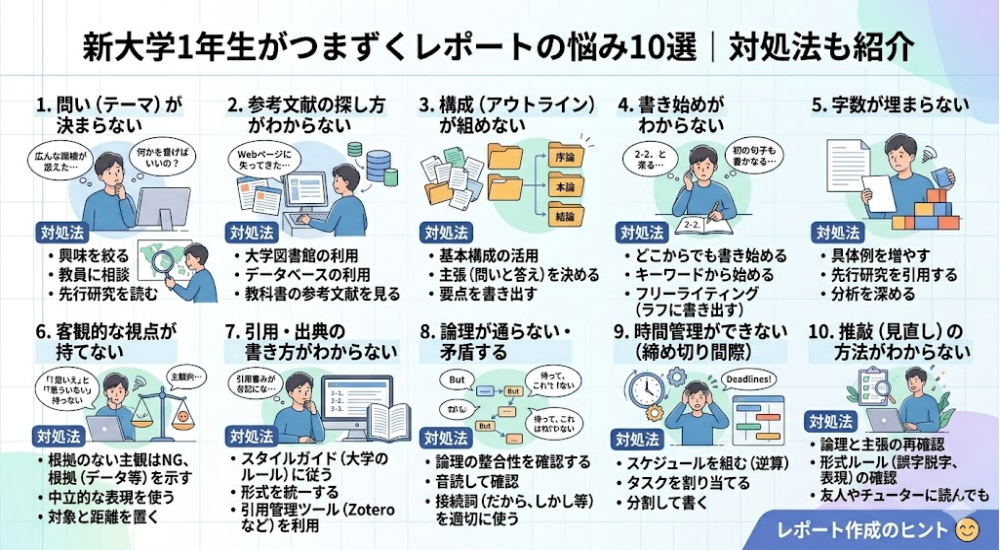
Ten Common Report Problems for First-Year Students | Solutions Explained
When students begin their first year at university, not only the way they attend classes but also the way assignments are given changes substantially. Reports are among the assignments that cause the most confusion. Unlike personal-response essays or compositions written in high school, university reports requirelogical writing that answers a question while presenting supporting evidenceso it is natural to struggle at first.
In fact, concerns such as “I do not know where to start,” “I cannot think of an opening sentence,” and “I do not know how to handle references” are extremely common among first-year students. Each of these problems can be addressed step by step. The important thing is not to assume that you are the only person who cannot do it.
This article first-year university student report problems、unable to write a university report、first-year university student report solutionsWith search needs such as these in mind, this article organizes ten common problems that first-year students encounter in university report writing and introduces a practical response to each one. The explanations are designed to help students facing their first report understand the overall process.
Problem 1 | I Do Not Understand What the Assignment Is Asking Me to Write
One of the first problems new university students encounter is difficulty interpreting the assignment prompt accurately. Expressions such as “discuss,” “analyze,” and “compare” may sound similar, but they require different kinds of responses. If you begin writing while this distinction remains unclear, your report can easily move in the wrong direction.
As a practical response, break the assignment prompt into smaller elements and check the topic, target, conditions, word count, and submission format. Most importantly, try restating in one sentence what the instructor wants you to answerOnce you can do this, the starting point of the report becomes much clearer.
Problem 2 | I Do Not Know Where to Start
Behind the feeling that “I cannot write a report” is often a lack of visibility into the preparation stage. If you try to write the body immediately, it is natural to get stuck. A university report is not something you begin by producing finished prose; the normal sequence is to check the assignment, gather sources, and plan the structure.
As a practical response, first confirm the assignment prompt, then collect relevant course materials and textbooks, and finally create a simple outline of headings.complete the preparation stages before writing the bodyDoing this substantially lowers the barrier to beginning the draft.
Problem 3 | I Cannot Think of an Opening Sentence
“I cannot think of the first sentence” is an extremely common concern. First-year students often feel that the opening must sound impressive, but in a university report, clearly showing the topic and direction is more important than producing a striking introduction.
A practical approach is to begin with a sentence such as, “This report examines X,” or “This paper organizes the characteristics and challenges of X.”Do not overcomplicate the opening; clearly state what the paper will address.This is one of the safest ways to begin.
Problem 4 | I Do Not Know How to Gather Sources
Students sometimes stop because they do not know what evidence to use in a university report. First-year students in particular may rely only on web searches and end up using information with limited reliability.
As a practical response, prioritize course handouts, lecture slides, assigned textbooks, and references introduced by the instructor. In university report writing, use sources with clear origins that you can explain and defendthis is the basic approach. Rather than searching too broadly from the start, it is easier and safer to gather reliable material from within the scope of the course first.
Problem 5 | I Do Not Know How to Build the Structure
If your discussion jumps from one topic to another while you write, the problem may be insufficient structural planning. Reports written in the order ideas occur tend to lose coherence and can end with an unclear conclusion.
As a practical response, first create broad sections such as “Introduction,” “Main Discussion,” and “Summary,” then place short notes under each section about what you will write.think of the structure as a blueprint that comes before the proseHaving this kind of framework greatly improves the logical flow.
Problem 6 | I Am Unsure Whether to Write My Own Opinion or Summarize Sources
A point that often confuses first-year students is the balance between “your own opinion” and “explanation based on sources.” A report focused only on impressions is weak, but a report that merely summarizes sources may also be judged as lacking analysis.
As a practical response, first understand the source accurately, then explain in your own words what can be concluded from that source.write evidence-based reasoning rather than unsupported impressionsKeeping this in mind helps your writing become more appropriate for university-level work.
Problem 7 | I Do Not Know How to Format Citations and References
When you use another person's words or ideas in a report, you must follow citation rules. For first-year students, however, even distinguishing where the citation ends and where their own writing begins can feel difficult.
A practical response is to put direct quotations in quotation marks and provide the source, and to identify the source even when you paraphrase or summarize it. Materials used in the body should also be included in the reference list.Do not postpone citation and reference management; record source information each time you use a source.This is the safer approach.
Problem 8 | My Writing Sounds Like a Personal-Response Essay
In a university report, statements such as “It was interesting” or “I learned a lot” are usually not enough. Habits from high-school writing can lead to impression-centered prose, but university work requires a clear relationship between claims and evidence.
As a practical response, pause whenever you make a claim and ask, “Why can I say this?” Then add an explanation based on sources such as course materials, examples, data, or textbook descriptions.Develop the habit of placing evidence after each claim.Building this habit is important.
Problem 9 | It Takes Too Long and I Cannot Finish Before the Deadline
When you are not yet used to report writing, it is difficult to predict how long each stage will take, and you may suddenly find yourself close to the deadline. A common pattern is to keep thinking “I will do it later” until most of the available time has been spent gathering sources.
As a practical response, when the assignment is given, roughly divide your available time among source checking, outlining, drafting, and review.A report should be completed in stages, not in a single day.Thinking this way makes deadline management easier.
Problem 10 | I Do Not Know How to Review My Draft
Many students finish writing and submit immediately because they do not know what to review. However, the review stage can substantially improve a report. In addition to checking typographical errors, you should confirm that the report answers the assignment, that the conclusion follows from the body, and that the writing style is consistent.
As a practical response, return to the assignment prompt first and check whether all conditions have been met. Then review paragraph flow, wording and notation, citations, and references. If possible, leave some time before rereading the draft; this often makes errors easier to notice.Pre-submission review is the final important stage for improving the content..
What First-Year Students Should Keep in Mind When They Struggle with Reports
As these examples show, there is no single cause of difficulty with university reports. However, many problems arise simply because students are not yet familiar with the report-writing process. In other words, the issue is often knowledge of the procedure rather than talent.
For that reason, do not try to write a perfect paper immediately. Gradually learn the sequence of checking the assignment, checking sources, planning the structure, drafting the body, and reviewing the finished report.Even if report writing feels difficult, learning the process will make it steadily easier.Keeping this point in mind can prevent unnecessary anxiety.
Summary | First-Year Report Problems Can Be Solved One Step at a Time
The report-writing problems faced by first-year university students include interpreting the assignment, gathering sources, planning the structure, beginning the draft, handling citations, and reviewing the final paper. Each problem has a practical solution. When you feel that you “cannot write,” do not simply blame yourself; identify the stage at which you are stuck.
University reports are not something you write skillfully from the very beginning. However, if you identify the type of problem and address each one in order, you can gradually produce a complete paper. Especially at the beginning of university, Focus more on “learning the correct process” than on “writing perfectly.”this should be the priority.
Points to Check to Improve the Reliability of This Article
When applying “Ten Common Report Problems for First-Year Students | Solutions Explained” to a report, paper, or assignment, do not copy the article text. Verify the supporting evidence using primary sources, official materials, and academic literature, and reconstruct the content to fit your own assignment requirements.
| ConfirmItem | What to Check | How to Use It in a Report |
|---|---|---|
| Accuracy of Information | Check whether the concepts, figures, systems, and cited sources in the text actually exist and are consistent with the latest information. | Add references and footnotes so that the relationship between claims and supporting evidence is clear. |
| Consistency with Assignment Requirements | Check that the work complies with the course topic, word count, required readings, writing style, citation format, and submission format. | Use a structure in which the introduction presents the question, the body develops the evidence, and the conclusion answers the question. |
| Originality / Discussion | Check that the discussion goes beyond general explanation and connects to the course content or your own research question. | Add, in your own words, why you think so and what limitations remain. |
Reference Materials / Verification Sources
The following are public, academic, and official sources worth checking when using the content of this article in a report or paper. If you cite them, format the citation according to the requirements of the institution where you will submit the work.
- CiNii Research: a major search service for finding Japanese papers, doctoral dissertations, research data, and related academic materials across multiple databases.
- J-STAGE: a platform useful for checking journals and academic papers published by Japanese academic societies.
- APA Style「Reference examples」: provides examples of how to format references in APA style.
- Zotero Official Website: an official tool useful for reference management, citation organization, and PDF management.
- Ministry of Education, Culture, Sports, Science and Technology: “Information on the Use of Generative AI”: an entry point to public information on the use of generative AI in education.
- Google Search Central「SEO Starter Guide」: basic guidelines for communicating page content correctly to search engines.
Related Services / Internal Links
In academic writing, not only appearance but also citations, evidence, logic, and compliance with submission requirements directly affect evaluation. Please review the related pages as well.
AI Report / Paper ConsultationUniversity Report SupportGraduation Thesis / Master's Thesis Writing SupportAcademic Paper and Literature SearchFree Quote / Consultation
Contact
To date, we have supported clients throughout Japan and overseas.over 10,000 casesof academic support requests. Experienced consultants carefully listen to your needs and provide prompt, appropriate support at reasonable fees.
Ibooks members across Japan will support you responsibly.
We send the profile of the responsible staff member when you apply.
When orders are busy, phone lines may be difficult to connect. We will reply in order, so urgent inquiries should be sent by
