
Why First-Year Students Fail When Using AI for Reports | Common Examples Explainedblog
Why First-Year Students Fail When Using AI for Reports | Common Examples Explained
A clear overview of common mistakes first-year university students make when using AI for reports and how to avoid them.
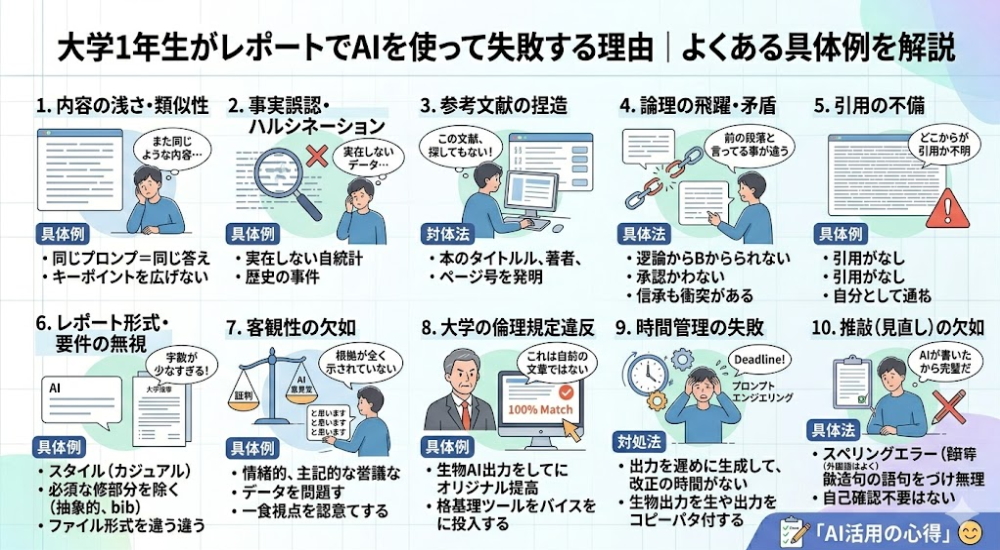
Why First-Year Students Fail When Using AI for Reports | Common Examples Explained
Many first-year university students are overwhelmed by the number and difficulty of report assignments and consider using AI to help manage the workload. AI can be useful for organizing ideas and assisting with early drafts. However, if it is used poorly, it can reduce the quality of the report or cause the writing to drift away from the assignment rather than making report writing easier.
First-year students are especially likely to trust AI output because they are not yet familiar with the standard form of university reports. As a result, they may believe they have produced convincing prose even when the content is shallow, inconsistent with course material, or weakly supported. In other words, the main source of failure is not AI itself but leaving the judgments required for a university report to AIlies in
This article first-year university student AI report mistakes、university report AI failure examples、AI report precautions for first-year studentsWith these issues in mind, this article explains why first-year students often make mistakes when using AI for reports, together with common examples. The purpose is not to reject AI entirely, but to clarify where problems are most likely to occur.
Reason 1 | Handing the Entire Assignment to AI Without Carefully Reading the Prompt
One of the greatest risks in university report writing is asking AI to “write about this topic” without first reading and understanding the assignment prompt yourself. University assignments may require you to “discuss,” “compare,” “analyze,” or “give specific examples,” and each instruction demands a different task. If you leave this unclear and delegate the work to AI, you may receive polished-looking prose that does not actually answer the assignment.
For example, even when an assignment says “discuss based on material covered in class,” AI may produce a response centered on general information. In that case, a long answer may still receive a poor evaluation.Before entering anything into AI, first understand the meaning and requirements of the assignment yourself.is the essential prerequisite.
Reason 2 | Mistaking Plausible Prose for Correct Content
AI-generated prose can look very natural and polished. First-year students may therefore think, “If it reads this well, it must be fine.” However, natural-sounding prose is not the same as accurate content. AI can generate contextually plausible language without necessarily matching what was taught in class or what the cited literature actually says.
A common example is the insertion of conceptual distinctions that do not appear in the textbook or issues that were never covered in class, presented as if they were established facts. If the student does not verify them, there is a risk of submitting those unsupported points unchanged.The more readable the prose appears, the more important it is not to skip content verification.is important.
Reason 3 | Prioritizing AI Output over Course Materials and Assigned Readings
University reports should generally be based on materials distributed by the instructor and assigned readings. When AI is used, however, plausible summaries and explanations can appear before the student has read those materials carefully. Because this is convenient, some students postpone reading the course materials they should actually prioritize.
For example, if you use an AI-generated paraphrase of an important concept without checking the definition given in the lecture slides, your wording may drift away from the instructor's intended meaning. In university report writing, First read the course materials and textbook, and then use AI as a supplementary tool.this sequence is important.
Reason 4 | Using an AI-Generated Structure Unchanged and Ending Up with Shallow Analysis
AI is good at producing safe, orderly outlines. University reports, however, require a structure tailored to the particular issues and course content. If you use an AI-generated outline unchanged, the result may become a thin report filled with generalities and may look to the reader like a superficial summary of familiar points.
For example, a report may follow the generic pattern “Introduction,” “Advantages,” “Disadvantages,” and “Summary” while omitting the comparison or analytical dimensions required by the course.Do not simply let AI determine the structure; always adjust the outline to fit your own assignment.is necessary.
Reason 5 | Blurring the Boundary Between Citations and Your Own Writing
AI can easily produce prose that sounds like a summary of other people's views. However, if you use that prose without checking which sources it is based on, citation practices become extremely unclear. In a university report, the boundary between your own reasoning and another person's argument must be explicit.
A common mistake is inserting an AI-generated statement such as “research has shown that...” into the body without identifying any source. This is not merely a content problem; it is also a problem of academic writing practice.Do not use text unchanged when you cannot verify its source.is important.
Reason 6 | Writing Content That Is Not Supported by the References
Writing from AI output can create the risk of discussing the contents of literature you have not actually read as though you had read it. First-year students are often still learning how to construct a reference list, so the correspondence between the body and references can easily break down.
For example, the body may mention a particular study or view that does not appear in the reference list, or a source may appear in the reference list even though it is never used in the body.Build the body only from sources you have actually checked yourself.is both the basic and safer approach.
Reason 7 | Using Unnatural Prose That Reveals a Shallow Understanding
Although AI-generated prose may look polished, it can be inconsistent with a first-year student's actual level of understanding or the context of the course, resulting in unnaturally formal writing. The report may then contain more statements that the student cannot explain when asked.
For example, highly technical expressions or abstract phrasing that the student would not normally use may appear repeatedly, making the whole paper sound disconnected from the writer's own voice. An instructor may then reasonably question whether the student truly understands what was written.It is better not to use expressions that you cannot explain yourself..
Reason 8 | Accepting AI Content Uncritically Without Checking the Facts
AI is not a dictionary or textbook in which every fact has already been verified. Users therefore need to check system names, definitions of concepts, historical facts, research findings, and similar information themselves. First-year students may nevertheless prioritize saving time and accept an AI explanation unchanged.
Common examples include using a definition that differs subtly from the one in course materials or including an example that has little relevance to the assignment.AI output is not the answer; it is a draft candidate that still requires verification.should be the way it is treated.
Reason 9 | Ignoring University- or Course-Specific Rules
Rules on AI use in university reports may differ by course or institution. Even where AI is not explicitly prohibited, students must still comply with submission formats, citation rules, reference styles, course-content requirements, and other conditions. AI will not automatically understand all of these requirements perfectly.
For example, if a course instructs students to focus on their own analysis, submitting AI-generated prose centered on generalities may depart from the purpose of the assignment.The final responsibility lies with the person submitting the work, not with AI.This point must not be forgotten.
Reason 10 | Assuming AI Makes the Work Easy and Skipping the Review Stage
Another major mistake is feeling satisfied after using AI and skipping the final review. In a university report, pre-submission checks are essential not only for typographical errors but also for whether the paper answers the question, whether paragraphs flow naturally, and whether citations correspond to the reference list.
AI-generated prose can look polished, making it easy to feel that review is unnecessary. In practice, however, this is exactly where inconsistencies and unnatural passages may remain.The more you use AI, the more important it is to reread the result with your own eyes..
What First-Year Students Should Keep in Mind to Avoid AI-Related Report Mistakes
As discussed above, the reasons first-year students fail when using AI for reports are not simply a matter of AI performance. The central problem is often skipping work that the student should perform personally, such as understanding the prompt, checking sources, adjusting the structure, checking citations, and reviewing the finished draft.
If you use AI, therefore, keep it within a supplementary role such as organizing ideas, comparing possible structures, or considering alternative wording, while continuing to read the sources and make the judgments yourself.Use AI as a support tool, not as a ghostwriter.This understanding is the most important factor in avoiding failure.
Summary | For First-Year Students, How AI Is Used Matters More Than Its Convenience
First-year students do not fail with AI reports simply because AI exists; they fail when they delegate too much judgment to it. Misreading the assignment, insufficient content verification, ambiguous citation practices, unnatural writing style, and inconsistency with course material are different forms of failure, but many can be explained by how the tool is used.
What a university report ultimately requires is the student's own understanding and expression based on course content and sources. Therefore, even when AI is used, Read for yourself, verify for yourself, and rewrite for yourself.this basic principle must not be abandoned. Do not use AI simply because it is convenient; maintain an appropriate distance so that convenience does not create avoidable mistakes.
Points to Check to Improve the Reliability of This Article
When applying “Why First-Year Students Fail When Using AI for Reports | Common Examples Explained” to a report, paper, or assignment, do not copy the article text. Verify supporting evidence using primary sources, official materials, and academic literature, and reconstruct the content to fit your own assignment requirements.
| ConfirmItem | What to Check | How to Use It in a Report |
|---|---|---|
| Accuracy of Information | Check whether the concepts, figures, systems, and cited sources in the text actually exist and are consistent with the latest information. | Add references and footnotes so that the relationship between claims and supporting evidence is clear. |
| Consistency with Assignment Requirements | Check that the work complies with the course topic, word count, required readings, writing style, citation format, and submission format. | Use a structure in which the introduction presents the question, the body develops the evidence, and the conclusion answers the question. |
| Originality / Discussion | Check that the discussion goes beyond general explanation and connects to the course content or your own research question. | Add, in your own words, why you think so and what limitations remain. |
Reference Materials / Verification Sources
The following are public, academic, and official sources worth checking when using the content of this article in a report or paper. If you cite them, format the citation according to the requirements of the institution where you will submit the work.
- CiNii Research: a major search service for finding Japanese papers, doctoral dissertations, research data, and related academic materials across multiple databases.
- J-STAGE: a platform useful for checking journals and academic papers published by Japanese academic societies.
- APA Style「Reference examples」: provides examples of how to format references in APA style.
- Zotero Official Website: an official tool useful for reference management, citation organization, and PDF management.
- Ministry of Education, Culture, Sports, Science and Technology: “Information on the Use of Generative AI”: an entry point to public information on the use of generative AI in education.
- Google Search Central「SEO Starter Guide」: basic guidelines for communicating page content correctly to search engines.
Related Services / Internal Links
In academic writing, not only appearance but also citations, evidence, logic, and compliance with submission requirements directly affect evaluation. Please review the related pages as well.
AI Report / Paper ConsultationUniversity Report SupportGraduation Thesis / Master's Thesis Writing SupportAcademic Paper and Literature SearchFree Quote / Consultation
Contact
To date, we have supported clients throughout Japan and overseas.over 10,000 casesof academic support requests. Experienced consultants carefully listen to your needs and provide prompt, appropriate support at reasonable fees.
Ibooks members across Japan will support you responsibly.
We send the profile of the responsible staff member when you apply.
When orders are busy, phone lines may be difficult to connect. We will reply in order, so urgent inquiries should be sent by
