
How Much Can AI Help With Reports? | A Prompt Primer for University Students and AI Models by Purposeblog
How Much Can AI Help With Reports? | A Prompt Primer for University Students and AI Models by Purpose
A simple guide for university students explaining which parts of report work AI can make easier and which parts still require personal judgment.
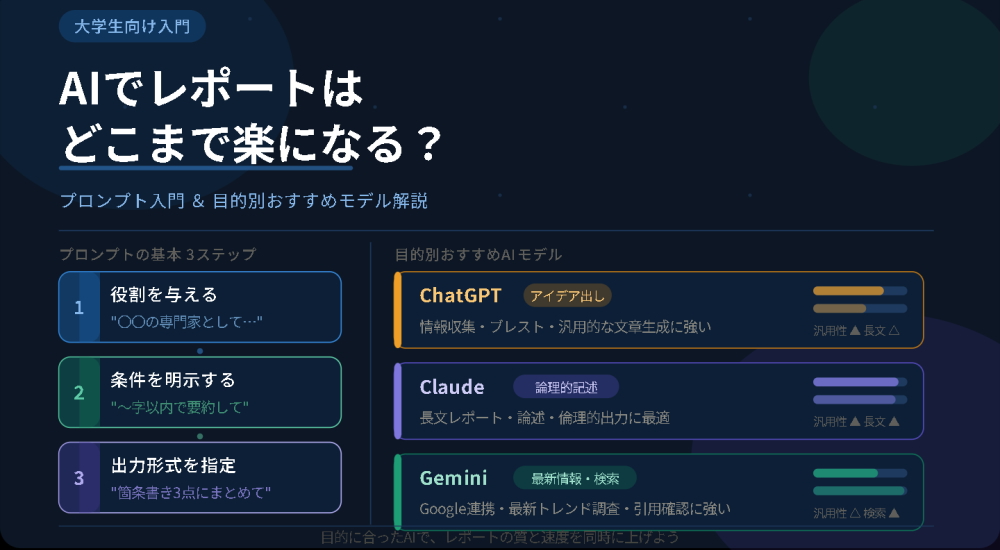
How Much Can AI Help With Reports? | A Prompt Primer for University Students and AI Models by Purpose
More university students are using AI for report writing. AI is certainly convenient for organizing topics, creating possible outlines, suggesting alternative wording, and assisting with review. As a result, many students wonder whether AI can make reports substantially easier.
AI can indeed reduce the burden of some tasks. However, it cannot automatically handle everything well. In university reports, students must ultimately make their own judgments about the assignment prompt, alignment with course content, verification of references, and development of their own analysis. The important point is to distinguish between tasks that AI can make easier and tasks that should not be delegated too far.
This article how much AI can simplify report writing、AI report prompts for university students、beginner AI prompt design、ChatGPT, Claude, and Gemini comparisonWith search intentions such as these in mind, this article organizes how AI can be useful in university reports, with particular attention to Prompt Basics for University Studentsand AI Models by Purposeand explains them in detail.
How Much Can AI Simplify Report Writing?
In short, AI can make the preparation, organization, and review stages of university report writing much easier. If a topic is too broad and you do not know what to write, AI can help organize possible issues. It can also help compare introduction-body-conclusion structures or identify passages in your own writing that are difficult to read.
On the other hand, there are parts that are not simply “difficult for AI,” but rather parts for which the student should take responsibilityparts for which the student should remain responsible. AI cannot responsibly be given the entire task of determining what the assignment requires, which course-material issues should be used, whether citations are appropriate, whether the reference list matches the body, or how far the student's own analysis should go.
AI can therefore reduce the workload of report writing, but it does not automate the university report itself. AI can help “before writing,” “while writing,” and “after writing,” but it does not assume responsibility for submission.This is the more realistic view.
Tasks AI Can Make Easier
Tasks that university students may find easier with AI include issue organization, developing possible structures, rephrasing key points, and supporting review. For example, prompts such as “reduce the issues for this topic to three” or “check whether the flow of this paragraph is unnatural” can provide a useful draft of the reasoning or a perspective for revision.
AI can also help when your own notes are scattered. Organizing fragmented notes or lecture notes into central and secondary issues is one area where AI can be useful as a support tool.getting ideas out of your head and rearranging them visiblyThis kind of work can become much easier with AI.
Tasks That Become Risky When Delegated Too Far to AI
By contrast, the most important caution is having AI create the entire final body from beginning to end. This may produce polished-looking prose, but it can also create a report that does not answer the assignment, introduces content not covered in class, includes claims unsupported by the references, or contains expressions the student cannot explain.
In university report writing, What matters is not whether the prose sounds plausible, but what evidence supports the reasoning and how the conclusion was reached.When the entire paper is delegated to AI, this essential part tends to weaken and requires particular caution.
Prompt Basics for University Students | What to Know First
How effectively AI can be used depends heavily on prompt design. A prompt is simply an instruction given to AI. Vague requests tend to produce vague answers, whereas well-organized conditions generally result in output that is easier to evaluate and use.
For a basic university-report prompt, start by includingpurpose, conditions, reference scope, and output formatthese four elements. They alone can substantially reduce variation in the response.
1. Make the Purpose Clear
The first thing to state is what you want AI to do. For university reports, requests such as “give me an outline,” “organize the meaning of this assignment prompt,” or “identify weak points in my own draft” are generally safer and more useful than “write the body for me.”
Limit each prompt to one role.This makes the output easier for students to work with.
2. State the Conditions Specifically
Next, specify the topic, word count, writing style, course, and scope. Even simple conditions such as “about 1,200 Japanese characters,” “plain ‘da/dearu’ style,” “for an education course,” and “limited to course materials” can substantially stabilize the direction of the output.
In university reports, small differences in conditions can create large deviations from the assignment. For that reason, it is better to provide conditions in more detail than you think may be necessary..
3. Tell AI What Sources or Information It May Use
If you specify a range such as “organize only from the course materials,” “create the outline only from the notes below,” or “compare only the key points from the assigned readings,” unrelated generalities are less likely to enter the output. In university assignments, focused organization within the designated scope is often more valuable than a broad but shallow survey.
Do not give AI more freedom than the task requires.This restraint is particularly important in university report writing.
4. Specify the Desired Output Format
Instead of turning AI's answer directly into body text, ask for headings, key-point summaries, lists of improvements, or checklists. These formats leave room for you to edit and judge the suggestions yourself.
For example, “structure only, not body text,” “three options in bullet points,” or “identify only the problems” can make the output much more practical.Ask for material that helps you think, not a finished paper.This is the key idea.
For University Students | Ready-to-Use Prompt Examples
Below are prompt examples that can be used relatively safely as support for university reports. Each is designed to assist organization or review rather than delegate the entire body.
When Creating an Outline
“Please create an outline for a university report. The topic is ‘The Role of Public Administration in Community Welfare.’ I plan to write about 1,200 Japanese characters in the plain ‘da/dearu’ style. Do not write the body. Please provide only the headings for the introduction, body, and conclusion, together with the key points that should be addressed in each paragraph. Limit the main issues to no more than three.”
When Reviewing Your Own Draft
“Below is a draft of a university report that I wrote myself. Without adding new content, please identify places where the logic jumps, repeated expressions, and sections that need more explanation. Do not rewrite it as a finished paper; list only the points that should be improved.”
When Interpreting an Assignment Prompt
“Please organize what the following university report assignment requires. Separate necessary tasks such as comparison, analysis, specific examples, and reference to course content. Do not write the body of the report.”
Recommended Models by Purpose
A common question for university students using AI is, “Which model should I use?” In university report work, however, it is more realistic to choose a model according to the purposethan to search for one universal model.
When ChatGPT May Be Useful
ChatGPT can be useful when you want to organize your thinking through dialogue. When the topic is still unclear, it can support iterative questions such as “What is this assignment asking?” “Give me three possible structures,” or “What is weak about this paragraph?”
They can therefore work well with processes such as interpreting assignment prompts, discussing structures, organizing issues, and improving draftsIt works well with processes such as
When Claude May Be Useful
Claude can be useful when you want to calmly organize longer text or several notes. Students may find it convenient when a draft has become too long, the issues are scattered, or the material needs to be reordered into a more readable sequence.
They may be especially useful for organizing long text, extracting key points, and reviewing the flow of the writingIt may suit students who prioritize
When Gemini May Be Useful
Gemini can be useful for students who primarily work in Google environments such as Google Docs and Google Drive. If you normally write reports in Google Docs, it may fit naturally into the surrounding workflow.
They can therefore work well with processes such as draft support, summarization, and revision within a Google-centered environmentIt may be a convenient option for university students who want
The Better Approach Is “Assign Roles,” Not “Find the Strongest Model”
For university reports, the practical recommendation is not to delegate everything to one model. One possible division of roles is ChatGPT for structure and discussion, Claude for organizing long text, and Gemini for a Google Docs-centered workflow.
Regardless of the model used, one caution remains common: AI cannot provide stronger academic grounding than course materials, assigned readings, and your own verified understanding.How you design the use of AI matters more than the model comparison itself.
Precautions When Using AI for University Reports
Because AI can make prose look polished, students may be tempted to skip content verification. University reports still require a final check of whether the paper answers the question, stays aligned with course content, contains unverifiable claims, matches references to the body, and includes any expressions the student cannot explain.
Before submission, Do not ask whether the AI prose sounds natural; ask whether the report contains only content you genuinely understand.Use this as the basis of the final review to avoid problems.
Summary | AI Can Make Report Work Easier, but It Cannot Replace the Thinking
AI can certainly make report work easier. It is highly useful for issue organization, developing structures, and supporting review. However, students must still personally handle the essential parts of a university report: understanding the assignment, reflecting course content, verifying evidence, and forming their own analysis.
To use AI effectively, university students should understand basic prompt design, choose tools according to the purpose, and finish by checking the work with their own judgment.AI can reduce the burden of report writing, but it does not assume the responsibility for learning itself.This understanding is the most important point.
Points to Check to Improve the Reliability of This Article
When applying “How Much Can AI Help With Reports? | A Prompt Primer for University Students and AI Models by Purpose” to a report, paper, or assignment, do not copy the article text. Verify supporting evidence using primary sources, official materials, and academic literature, and reconstruct the content to fit your own assignment requirements.
| ConfirmItem | What to Check | How to Use It in a Report |
|---|---|---|
| Accuracy of Information | Check whether the concepts, figures, systems, and cited sources in the text actually exist and are consistent with the latest information. | Add references and footnotes so that the relationship between claims and supporting evidence is clear. |
| Consistency with Assignment Requirements | Check that the work complies with the course topic, word count, required readings, writing style, citation format, and submission format. | Use a structure in which the introduction presents the question, the body develops the evidence, and the conclusion answers the question. |
| Originality / Discussion | Check that the discussion goes beyond general explanation and connects to the course content or your own research question. | Add, in your own words, why you think so and what limitations remain. |
| Transparency About AI Use | Be able to explain what parts involved generative AI, how sources were checked, and whether the text was rewritten. | Treat AI output not as a finished product but as assistance for research, structuring, and revision. |
Reference Materials / Verification Sources
The following are public, academic, and official sources worth checking when using the content of this article in a report or paper. If you cite them, format the citation according to the requirements of the institution where you will submit the work.
- Ministry of Education, Culture, Sports, Science and Technology: “Handling of Generative AI in Teaching and Learning at Universities and Colleges of Technology”: provides basic guidance on handling generative AI in university and college classes, reports, examinations, and related educational settings.
- Agency for Cultural Affairs: “AI and Copyright”: a public source for considering risks involving AI-generated content, copyright, plagiarism, and similar wording.
- OpenAI「A Student's Guide to Writing with ChatGPT」: provides guidance on using ChatGPT as a learning aid and for improving writing.
- Google NotebookLM Official Website: official information on an AI research tool that summarizes and answers questions based on materials provided by the user.
- Elicit Official Website: official information on an AI research-support tool used to search, summarize, and extract information from academic papers.
- Zotero Official Website: official information on a reference-management tool used to collect, organize, cite, and share references.
Related Services / Internal Links
In academic writing, not only appearance but also citations, evidence, logic, and compliance with submission requirements directly affect evaluation. Please review the related pages as well.
AI Report / Paper ConsultationUniversity Report SupportGraduation Thesis / Master's Thesis Writing SupportAcademic Paper and Literature SearchFree Quote / Consultation
FAQ
Can I submit a report generated with generative AI as it is?
Submitting it unchanged is not recommended. Check the rules of your university and course, treat AI output as an outline or draft, verify sources, and reconstruct the content in your own words.
Can references generated by AI be trusted?
It is risky to trust them without verification. AI may produce nonexistent references or incorrect bibliographic details, so confirm both existence and content using sources such as CiNii, J-STAGE, Google Scholar, PubMed, and publisher websites.
What matters if I want to avoid problems or suspicion regarding AI use?
The important point is not to evade AI detection, but to keep records of how AI was used, check applicable rules, verify evidence, connect the writing to course content, and add your own analysis.
Contact
To date, we have supported clients throughout Japan and overseas.over 10,000 casesof academic support requests. Experienced consultants carefully listen to your needs and provide prompt, appropriate support at reasonable fees.
Ibooks members across Japan will support you responsibly.
We send the profile of the responsible staff member when you apply.
When orders are busy, phone lines may be difficult to connect. We will reply in order, so urgent inquiries should be sent by
