
Common Failure Stories in Graduation and Master's Theses and How to Prevent Themblog
Common Failure Stories in Graduation and Master's Theses and How to Prevent Them
Knowing common problems in graduation and master's theses in advance makes it easier to proceed calmly through topic selection, literature review, data collection, analysis, writing, and final checks.
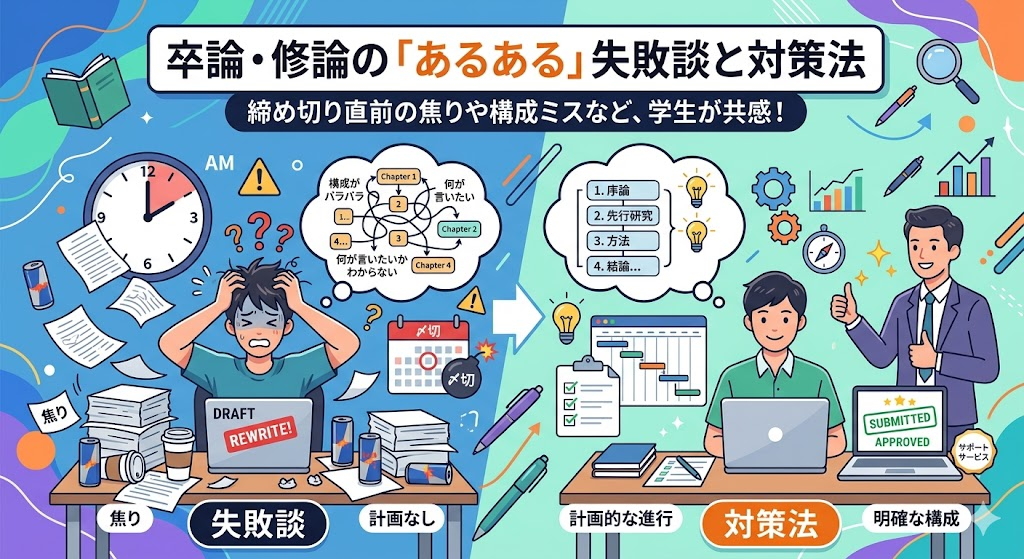
Common Failure Stories in Graduation and Master's Theses and How to Prevent Them
A graduation or master's thesis is one of the largest projects in a student's university or graduate-school experience. Unlike an ordinary course report, it requires several long-term tasks, including topic selection, organizing previous studies, considering research methods, conducting and analyzing research, discussion, citations, and preparation of the reference list.
In practice, however, few students progress smoothly from the beginning. Common experiences include “I thought I had chosen a topic, but it was too broad,” “I cannot find enough previous studies,” “I conducted a survey but do not know how to analyze it,” and “I noticed just before the deadline that the reference formatting was inconsistent.” Graduation and master's theses contain manycommon failuresof these situations.
The important thing is not to fear mistakes themselves. It is more useful to learn about common problems early and prepare countermeasures. The quality of a graduation or master's thesis does not depend on talent alone; it changes substantially through planning, checking, revising, and consulting othersthese accumulated practices.
This article graduation thesis failure stories、master's thesis failure stories、graduation thesis behind schedule、unable to write a master's thesis、academic paper writing strategiesWith search intentions such as these in mind, this article clearly organizes common failures in graduation and master's theses and practical ways to address them.
Failure 1 | The Topic Is Too Broad and You No Longer Know What to Write
One of the most common problems in graduation and master's theses is setting the topic too broadly. Topics such as “social media and young people,” “tourism and regional revitalization,” “educational inequality,” “work-style reform,” or “communication in nursing” may be good directions of interest, but they are too broad in that form.
An overly broad topic creates an enormous body of previous research, disperses the issues, and makes it difficult to decide what to focus on. The introduction may present a major problem while the body provides fragmented explanations and the conclusion remains vague.
The solution is to specify the population, period, region, field, comparison axis, or research participants. For example, narrowing “social media and young people” to “social media use in university students' job searches and the formation of corporate image” creates a much clearer research focus.Convert a broad topic into a researchable question rather than trying to address it unchanged.This is the first countermeasure.
Failure 2 | Starting to Write Before Reading Previous Studies
Another common problem is beginning to write before adequately reading previous studies because “writing something will at least move the project forward.” Starting early is not itself a problem. However, writing without reviewing previous research can make the position of your own argument unclear.
Graduation and master's theses need to show not only the student's opinion but also what previous research has established and what problems remain. Without this review, students may present already-established findings as new discoveries or overlook important studies.
The solution is not to create a perfect bibliography immediately, but to begin by reading several major articles and books to understand the research landscape. Then organize each source according to what it established, what method it used, and what limitations remain. This makes the position of your own study easier to identify.Previous studies are not decoration; they form the foundation of the entire thesis..
Failure 3 | The Research Purpose and Conclusion Do Not Connect
A graduation or master's thesis should state its research purpose in the introduction, conduct the investigation or analysis in the body, and answer that purpose in the conclusion. As writing progresses, however, the argument may drift so that the original research purpose and final conclusion no longer connect.
For example, an introduction may state that the study will “clarify the significance of resident participation in regional tourism,” while the body only describes changes in tourist numbers and the conclusion ends by emphasizing regional promotion. The content may be related, but it does not adequately answer the stated research purpose.
A useful countermeasure is to ask before drafting each chapter, “Which part of the research purpose does this chapter answer?” The research purpose should also be reviewed during the writing process. Minor revisions may become necessary as the study develops, but if the purpose changes, the introduction, methods, results, discussion, and conclusion must all be adjusted consistently. Maintain a clear correspondence between the research purpose and the conclusion.is important.
Failure 4 | Conducting a Survey or Interview but Not Knowing How to Analyze the Data
A frequent problem in survey-based graduation and master's theses is conducting questionnaires or interviews and only later realizing that the analysis method is unclear. If the analysis has not been considered when the questions are designed, it can become difficult to determine how to use the collected data.
For example, a questionnaire may collect mostly open-ended responses without deciding on a qualitative analysis method, or multiple-choice items may not be structured in a way suitable for tests or cross-tabulation. In interviews, questions that are too broad can produce widely divergent answers and make it difficult to establish an analytical framework.
The solution is to decide before data collection what each question is intended to reveal and how it will be analyzed. For quantitative research, possible methods may include descriptive tabulation, cross-tabulation, t-tests, analysis of variance, correlation analysis, or regression analysis. For qualitative research, consider approaches such as categorization, thematic analysis, or M-GTA.Design questionnaires and interview items backward from the intended analysis.is important.
Failure 5 | Postponing Citation and Reference Management
Students often focus so heavily on drafting that they postpone organizing citations and references. During writing it is easy to think, “I can fix this later,” but near the deadline they may no longer remember which source a quotation came from, which page was consulted, or whether in-text citations correspond to the reference list.
Problems with citations and references directly affect the credibility of a thesis. Inaccurate author names, years, titles, publishers, journal names, volume and issue numbers, pages, URLs, or access dates can affect the evaluation even when the substantive content is strong. Attention is also required if the citation style differs from the format specified by the faculty or graduate school.
The solution is to record bibliographic information as soon as you read each source. If a passage may be quoted, note the page number at the same time. It is also important to format sources early according to the required style, whether APA, MLA, Chicago, or a Japanese academic format specified by the institution.Reference management is not a final-stage task; it should proceed alongside the writing..
Failure 6 | Writing the Body Without Developing a Chapter Structure
In graduation and master's theses, the chapter structure serves as the blueprint for the entire paper. If you begin writing without an adequate chapter plan, you may repeat the same content, omit necessary issues, or create an unnatural progression toward the conclusion.
If the roles of the introduction, previous studies, research methods, results, discussion, and conclusion remain unclear, the thesis can become a collection of disconnected reports. Each chapter should have its own function while contributing to a single overall structure that answers one research question.
A useful countermeasure is to write the purpose of each chapter in one sentence before drafting. For example: Chapter 1 presents the problem and research purpose; Chapter 2 organizes previous studies; Chapter 3 explains the research method; Chapter 4 presents the results; Chapter 5 provides the discussion; and Chapter 6 states the conclusion.A chapter structure is not merely a table of contents; it is a blueprint showing the logical flow..
Failure 7 | Trying to Add Words at the Last Minute Simply to Reach the Required Length
As a deadline approaches, students may think, “I just have to reach the required word count,” and try to increase length by stretching explanations or repeating the same content in different words. Simply adding words, however, does not necessarily improve the quality of a thesis.
If more length is genuinely needed, the substance should become richer. You might add comparisons among previous studies, deepen the interpretation of analysis results, add concrete examples, or organize limitations and future research. By contrast, redundant explanations and repetition make the paper harder to read and may lower its evaluation.
The solution is to check the role of each chapter rather than focusing on word count. Identify which chapter is thin and which issues are insufficiently developed, then add evidence or analysis where it is actually needed.Do not fill space; strengthen the argument.This mindset is important.
Failure 8 | Consulting the Supervisor Too Late
Students sometimes delay consulting their supervisor because they think, “I have not written enough yet,” “I am afraid I will be criticized,” or “I want to fix it myself before showing anyone.” In graduation and master's theses, however, checking the direction early is extremely important.
If you write a substantial amount before learning that the topic or method is fundamentally misaligned, major revision may become necessary. Research methods, participants, analytical methods, and chapter structure are especially important to confirm early.
The solution is to consult your supervisor even with interim notes or a draft chapter structure rather than waiting for a complete manuscript. When consulting, clearly state what you are struggling with and what you want reviewed; this makes specific advice easier to obtain.Consultation is not something to do only after completion; it is a process for improving the work while it develops..
Failure 9 | Discovering a Major Error During the Final Pre-Submission Check
Immediately before submitting a graduation or master's thesis, many elements require checking in addition to the body text: the cover page, table of contents, page numbers, figure and table numbering, citation style, references, footnotes, abstract, and required file format. Students sometimes use all their energy finishing the body and leave too little time for these checks.
Common errors include incorrect page numbers in the table of contents, duplicate figure or table numbers, references that are never cited in the body, sources cited in the body but missing from the reference list, and formatting that does not match the university's requirements.
The solution is to reserve time for format checks several days before submission rather than on the previous day. Separating content review, format review, citation review, proofreading, and verification of the submission method can reduce mistakes.The pre-submission check is the final stage that protects the quality and evaluation of the thesis..
Basic Strategies for Avoiding Problems in Graduation and Master's Theses
To avoid problems in graduation and master's theses, it is more important to divide the project into manageable tasks than to try to write perfect prose early. Attempting to complete topic selection, previous studies, research purpose, methodology, data collection, analysis, discussion, citations, and submission formatting all at once creates an excessive burden.
First, make the research topic specific and reach the point where you can explain the research purpose in one sentence. Next, read previous studies and organize the major research trends. Then decide what your own study will clarify and translate that purpose into a chapter structure.
If the study involves data collection or analysis, confirm the analytical method before collecting the data. Also organize citations and references during the writing process rather than after the body is finished, and reserve time for formatting checks before submission.Academic paper writing is project management, not improvisation..
Support Available from iBooks Academic Support
iBooks Academic Support provides broad support for graduation and master's theses, including topic selection, chapter structure, organization of previous studies, research planning, source checking, citation formatting, writing structure, development of the discussion, and pre-submission review.
Even if you are worried that “the topic may be too broad,” “I cannot organize the previous studies,” “I do not know how to analyze my findings,” “I am unsure about citation and reference formatting,” or “I do not know what to fix first before the deadline,” the necessary tasks can be organized according to your current stage of progress.
Graduation and master's theses can become more stressful when students try to handle everything alone. Reviewing the structure and logical flow from a third-party perspective can make it easier to identify what needs revision.Identifying the problems early is one of the shortest routes to a stronger final thesis..
Summary | Many Graduation and Master's Thesis Problems Can Be Prevented by Acting Early
Graduation and master's theses are prone to many common problems: topics that are too broad, writing before reviewing previous studies, a mismatch between the research purpose and conclusion, collecting data without knowing how to analyze it, postponing citations and references, and trying to increase the word count at the last minute.
Many of these problems can be addressed in advance. Narrow the topic, organize previous studies, align the research purpose with the chapter structure, determine the analytical method before data collection, record citations and references while writing, and reserve time for pre-submission review. Accumulating these basic practices makes the writing process much more stable.
A graduation or master's thesis is not simply a long piece of writing. It involves formulating a question, gathering evidence, analyzing it, and presenting your own conclusion. Therefore, Learn common failure patterns early and address them systematically.this is important. If you are uncertain, it can be useful to seek specialized review early rather than carrying all concerns alone until immediately before submission.
Points to Check to Improve the Reliability of This Article
When applying “Common Failure Stories in Graduation and Master's Theses and How to Prevent Them” to a report, paper, or assignment, do not copy the article text. Verify supporting evidence using primary sources, official materials, and academic literature, and reconstruct the content to fit your own assignment requirements.
| ConfirmItem | What to Check | How to Use It in a Report |
|---|---|---|
| Accuracy of Information | Check whether the concepts, figures, systems, and cited sources in the text actually exist and are consistent with the latest information. | Add references and footnotes so that the relationship between claims and supporting evidence is clear. |
| Consistency with Assignment Requirements | Check that the work complies with the course topic, word count, required readings, writing style, citation format, and submission format. | Use a structure in which the introduction presents the question, the body develops the evidence, and the conclusion answers the question. |
| Originality / Discussion | Check that the discussion goes beyond general explanation and connects to the course content or your own research question. | Add, in your own words, why you think so and what limitations remain. |
Reference Materials / Verification Sources
The following are public, academic, and official sources worth checking when using the content of this article in a report or paper. If you cite them, format the citation according to the requirements of the institution where you will submit the work.
- CiNii Research: a major search service for finding Japanese papers, doctoral dissertations, research data, and related academic materials across multiple databases.
- J-STAGE: a platform useful for checking journals and academic papers published by Japanese academic societies.
- APA Style「Reference examples」: provides examples of how to format references in APA style.
- Zotero Official Website: an official tool useful for reference management, citation organization, and PDF management.
- Ministry of Education, Culture, Sports, Science and Technology: “Information on the Use of Generative AI”: an entry point to public information on the use of generative AI in education.
- Google Search Central「SEO Starter Guide」: basic guidelines for communicating page content correctly to search engines.
Related Services / Internal Links
In academic writing, not only appearance but also citations, evidence, logic, and compliance with submission requirements directly affect evaluation. Please review the related pages as well.
AI Report / Paper ConsultationUniversity Report SupportGraduation Thesis / Master's Thesis Writing SupportAcademic Paper and Literature SearchFree Quote / Consultation
Contact
To date, we have supported clients throughout Japan and overseas.over 10,000 casesof academic support requests. Experienced consultants carefully listen to your needs and provide prompt, appropriate support at reasonable fees.
Ibooks members across Japan will support you responsibly.
We send the profile of the responsible staff member when you apply.
When orders are busy, phone lines may be difficult to connect. We will reply in order, so urgent inquiries should be sent by
