
Top 5 AI Academic Writing Tools in 2026blog
Top 5 AI Academic Writing Tools in 2026
Academic paper writing involves many stages, including research, outlining, first-draft preparation, citation management, English-language editing, and pre-submission review. As described on this page, AI writing tools in 2026 can serve as powerful support for making these tasks more efficient. They do not replace the researcher, and critical thinking, research ethics, source verification, and final judgment must remain human responsibilities.
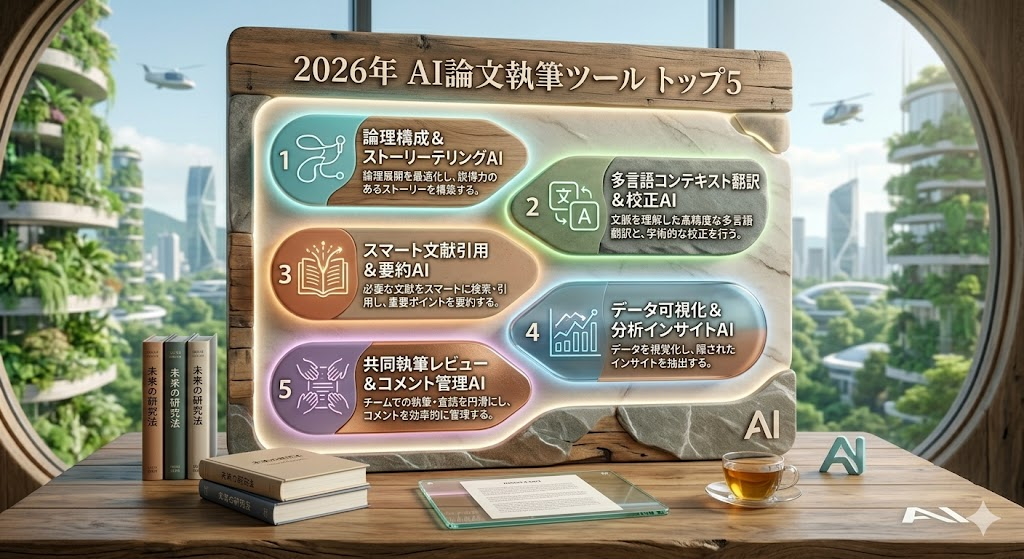
Top 5 AI Academic Writing Tools in 2026
Academic paper writing is demanding. Selecting a research topic, reading previous studies, developing a structure, drafting the text, organizing citations, and adapting the manuscript to submission guidelines require significant time and concentration. When deadlines are close, researchers may spend more time on literature organization, wording changes, and format adjustments than on the substantive research itself.
AI academic-writing tools are increasingly used to support these tasks. They may assist with prompt analysis, information organization, outlining, drafting support, grammar correction, citation formatting, plagiarism checks, and pre-submission review. The important point is to use AInot as a tool that automatically completes the paper, but as an assistant that supports the researcher's thinkingin this role.
This article highlights five AI academic-writing tools discussed for 2026, eesel AI blog writer、Paperguide、Jenni AI、Yomu AI、Paperpaland organizes them by intended use: tools focused on structured first drafts, tools emphasizing source-based document generation, collaborative writing support, integrated academic writing and citation functions, and tools focused on English-language editing and submission preparation.
Introduction | What Do AI Academic-Writing Tools Support?
AI academic-writing tools are software designed to make parts of the paper-writing process more efficient. They may assist with topic-based outlining, first-draft support, paraphrasing, English-language improvement, citation suggestions, reference formatting, plagiarism checks, and pre-submission review.
However, AI-generated writing is not a finished manuscript that can automatically be submitted. AI can produce plausible prose while still including source errors, nonexistent references, logical gaps, inconsistencies with research data, or research-ethics problems. AI output should therefore be checked against original sources, the data, the research purpose, and submission requirements.
What Is an AI Academic-Writing Tool?
“AI academic-writing tools” is a general term for services that use artificial intelligence to support scholarly writing. Different tools have different strengths: some focus on first-draft generation, some on source-grounded drafting, some on sentence-by-sentence collaborative writing, and others on English-language editing and pre-submission checks.
The important point is Do not delegate final academic judgment to AI.that the core of an academic paper remains the research question, methods, results, discussion, and originality. Researchers must design and explain these elements themselves and retain responsibility for them. AI should serve as an aid that reduces operational workload.
Five Criteria to Examine When Comparing Tools
When comparing AI academic-writing tools, natural-sounding prose alone is not enough. First, examine whether the tool supports accurate and internally consistent academic content. Second, consider the extent of its citation and reference-management functions. Third, examine editing functions for grammar, tone, readability, and academic expression. Fourth, consider whether the interface is intuitive and can fit naturally into the research workflow. Fifth, compare free and paid plans, usage limits, and the balance between price and functionality.
Comparison Table of AI Academic-Writing Tools for 2026
The following table organizes five AI academic-writing tools highlighted on this page for 2026. Prices and features may change, so check each service's official information before adopting it.
Top Five: Use Cases, Citations, Plagiarism Checking, and Approximate Pricing
| Tool | Best Use Case | Citation Support | Plagiarism or Similarity Checking | Free Plan or Trial | Approximate Price |
|---|---|---|---|---|---|
| eesel AI blog writer | Creating Structured First Drafts and Media-Rich Draft Content | Supports Use of External Citations and References | Separate Verification Is Needed for Academic Plagiarism Checking | Free Trial Available | Listed at Approximately USD 99 for 50 Generations |
| Paperguide | Source-Based Research Document Generation and Literature Review | Supports Citation Management and Multiple Citation Styles | Plagiarism Checker Available on Some Plans | Free Plan Available | Plus Listed at Approximately USD 12 per Month with Annual Billing |
| Jenni AI | Collaborative Writing Through AI Autocomplete | Citation Support for APA, MLA, Chicago, and Other Styles | Plagiarism Checking Is Not the Main Function and Requires Separate Verification | Free Plan Available | Unlimited Listed at Approximately USD 12 per Month with Annual Billing |
| Yomu AI | Integrated Academic Writing, Editing, Citations, and Plagiarism Checking | AI-Assisted Citation Search and Formatting Support | Plagiarism Checking Available on Some Plans | Free Usage Allowance Available | Pro Listed at Approximately USD 11 per Month with Annual Billing |
| Paperpal | Editing, Revision, and Submission Preparation for English-Language Papers | Research-Article Search Across More Than 250 Million Articles and Citation Support | Plagiarism Checking, AI Detection, and Pre-Submission Checks Listed as Available | Free Plan Available | Prime Listed at Approximately USD 139 per Year |
Top 5 AI Academic Writing Tools in 2026
The following sections organize each tool's characteristics, suitable use cases, and cautions. The “best” tool depends on the researcher's purpose: quickly producing an initial draft, building from references, improving English expression, or conducting pre-submission checks.
1. eesel AI Blog Writer | A Tool Focused on Structured First-Draft Creation
eesel AI Blog Writer is not strictly an academic-paper-specific tool, but the source describes it as useful for creating long, researched drafts based on a topic. It is designed to generate content that can include assets such as images, charts, and video. Rather than completing an academic paper itself, it may be useful for organizing a research-topic overview, creating an explanatory article or public-facing research summary, or producing an early structural draft.
Its strength is the ability to generate structured text quickly, which can reduce the burden of starting from a blank page and help users inspect the ordering of issues. Because it is designed around a blog-style workflow, academic styles such as APA, MLA, or Chicago may require manual adjustment. For formal academic papers, plagiarism checking and peer-review-response preparation may also require separate tools or specialist review.
This tool may be suitable when you want to explain research content clearly for an external audience or quickly create a possible structure for an early draftfor the following purposes. If any output is used in a submitted manuscript, graduation thesis, or master's thesis, the researcher must still check original sources, reconcile the literature, and adjust the format.
2. Paperguide | A Tool Focused on Source-Based Document Generation
Paperguide is described as an AI research assistant integrating literature search, paper analysis, reference management, and document creation. One strength described on the page is the ability to generate structured research documents based on supplied references or imported sources. This can help users build literature reviews, essays, or research-paper drafts around source material rather than unrestricted generation.
A stated advantage of Paperguide is handling citations and document generation in the same workflow. Because content can be built around a reference list or imported research material, the process is less like unconstrained AI composition. The source also describes literature-review and plagiarism-checking functions, allowing several paper-writing tasks to be managed in one environment.
On the other hand, a full-document-generation workflow may feel less interactive to some users. Researchers who prefer to think sentence by sentence may prefer a collaborative-writing tool such as Jenni AI. Paperguide may be suitable for researchers who want to organize the overall paper around a defined body of referencesfor the following use case.
3. Jenni AI | Collaborative AI Writing Support
Jenni AI is described as a tool that supports researchers and students sentence by sentence through AI autocomplete. Rather than generating a large body of text all at once, it offers a collaborative-writing experience in which the human writer remains in control and AI suggests possible next sentences or expressions. The source notes that suggestions can be based on prompts or uploaded research materials and may include citation assistance.
A stated advantage of Jenni AI is reducing writer's block. It may help when the researcher already has a research purpose or argument but is unsure how to express it. The source also describes citation support for styles such as APA, MLA, and Chicago.
AI-suggested prose should not be accepted automatically. The researcher must personally verify interpretation of the literature, the positioning of previous studies, and the meaning of the results. Because privacy and data-use policies may change, current policies should also be checked before uploading unpublished or sensitive material.
4. Yomu AI | A Tool Integrating Academic Writing, Editing, and Citations
Yomu AI is described as an assistant designed to support academic writing through functions such as autocomplete, paraphrasing, summarization, citation support, and plagiarism checking. It is intended for users who want to draft, edit, manage citations, and perform checks in one workspace.
A stated strength of Yomu AI is integrating several functions required in academic writing. Users can draft text, edit paragraphs, search for citations, and check formatting or plagiarism risks within the same environment, reducing the need to move among several applications.
Available AI models and included functions may vary by plan. Advanced models or additional functions may be restricted to higher-tier plans, so users should check the required functions and current pricing before subscribing. Yomu AI may be suitable students and researchers who want to integrate drafting, citations, editing, and review in one workflowfor the following users.
5. Paperpal | Academic Support Focused on English-Language Editing and Submission Preparation
Paperpal is described as an AI academic-writing tool focused on English-language editing, language improvement, and submission preparation. The source lists functions beyond grammar and vocabulary correction, including academic tone, clarity, word-count reduction, paraphrasing, citation support, plagiarism checking, AI detection, and pre-submission checklist functions. It may be especially useful when a draft already exists and the goal is to improve its final presentation.
The stated strength of Paperpal is refining an existing manuscript into clearer academic English rather than generating a paper from scratch. For researchers whose first language is not English, improving naturalness and clarity without changing the intended research meaning can be important. Pre-submission checks may also reduce uncertainty about language and formatting before journal submission.
Paperpal is therefore better viewed as a revision, editing, and submission-preparation tool than as a complete first-draft generator. One possible workflow is to use Jenni AI, Paperguide, or Yomu AI for early structure or drafting support and then use Paperpal during the finishing stage.as a tool for final quality control.It may be most useful when positioned
How to Choose by Purpose
When choosing an AI academic-writing tool, work backward from the stage where you need help rather than relying only on rankings. The appropriate tool depends on whether the problem is generating an early draft, organizing references, improving English expression, or integrating citation and plagiarism checks.
Use Different Tools for First Drafts, Collaborative Writing, Editing, and Submission Preparation
If you want a broad first draft quickly, a generative tool such as eesel AI Blog Writer may provide a starting point, but academic use still requires correction of structure, citations, style, and source verification. If the goal is to build around a reference list, Paperguide may be more suitable. If the writer wants to maintain sentence-by-sentence control, Jenni AI may be convenient.
Yomu AI may be an option for integrating drafting, editing, citations, and plagiarism checking. Paperpal may be suitable when a manuscript already exists and the priority is English-language editing, tone adjustment, and pre-submission review.
A Practical Approach Is Two-Stage Use: Generation Support Followed by Editing Support
In practice, using two stages may be more stable than relying on one tool for everything. For example, Paperguide or Jenni AI might support structure and early drafting, followed by Paperpal for English-language refinement and submission checks. For Japanese papers, ChatGPT or Gemini may be used to review logical flow, followed by human literature reconciliation and expression adjustment.
In this way, separate generation, citation, editing, and verification into distinct tasksthe convenience of AI can be used while academic reliability is protected.
Ethics and Precautions When Using AI Academic-Writing Tools
Academic integrity is the most important consideration when using AI academic-writing tools. Do not submit AI output uncritically as your own thinking, cite information without checking its source, or include unverified claims in a paper.
Tasks That Should Remain Human-Led
Research design, hypothesis development, critical review of previous studies, method selection, interpretation of data, and construction of the discussion should remain human-led tasks. AI is more suitable for supporting operations such as text formatting, expression improvement, summarization, format adjustment, and checklist review. The more AI is used, the more important the researcher's judgment becomes in deciding what to accept and reject.
Check the AI-use policies of your university, academic society, and target journal.
Universities, graduate schools, academic societies, and journals may regulate whether AI may be used and how its use must be disclosed. Depending on the policy, use may need to be described in acknowledgments, methods, notes, or submission declarations. Uploading unpublished data, personal information, statements from participants, or internal corporate or organizational materials to external AI services may also create confidentiality or research-ethics concerns.
Before adopting an AI academic-writing tool, check its terms of use, data-retention practices, whether data may be used for training, privacy policy, and the rules of your institution.
FAQ
Are there AI academic-writing tools suitable for students with limited budgets?
Many tools offer free plans or trial allowances. The source suggests first testing free access to services such as Paperguide, Jenni AI, Yomu AI, or Paperpal to see whether they fit your research workflow. It is generally safer to test a tool on an actual assignment or research topic before committing to a paid plan.
Do AI academic-writing tools support citations and formatting?
The source describes Paperguide, Jenni AI, Yomu AI, and Paperpal as providing citation or reference-management and formatting support. Citation information should still be checked in the original source, including DOI, author name, publication year, journal, and page numbers.
Is it ethical to use AI academic-writing tools for academic purposes?
Using AI as a support tool is not automatically inappropriate. Problems arise when use violates institutional or journal policies, when AI-generated text is submitted as the user's own original contribution without appropriate handling, or when sources are not verified. The scope of AI use should be clear and disclosed where required.
Is a plagiarism-checking function enough to make the work safe?
Plagiarism checking is a useful support function but does not guarantee complete academic integrity. Humans still need to check quotation marks, source attribution, the appropriateness of paraphrasing, correspondence with the reference list, and possible self-plagiarism. Submitted manuscripts also require review of research ethics and citation practice.
Is it acceptable to let AI create a complete first draft?
AI can be used to create preliminary draft material where permitted, but it should not be submitted or published unchanged. Treat the AI draft as material for organizing issues or reviewing structure, then verify the content, reconcile it with the literature and data, and revise the expression yourself.
Support Available from iBooks Academic Support
iBooks Academic Support assists people who are uncertain about AI-assisted academic and report writing with topic selection, chapter planning, organization of previous studies, literature checking, citation formatting, writing structure, deeper discussion, and pre-submission review. AI-assisted text can also be checked for misalignment with the research purpose, citation problems, logical gaps, unnatural wording, and places where sources require verification.
In graduation theses, master's theses, doctoral dissertations, MBA papers, and submitted manuscripts, natural wording alone is not enough. The research purpose, previous studies, methods, results, discussion, and conclusion should be consistent; citations must correspond to the reference list; and the manuscript must follow the required submission format.Professional human review after AI use is an important process for protecting the reliability of an academic paper..
Summary | AI Can Accelerate Academic Writing, but It Does Not Replace Research Judgment
The five AI academic-writing tools discussed for 2026 support different parts of the workflow. The source positions eesel AI Blog Writer as support for early drafts and structure, Paperguide for source-based document generation, Jenni AI for collaborative writing, Yomu AI for integrated academic writing, citations, and editing, and Paperpal for English-language editing and submission preparation.
AI does not assume responsibility for the paper. Formulating the research question, constructing the logic, critically reading previous studies, interpreting data, and deciding the final claim remain the researcher's responsibilities. AI is a tool for searching, organizing, supporting, and checking. Therefore, use AI while keeping final responsibility with humans.this attitude is essential for future academic writing.
If you are unsure whether AI academic-writing tools may be used, concerned about whether AI-assisted prose is academically appropriate, want citation and reference consistency checked, or want to know whether a manuscript is ready for submission, specialized review before submission can be useful. iBooks Academic Support provides literature checking, citation formatting, logical review, and structural checks needed for academic writing in the AI era.
Points to Check to Improve the Reliability of This Article
When applying “Top 5 AI Academic Writing Tools in 2026” to a report, paper, or assignment, do not copy the article text. Verify supporting evidence using primary sources, official materials, and academic literature, and reconstruct the content to fit your own assignment requirements.
| ConfirmItem | What to Check | How to Use It in a Report |
|---|---|---|
| Accuracy of Information | Check whether the concepts, figures, systems, and cited sources in the text actually exist and are consistent with the latest information. | Add references and footnotes so that the relationship between claims and supporting evidence is clear. |
| Consistency with Assignment Requirements | Check that the work complies with the course topic, word count, required readings, writing style, citation format, and submission format. | Use a structure in which the introduction presents the question, the body develops the evidence, and the conclusion answers the question. |
| Originality / Discussion | Check that the discussion goes beyond general explanation and connects to the course content or your own research question. | Add, in your own words, why you think so and what limitations remain. |
| Transparency About AI Use | Be able to explain what parts involved generative AI, how sources were checked, and whether the text was rewritten. | Treat AI output not as a finished product but as assistance for research, structuring, and revision. |
Reference Materials / Verification Sources
The following are public, academic, and official sources worth checking when using the content of this article in a report or paper. If you cite them, format the citation according to the requirements of the institution where you will submit the work.
- Ministry of Education, Culture, Sports, Science and Technology: “Handling of Generative AI in Teaching and Learning at Universities and Colleges of Technology”: provides basic guidance on handling generative AI in university and college classes, reports, examinations, and related educational settings.
- Agency for Cultural Affairs: “AI and Copyright”: a public source for considering risks involving AI-generated content, copyright, plagiarism, and similar wording.
- OpenAI「A Student's Guide to Writing with ChatGPT」: provides guidance on using ChatGPT as a learning aid and for improving writing.
- Google NotebookLM Official Website: official information on an AI research tool that summarizes and answers questions based on materials provided by the user.
- Elicit Official Website: official information on an AI research-support tool used to search, summarize, and extract information from academic papers.
- Zotero Official Website: official information on a reference-management tool used to collect, organize, cite, and share references.
Related Services / Internal Links
In academic writing, not only appearance but also citations, evidence, logic, and compliance with submission requirements directly affect evaluation. Please review the related pages as well.
AI Report / Paper ConsultationUniversity Report SupportGraduation Thesis / Master's Thesis Writing SupportAcademic Paper and Literature SearchFree Quote / Consultation
FAQ
Can I submit a report generated with generative AI as it is?
Submitting it unchanged is not recommended. Check the rules of your university and course, treat AI output as an outline or draft, verify sources, and reconstruct the content in your own words.
Can references generated by AI be trusted?
It is risky to trust them without verification. AI may produce nonexistent references or incorrect bibliographic details, so confirm both existence and content using sources such as CiNii, J-STAGE, Google Scholar, PubMed, and publisher websites.
What matters if I want to avoid problems or suspicion regarding AI use?
The important point is not to evade AI detection, but to keep records of how AI was used, check applicable rules, verify evidence, connect the writing to course content, and add your own analysis.
Contact
To date, we have supported clients throughout Japan and overseas.over 10,000 casesof academic support requests. Experienced consultants carefully listen to your needs and provide prompt, appropriate support at reasonable fees.
Ibooks members across Japan will support you responsibly.
We send the profile of the responsible staff member when you apply.
When orders are busy, phone lines may be difficult to connect. We will reply in order, so urgent inquiries should be sent by
