
Can AI Make Academic Paper Writing This Easy? Recommended Tools and Practical Useblog
Can AI Make Academic Paper Writing This Easy? Recommended Tools and Practical Use
AI does not automate every part of academic paper writing. It can, however, substantially improve efficiency in tasks such as organizing a research topic, literature search, paper understanding, structural design, drafting, English-language editing, citation management, and pre-submission checks. This article explains how far AI can simplify academic paper writing, which tools may be useful, and how to use them in practice.
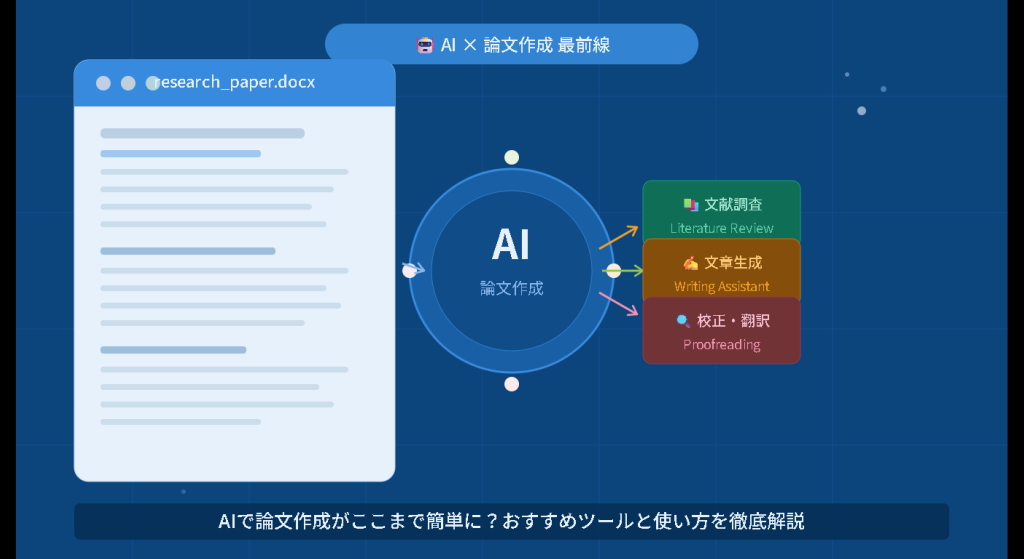
Can AI Make Academic Paper Writing This Easy? Recommended Tools and Practical Use
Recent advances in generative AI and research-support AI have significantly changed academic writing workflows. Literature searching, review of previous studies, paper structure, drafting, English-language editing, and reference management once required large amounts of time; AI can now support organization of many of these tasks more efficiently.
The phrase “AI makes academic paper writing easy” requires caution. AI can simplify information gathering, summarization, organization, expression improvement, and routine work. Researchers themselves remain responsible for assessing the validity of the topic, selecting methods, interpreting data, developing a substantive discussion, verifying citations, and making research-ethics judgments.
The essence of AI use in academic paper writing is therefore not delegating the paper to AI, but increasing the time available for researchers to think.this. The article organizes recommended tools, practical workflows, cautions, and the human verification still required in the AI era.
Introduction | Does AI Really Make Academic Paper Writing Easier?
AI can certainly reduce the burden of academic paper writing. Tasks such as organizing keywords related to a topic, comparing previous studies, creating a preliminary structure, improving English expression, and checking reference-list formatting are often well suited to AI support.
However, AI does not automatically produce an excellent paper. A paper is an intellectual task that must align its question, evidence, methods, results, discussion, and conclusion. Submitting or publishing AI-generated prose unchanged can create problems such as literature errors, logical gaps, mismatches between claims and evidence, and research-ethics concerns.
To simplify academic paper writing with AI, clearly separate stages where AI provides support from stages where humans make the substantive judgments.this distinction is important. AI can shorten tasks, but it cannot take responsibility for the paper.
Tasks AI Can Simplify and Tasks That Must Not Be Oversimplified
Many academic-writing tasks can be made easier with AI. It is particularly useful for information organization, summarization, expression improvement, comparison tables, English-language editing, and checklist creation.
Delegating the core of the research to AI is much riskier. Novelty of the topic, critical review of previous studies, validity of the research method, selection of statistical analysis, interpretation of results, and depth of discussion should remain researcher-led.
| Category | Tasks Well Suited to AI Support | Tasks That Should Remain Human-Led |
|---|---|---|
| Topic Development | Organizing keywords and generating possible research questions | Judging originality and feasibility |
| Literature Review | Paper summaries, comparison tables, and search-term development | Selecting key literature, critical reading, and citation decisions |
| Drafting the Manuscript | Chapter planning, wording adjustment, and English-language editing | Responsibility for claims, logical development, discussion, and conclusions |
| Analysis | Code support, possible graph designs, and organizing candidate methods | Validity of analytical methods, assumptions, and interpretation of results |
| Pre-Submission Review | Checklists, proofreading, and formatting checks | Final judgment on research ethics, citations, institutional rules, and journal requirements |
Break Down the Academic Paper Writing Workflow
When using AI in academic paper writing, it is useful to first break the workflow into stages. Broadly, the process includes topic development, literature search, paper understanding, structural design, drafting, citation management, and pre-submission review.
Different tools are suited to different stages. Combining tools strong in literature search, PDF reading, English-language editing, or research-note management can make the overall workflow smoother.
Recommended AI Tools for Academic Paper Writing
The number of AI tools for academic writing is growing, but the important principle is not to use a famous AI simply because it is famous; choose a tool that fits the purpose. The following sections organize representative tools by stage.
| Tool | Main Use | Recommended Use |
|---|---|---|
| ChatGPT | Structural Design, Drafting, Revision, and Code Support | Use for organizing the research question, developing chapter structure, revising prose, and checking logic |
| Perplexity | AI Search and Background Research | Use for exploring the background, recent developments, and related keywords around a research topic |
| Elicit | Literature Review and Paper Comparison | Compare objectives, methods, results, and limitations across papers |
| NotebookLM | Cross-Document Organization of Local Materials | Load PDFs, research notes, and submission requirements to support issue organization |
| SciSpace | Support for Reading Paper PDFs | Use to understand difficult technical terms, equations, figures, and methodological explanations |
| Paperpal and Grammarly | English-Language Editing and Expression Improvement | Use to check naturalness, grammar, and academic tone in English-language papers |
| Zotero, Notion, and Obsidian | Reference and Research-Note Management | Centralize source information, PDFs, research notes, and progress management |
ChatGPT | General-Purpose AI for Structure, Drafting, and Revision
ChatGPT can support many stages of academic writing, including organizing topics, generating possible titles, chapter planning, reviewing the flow of an Introduction, checking Methods descriptions, organizing Discussion issues, refining English, and drafting possible responses to reviewer comments.
ChatGPT is not infallible. References, statistical results, and specialist factual claims require verification in original sources. Plausible-looking citation information may still refer to nonexistent literature or confuse the content of real sources.
When using ChatGPT for academic paper writing, Do not use it only to generate prose; also use it to identify logical inconsistencies, check whether claims are supported, and identify missing elements in the structure.this approach can be effective.
Perplexity | AI Search for Exploring Background Information Around a Research Topic
Perplexity combines search-engine functions with generative AI. It can support early exploration of the background of a research topic and help identify related research areas, keywords, academic terms, and issues.
For example, natural-language queries such as “research trends on social-media use and loneliness among university students,” “previous studies on turnover intentions among care workers,” or “educational challenges related to AI-report detection” can provide an entry point for further research.
Perplexity should be treated as a discovery tool. Any source cited in the paper should be checked in the original through resources such as Google Scholar, CiNii, J-STAGE, PubMed, Semantic Scholar, or the publisher's website.
Elicit | AI for Reviewing Previous Studies and Creating Comparison Tables
Elicit is suited to literature review. It can help find papers related to a research topic and organize information such as research purpose, methods, participants, results, and limitations in tabular form.
In graduation theses, master's theses, and submitted manuscripts, simply listing previous studies is insufficient. The writer needs to explain what each study established, what remains unresolved, and where the current research is positioned. Elicit can reduce the burden of this comparison and organization.
Any organization produced by Elicit should still be verified in the original literature. Writing the body solely from an AI summary risks misunderstanding research conditions or conclusions.
NotebookLM | AI for Organizing Your Own Paper PDFs Across Sources
NotebookLM is an AI system that can answer questions based on materials uploaded by the user. Providing several paper PDFs, research notes, lecture materials, or submission guidelines can make source-grounded organization easier.
Possible prompts include “organize the similarities and differences across these five papers,” “identify the research gaps,” or “extract the issues most closely related to my research topic.” It can support preparation for literature review and paper structure.
NotebookLM depends on the materials supplied. If the collected literature is biased, the resulting organization will also be biased. Multiple databases should therefore be used during the literature-search stage to reduce the risk of missing important work.
SciSpace | AI Supporting the Reading of Difficult Papers
SciSpace is an AI tool that can support reading paper PDFs. When technical terms, equations, statistical methods, figures, or methodology are difficult to understand, users can select the relevant passage and request a natural-language explanation.
In fields such as science, medicine, psychology and statistics, engineering, and information science, understanding the methods and analysis is a prerequisite for writing. SciSpace can reduce obstacles during close reading.
AI explanations are aids, not authoritative sources. Important concepts, equations, and statistical methods should be checked in the paper itself, supplementary materials, textbooks, or official documentation.
Paperpal and Grammarly | AI for Refining English-Language Academic Writing
English-language papers require not only accurate research content but also readable English. Paperpal and Grammarly may support checks of grammar, usage, redundancy, and academic tone.
However, AI editing can change the substantive meaning. Terms such as causal, associated with, significant, effective, suggest, and indicate must be used carefully according to the study design and statistical results.
English-language editing AI should be understood as It can make English more natural, but it does not guarantee that the research itself is correct. a tool whose output still requires review by an author or expert who understands the research content.
Zotero, Notion, and Obsidian | Tools for Research Management
In academic paper writing, managing literature and research notes can be as important as using AI to generate prose. Zotero is suited to reference management, Notion to progress management, and Obsidian to accumulating research notes and ideas.
Managing bibliographic information in Zotero, writing schedules in Notion, and reading notes and hypotheses in Obsidian can help maintain research reproducibility and consistency. Precisely because this is the AI era, keeping your own research log is important.
A Practical AI-Assisted Academic Writing Workflow
When using AI for paper writing, it is important to use it step by step rather than asking it to write the main text immediately. Here, AI use is organized according to the actual paper-writing process.
Step 1: Organize the Research Topic and Question
The first step is to clarify the research topic. Useful prompts include: “Organize this topic as a research question,” “List the perspectives that should be examined in previous studies,” and “How could this be narrowed into a graduation-thesis topic?”
However, AI-generated topic ideas may not take into account actual data availability, research participants, the research period, the supervisor’s policy, or the expected level for undergraduate or graduate work. Rather than adopting an AI proposal as-is, it must be adjusted into a realistically feasible form.
Step 2: Conduct Literature Search and Review Previous Studies
Next, conduct a literature search. AI can be useful for generating candidate search terms, English keywords, related concepts, and perspectives for reviewing previous studies.
For example, you can ask, “Create search terms for Google Scholar on this research topic,” “List Japanese keywords for searching CiNii,” or “Make a table of the items that should be compared in a review of previous studies.”
A literature review should do more than summarize. It is important to compare research purpose, participants, methods, results, limitations, and remaining issues. Using AI to create a comparison table can make research gaps easier to identify.
Step 3: Develop the Paper Structure and Chapters
Once the literature has been organized, build the paper structure. You can ask AI to “Create a chapter structure in the order Introduction, Previous Studies, Methods, Results, Discussion, and Conclusion,” or “Provide three possible paper structures suited to this research topic.”
When designing chapters, what matters is not simply listing headings but arranging the logic so that it progresses from the research question toward the conclusion. An AI-generated outline should be revised while checking for logical gaps and duplication.
Step 4: Draft and Revise the Body
During drafting, AI can be used to create a rough starting point for a paragraph. However, it is safer and more effective to ask, “Organize the main issue in this paragraph,” “Check whether the claims are supported by the evidence,” or “Identify any leaps in logic,” rather than requesting finished prose from the outset.
The discussion is one area that should not be delegated wholesale to AI. It requires comparing your own findings with previous studies and explaining why the results occurred, what they mean, and what limitations remain. This is where the researcher’s own understanding is tested most strongly.
Step 5: Verify Citations, References, and Sources
One of the most important points when using AI to prepare a paper is citations and references. AI may produce references that do not exist or describe real publications in ways that do not match their content.
Therefore, every citation used in the text must be checked against the original source. Confirm the author, year, paper title, journal, volume and issue, pages, DOI, and URL, and format the citation according to the required style.
Reference-management tools such as Zotero make bibliographies easier to manage. However, bibliographic metadata retrieved by such tools can also contain errors, so a final check remains necessary.
Step 6: Conduct Pre-Submission Checks
Finally, conduct a pre-submission or pre-publication review. You can ask AI to “Identify leaps in logic in this paper,” “Point out passages that may require citations,” “Check whether claims and evidence correspond,” or “Create a pre-submission checklist.”
AI review is only supplementary. Institutional rules, submission guidelines, research ethics, AI-use rules, citation style, word limits, and figure/table requirements must still be checked in the official information issued by the institution or publication venue.
AI Prompt Examples for Academic Paper Writing
When using AI for paper writing, the way instructions are given matters. Instead of saying simply “Write a paper,” specify what you want, under what conditions, at what academic level, and in what format. This produces output that is easier to use appropriately.
Prompt Examples by Purpose
| purpose | Prompt examples | Points to check |
|---|---|---|
| Organizing the research topic | Organize this topic as a graduation-thesis research question by separating the target, method, and question. | Feasibility, originality, and data availability |
| literature search | Suggest 10 Japanese and 10 English search keywords for this research topic. | Coverage of search terms and fit with the discipline |
| Review of previous studies | Put the following paper abstracts into a table organized by purpose, method, results, limitations, and relationship to my own research. | Accuracy of the summary and consistency with the original text |
| Creating the structure | Create a chapter structure for this research topic consisting of Introduction, Previous Studies, Methods, Results, Discussion, and Conclusion. | Consistency between the research question and conclusion, and whether there is duplication |
| Revising the main text | Revise the following passage into natural academic prose and point out any leaps in logic. | Whether the meaning has changed and whether claims are supported |
| Pre-Submission Review | For the following paper, identify insufficient citations, leaps in logic, weak discussion, and unnatural wording. | Validity of the AI’s comments and consistency with submission requirements |
AI Uses to Avoid
Avoid delegating the entire task to AI with a request such as, “Write the whole paper on this topic.” This can make the evidentiary basis of the literature unclear, lead to unnatural research methods, and cause the discussion to drift into generalities.
Also avoid using AI-generated citations without checking the source information, entering unpublished data or personal information into an external AI service, or submitting a manuscript without checking the destination’s rules on AI use.
AI is safer when used AI should not be used instead of thinking; it should be used to organize material that supports thinking.as follows.
Risks and Precautions in AI-Assisted Academic Writing
Using AI for paper writing offers many benefits, but it also involves risks. Particular concerns include fabricated references, miscitation, plagiarism, leakage of personal information, research-ethics violations, and failure to disclose AI use when disclosure is required.
Risks of Fabricated References and Hallucinations
AI can invent references or incorrectly describe the content of real publications. This is known as hallucination, and in paper writing it can become a serious problem.
Bibliographic information produced by AI must always be checked against the original source. Pay particular attention to author names, years, titles, journal names, DOIs, page numbers, and descriptions of research findings. Even if AI produces fluent prose, that does not mean the content is correct.
Research Ethics, AI-Use Disclosure, and Author Responsibility
When AI is used in paper writing, the rules of the institution or publication venue must be checked. Universities, academic societies, and journals may differ in whether AI use is permitted, how it must be disclosed, and how AI-assisted material may be reflected in the manuscript.
AI tools cannot be authors. Human authors remain responsible for the content, citations, data, analysis, discussion, and conclusions of a paper. Even when AI is used, final verification remains the author’s responsibility.
If AI use must be disclosed, it is advisable to be able to explain specifically which tool was used, at what stage, and for what scope. For example, keep separate records for purposes such as English-language editing, summarization, literature organization, figure/table preparation, or assistance with statistical code.
Support Available from iBooks Academic Support
iBooks Academic Support assists with graduation theses, master's theses, doctoral dissertations, MBA papers, submitted manuscripts, and university reports, including topic selection, chapter planning, organization of previous studies, source checking, citation formatting, paper structure, revision, and pre-submission review.
For papers prepared with AI assistance, it is still necessary to check for misalignment with the research purpose, insufficient literature, citation problems, leaps in logic, shallow discussion, and unnatural academic expression. AI-generated prose may look polished while still containing problems in substantive validity or citation accuracy.
Submitted manuscripts and graduate-level papers are evaluated not only on natural expression but also on consistency across the entire study.Specialized review after AI use is an important stage for protecting the reliability of an academic paper..
Summary | Let AI Simplify Support Work While Humans Protect the Paper's Reliability
AI can certainly make many parts of paper writing easier. It can streamline topic organization, literature searching, reviews of previous studies, paper structuring, revision, English editing, reference management, and pre-submission checking.
However, AI makes tasks easier; it does not take over responsibility for the research itself. Formulating the question, checking evidence, selecting methods, interpreting results, deepening the discussion, and citing accurately remain responsibilities for people.
Recommended AI and related tools for paper writing include ChatGPT, Perplexity, Elicit, NotebookLM, SciSpace, Paperpal, Grammarly, Zotero, Notion, and Obsidian. Regardless of the tool used, use AI as an assistant and have a person perform the final verification.proper source attribution is essential.
If you want to check whether an AI-generated paper structure is appropriate, are unsure whether AI-summarized literature has been used correctly, or want citations, logic, and wording reviewed before submission, a specialist review can also be useful. iBooks Academic Support provides support for paper writing in the AI era through source verification, citation formatting, logic checks, and structural review.
Points to Check to Improve the Reliability of This Article
When applying the article “Can AI Make Paper Writing This Easy? A Detailed Guide to Recommended Tools and How to Use Them” to a report, paper, or assignment, do not copy its explanations verbatim. Check the evidence against primary sources, official materials, and academic literature, and reconstruct the content to fit the conditions of your own assignment.
| ConfirmItem | What to Check | How to Use It in a Report |
|---|---|---|
| Accuracy of Information | Check whether the concepts, figures, systems, and cited sources in the text actually exist and are consistent with the latest information. | Add references and footnotes so that the relationship between claims and supporting evidence is clear. |
| Consistency with Assignment Requirements | Check that the work complies with the course topic, word count, required readings, writing style, citation format, and submission format. | Use a structure in which the introduction presents the question, the body develops the evidence, and the conclusion answers the question. |
| Originality / Discussion | Check that the discussion goes beyond general explanation and connects to the course content or your own research question. | Add, in your own words, why you think so and what limitations remain. |
| Transparency About AI Use | Be able to explain what parts involved generative AI, how sources were checked, and whether the text was rewritten. | Treat AI output not as a finished product but as assistance for research, structuring, and revision. |
Reference Materials / Verification Sources
The following are public, academic, and official sources worth checking when using the content of this article in a report or paper. If you cite them, format the citation according to the requirements of the institution where you will submit the work.
- Ministry of Education, Culture, Sports, Science and Technology: “Handling of Generative AI in Teaching and Learning at Universities and Colleges of Technology”: provides basic guidance on handling generative AI in university and college classes, reports, examinations, and related educational settings.
- Agency for Cultural Affairs: “AI and Copyright”: a public source for considering risks involving AI-generated content, copyright, plagiarism, and similar wording.
- OpenAI「A Student's Guide to Writing with ChatGPT」: provides guidance on using ChatGPT as a learning aid and for improving writing.
- Google NotebookLM Official Website: official information on an AI research tool that summarizes and answers questions based on materials provided by the user.
- Elicit Official Website: official information on an AI research-support tool used to search, summarize, and extract information from academic papers.
- Zotero Official Website: official information on a reference-management tool used to collect, organize, cite, and share references.
Related Services / Internal Links
In academic writing, not only appearance but also citations, evidence, logic, and compliance with submission requirements directly affect evaluation. Please review the related pages as well.
AI Report / Paper ConsultationUniversity Report SupportGraduation Thesis / Master's Thesis Writing SupportAcademic Paper and Literature SearchFree Quote / Consultation
FAQ
Can I submit a report generated with generative AI as it is?
Submitting it unchanged is not recommended. Check the rules of your university and course, treat AI output as an outline or draft, verify sources, and reconstruct the content in your own words.
Can references generated by AI be trusted?
It is risky to trust them without verification. AI may produce nonexistent references or incorrect bibliographic details, so confirm both existence and content using sources such as CiNii, J-STAGE, Google Scholar, PubMed, and publisher websites.
What matters if I want to avoid problems or suspicion regarding AI use?
The important point is not to evade AI detection, but to keep records of how AI was used, check applicable rules, verify evidence, connect the writing to course content, and add your own analysis.
Contact
To date, we have supported clients throughout Japan and overseas.over 10,000 casesof academic support requests. Experienced consultants carefully listen to your needs and provide prompt, appropriate support at reasonable fees.
Ibooks members across Japan will support you responsibly.
We send the profile of the responsible staff member when you apply.
When orders are busy, phone lines may be difficult to connect. We will reply in order, so urgent inquiries should be sent by
