![Recommended AI Tools for Report Writing for University and Graduate Students [2026 Edition] | iBooks Academic Support](../../img/logo.png)
Recommended AI Tools for Report Writing for University and Graduate Students [2026 Edition]blog
Recommended AI Tools for Report Writing for University and Graduate Students [2026 Edition]
AI can substantially reduce the time required for report writing by university and graduate students. However, submitting text delegated entirely to AI without revision is risky. What matters is choosing appropriate AI tools for each stage: topic selection, structuring, literature searching, summarization, revision, citation management, and pre-submission checking. This article explains recommended AI tools for report writing as of 2026 and how to use them safely in ways that support academic evaluation.
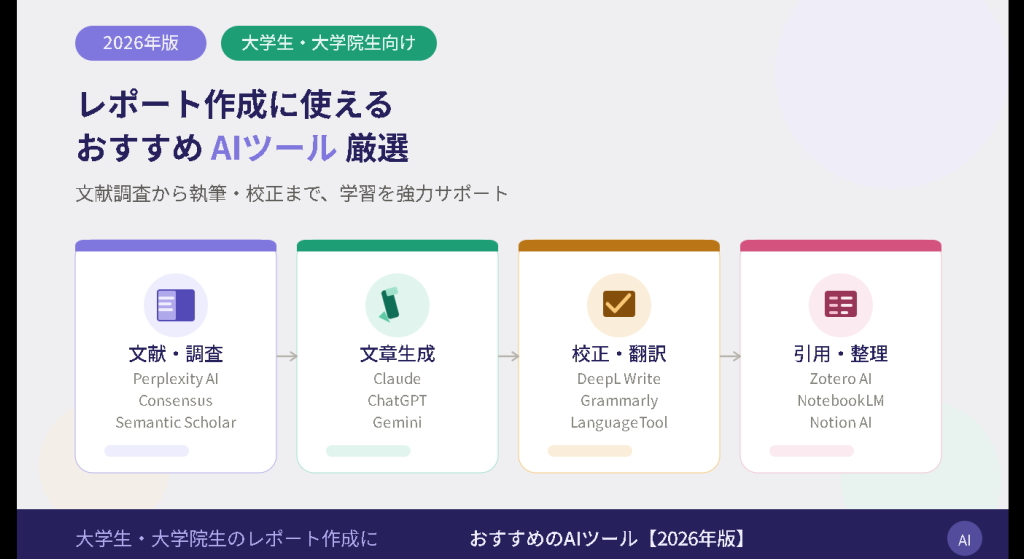
Recommended AI Tools for Report Writing for University and Graduate Students [2026 Edition]
Many students struggle with how much time university report writing takes. Completing one report involves many stages, including choosing a topic, collecting materials, building the structure, organizing citations, drafting, revising, and conducting a final review. Graduate-level work can require even more effort because it may demand engagement with previous studies, theoretical frameworks, methodology, and deeper discussion rather than a simple personal response.
This has drawn attention to AI tools such as ChatGPT, Gemini, Claude, Perplexity, Elicit, NotebookLM, DeepL, Grammarly, Zotero, and Notion AI. Used appropriately, these tools can streamline information gathering, structure development, revision, English-language checking, and reference management.
However, using AI does not automatically lead to a highly evaluated report. University reports are assessed not merely on polished prose but on whether the student’s own question, understanding, and analysis are expressed on the basis of evidence.AI is only an aid to learning and writing; the final judgment and responsibility remain with the student.
Introduction | University Report Support and AI Use in 2026
As of 2026, the source describes AI tools as a practical means for university and graduate students to streamline report writing. A workflow that uses ChatGPT for structure, Gemini or Perplexity for background research, Elicit for literature-review organization, DeepL or Grammarly for English-language checking, and Zotero for reference management has become increasingly familiar to students.
As AI tools have become more widespread, universities have also been developing rules for their use. Some assignments may prohibit AI, while others may require disclosure of how it was used. Before using AI for report writing, students therefore need to check the syllabus, course materials, institutional portal, and instructions from the instructor.
This article not only introduces recommended AI tools for report writing by university and graduate students, but also explains how to use AI while still producing a report that can be properly evaluated.the following points.
Summary of how AI can be used in university reports
The main benefit of AI in university reports is that it can streamline part of the work. Developing an outline, organizing issues, revising prose, checking English expression, and managing references are stages that work well with AI. By contrast, deciding the claim, conducting the discussion, performing final source verification, and making research-ethics judgments remain the student’s responsibility.
| Tasks AI can streamline | Tasks the student should perform personally | Points of caution |
|---|---|---|
| Organizing issues around the topic | Deciding your own position and claim | Do not adopt AI suggestions unchanged |
| Creating an outline and heading options | Revise them to fit the course content and assignment requirements | Do not drift away from the assignment question |
| Summarizing and comparing literature | Read the originals and verify the basis for citations | Watch for fabricated references and inaccurate summaries |
| Revising and rephrasing prose | Rewrite it based on your own understanding | Avoid drifting into generic, formulaic AI-style discussion |
| Checking English and correcting grammar | Verify that the meaning has not changed | Natural English and accurate claims are not the same thing |
University and course rules to check before using AI
Before using AI for a university report, first check the rules of your university and instructor. Some universities prohibit generative AI entirely, some allow it only for tasks such as brainstorming or revision, and some require disclosure of the sections in which it was used. Treatment may also differ by course or assignment within the same university.
Check the syllabus, materials distributed at the beginning of the course, the institutional portal, guidance from academic-affairs offices, and instructions sent by the instructor by email or through the LMS. If the rule is unclear, ask about a specific use, such as whether AI may be used to create an outline, revise prose, or whether its use must be disclosed.
More often than the mere fact that AI was used, the problems arise from using AI without checking the rules, or submitting AI output as though it were your own thinking.the following practices.
Why students are expected to write “in their own words”
The purpose of a university report is not merely to list correct information. It is to understand course content, read the assigned materials, formulate a question, and express your own thinking on the basis of evidence. If AI-generated prose is submitted as-is, the student’s own understanding and thought process can become difficult to see.
Writing “in your own words” does not simply mean paraphrasing. It means connecting concepts addressed in class, assigned readings, lecture content, and your own problem awareness, and explaining why you think as you do. AI prose may look polished but can lack the specific course context and the student’s own perspective.
AI should therefore be used to assist with rough drafts and issue organization, while the final text should be completed on the basis oflanguage you understand, logic you can explain yourself, and evidence you have personally checked.the following.
10 Recommended AI Tools for University and Graduate Students [2026 Edition]
Here, AI and related tools that are easy to use for report writing by university and graduate students are organized by purpose. It is important to consider not only tools that generate prose automatically but also tools for literature searching, PDF reading, translation, English editing, citation management, and research-note management.
| Tool | Best-suited stage | Recommended use in university reports |
|---|---|---|
| ChatGPT | Structuring, prose revision, and issue organization | Topic organization, chapter structure, drafting, revision, and logic checks |
| Gemini | Information gathering and Google integration | Background information, recent information, and Google Docs integration |
| Claude | Long-text organization and logical structure | Longer reports, graduate assignments, and organizing literature notes |
| Perplexity | AI search and source-linked research | Background research on a topic and discovery of related keywords |
| Elicit | Literature Review | Comparing the purposes, methods, results, and limitations of previous studies |
| NotebookLM | Cross-Document Organization of Local Materials | Organizing key points from PDFs, course materials, and assigned readings |
| DeepL | Translation and English expression | Reading English literature and checking wording in English reports |
| Grammarly | English-language editing | Checking grammar, spelling, and tone in English reports |
| Zotero | Reference and citation management | Creating bibliographies, managing PDFs, and managing citation styles |
| Notion AI | Notes and progress management | Managing course notes, materials, and writing schedules |
ChatGPT | A versatile AI for structuring, revision, and learning how to prompt
ChatGPT is one of the most versatile AI tools for report writing by university and graduate students. It can be used for organizing topics, identifying issues, building chapter structures, revising prose, adjusting expression, checking English wording, and conducting pre-submission reviews.
Particularly useful applications include asking, “Create an introduction-body-conclusion outline for this topic,” “Identify leaps in logic in this passage,” or “Revise this wording to suit a university report.” It is generally safer and more effective to use ChatGPT to check the report’s framework and points for improvement rather than simply asking it to write the body text.
However, sources and bibliographic information presented by ChatGPT must always be verified. Fabricated references or incorrect information may be included, so use ChatGPT as an entry point for research and an aid to revision, and perform final source verification yourself.this is important.
Gemini | AI with strengths in information gathering and Google integration
The source describes Gemini as an AI assistant provided by Google with strengths in information gathering and integration with Google services. It can be useful for investigating a report topic’s background, understanding related news or concepts, and working with Google Docs.
Initial research on a university report topic can take considerable time. Gemini can help organize related keywords and background information quickly. The source presents it as particularly useful for topics involving recent developments, such as social issues, economics, education, tourism, welfare, healthcare, and IT.
However, information on the web varies in reliability. Rather than citing Gemini’s output directly, verify it against academic papers, specialist books, government materials, university-library databases, and other reliable sources.
Claude | AI suited to organizing long reports and graduate-level structures
The source describes Claude as an AI suited to reading and organizing long texts and producing careful prose. It can help organize key points across multiple materials, structure longer graduate-level reports or master’s papers, and compare literature notes.
For example, after entering notes from several previous studies, you can ask it to “Organize the common points, differences, and research gaps.” You can also enter a long passage you wrote yourself and ask it to “Check the consistency of the claim” or “Identify duplicated paragraphs.”
Claude’s output is not infallible. Even if it organizes long text neatly, it does not guarantee the accuracy of sources or the validity of research methods. Graduate students still need to reconsider theoretical frameworks and methodology themselves on the basis of the material AI has organized.
Perplexity | Search-oriented AI for quickly understanding a topic’s background
The source describes Perplexity as an AI search tool that combines a search engine with generative AI. It can be convenient for investigating a report topic’s background, related concepts, research trends, and keywords, and often presents information in a concise form in response to natural-language questions.
For example, prompts might include, “Organize the key issues for a university report on Japan’s declining-birthrate policies,” “What are the recent issues surrounding overtourism?” or “List keywords for previous studies on educational inequality.”
Perplexity can be useful as an entry point for research, but a final report should rely on trustworthy sources. Information found through AI search should be traced back to primary materials and academic literature and prepared in a form suitable for citation.
Elicit | AI with strengths in reviewing and comparing previous studies
Elicit is an AI tool designed to assist academic literature searching and review. It can be particularly useful for graduate students and those working on graduation or master’s theses when comparing the purposes, methods, participants, results, and limitations of multiple papers.
A literature-review report must do more than summarize papers; it should show differences among previous studies and their relationship to your own research question. Elicit can help create a preliminary literature-comparison table.
However, information extracted by Elicit must still be checked against the original paper. Misidentifying participants, research methods, analytical procedures, or conclusions can reduce the reliability of the entire report.
NotebookLM | AI for organizing PDFs and course materials across sources
NotebookLM is an AI tool that can interact with uploaded PDFs and other materials. Loading assigned readings, course materials, your own notes, and assignment instructions can make it easier to organize information on the basis of those materials.
University reports often need to be grounded in materials used in class. With NotebookLM, you can ask, “Organize the key concepts in these materials,” “Extract issues that could be used in the report,” or “Show common points across multiple sources.”
However, it cannot fully address information that is absent from the uploaded materials. If the materials are biased or incomplete, the output may also be biased, so additional literature searching may be necessary.
DeepL | Useful for translating English literature and checking English expression
DeepL is a translation and writing-support tool that can help with reading English literature and checking expression in English reports. It can provide a natural Japanese translation as a starting point when reading English papers or overseas literature, reducing the time required for initial comprehension.
Graduate students in particular often need to read more English-language literature. DeepL can help grasp the general meaning of sections such as the Abstract, Introduction, and Discussion. However, technical terminology and statistical expressions may be mistranslated, so important passages should be checked against the original.
When writing an English report, writing-improvement functions such as DeepL Write can also help check grammar, tone, and naturalness. Do not submit the translated or revised output as-is; adjust the wording on the basis of your own understanding.
Grammarly | Strong for grammar and expression checks in English reports
Grammarly is an AI writing-support tool that can help check grammar, spelling, and expression in English reports and abstracts. It can flag areas Japanese speakers often find difficult, such as articles, tense, singular/plural agreement, punctuation, and usage.
Even when the content of an English report is strong, frequent grammar errors can reduce its evaluation. Grammarly can help reduce basic mistakes before submission and improve readability.
However, you do not need to accept every Grammarly suggestion. Use it while checking that the academic meaning has not changed and that your claim has not been weakened.
Zotero | A free tool essential for reference and citation management
Zotero is a reference-management tool for collecting, organizing, annotating, citing, and sharing sources. Accurate citation formatting is important in university reports, graduation theses, master’s theses, and submitted manuscripts. Zotero can help organize bibliographic information and PDFs and make it easier to create reference lists.
Graduate students and students writing graduation theses are especially encouraged to start using Zotero early. If organization is postponed until the number of sources has grown, notes and PDFs with unclear origins can accumulate and increase the risk of citation errors.
However, bibliographic information retrieved by Zotero can also contain errors. Before submission, always check the author, year, title, journal, volume and issue, pages, and DOI.
Notion AI | Centralized management of course notes, materials, and progress
Notion AI is suited to students who want to organize course notes, report structures, literature notes, and deadlines in a single workspace. It can summarize notes, generate heading ideas, and organize tasks within Notion, making it useful for managing report writing.
In university report writing, students may collect many materials and then lose track of where particular information was recorded. Creating a page for each course and keeping assignment requirements, references, lecture notes, outlines, and progress together in Notion can make final checking easier.
AI functions are convenient, but care is needed when entering personal information or unpublished data into Notion. If you handle research data or collaborative-research materials, check your institution’s information-management rules.
By Report Type | How to Choose the Right AI Tool
AI tools should be selected according to the type of report. Argumentative reports, literature reviews, summary reports, English reports, and graduate-level research reports require different kinds of work.
Choosing tools for argumentative reports, literature reviews, English reports, and graduate-level reports
| Report type | Work to prioritize | Recommended AI tools |
|---|---|---|
| Argumentative report | Claims, evidence, structure, and discussion | ChatGPT、Claude、Notion AI |
| Literature-review report | Organizing previous studies, comparison, and research gaps | Elicit、NotebookLM、Zotero |
| Summary report | Understanding materials, extracting key points, and connecting them to course content | NotebookLM、ChatGPT、Claude |
| Englishreport | Translation, grammar, and natural English expression | DeepL、Grammarly、ChatGPT |
| Graduate-level report | Theoretical framework, methodology, and critical review of previous studies | Claude、Elicit、Zotero、NotebookLM |
Recommended workflow for combining multiple AI tools
The most efficient approach is to assign different stages to different tools rather than asking one AI to do everything. For example, you might organize the topic and structure with ChatGPT, investigate background information with Perplexity, compare literature with Elicit, manage citations with Zotero, and check English expression with DeepL or Grammarly.
Clear division of roles makes it easier to use each tool’s strengths. However, using multiple AI systems can also create inconsistencies. If outputs conflict, do not simply compare one AI answer with another; return to primary sources or assigned readings and verify the information there.
How to Use AI Properly for University Report Support
Process matters in AI-assisted report writing. Do not begin by asking AI to “write the report.” First organize your own thinking, use AI as support, and finish the report in your own words.
Step 1: Write down your own claim and key issues first
Before using AI, write down your own thoughts. Clarify what you want to argue about the assignment topic, which concepts from the course you will use, and which literature will provide the evidence.
Without this preparation, delegating the task to AI tends to produce a shallow report filled with generalities. If you already have your own issues and position, you can select among AI suggestions more effectively and improve the quality of the report as a whole.
Step 2: Use AI to check the outline and identify missing issues
Next, ask AI to create an outline. At this stage, the goal is not finished prose but checking the flow of the introduction, body, and conclusion, the issue handled in each paragraph, and the evidence that will be needed.
For example, you might ask, “Create an introduction-body-conclusion outline for this topic as a second-year university report,” or “Organize the issues while also including opposing views and alternative perspectives.” This can broaden the discussion.
Step 3: Organize literature searches, summaries, and possible citation sources
A persuasive report needs references and evidence. AI can help generate search keywords or preliminary summaries, but any source used for citation must be checked personally.
Use resources such as Google Scholar, CiNii, J-STAGE, PubMed, university-library databases, and government materials to check whether a source actually exists, whether its content is accurate, and whether it relates to the assignment topic. Do not accept AI-suggested references without verification.
Step 4: Reconstruct the draft in your own words
An AI-generated draft is material, not a finished product. Before submission, rewrite it on the basis of your own understanding. Check each sentence and remove or revise wording you cannot explain or assertions that lack evidence.
When rewriting in your own words, incorporate course content, assigned readings, and keywords used in class. This helps move beyond generic AI-style discussion.Reconstruct the material from your own understanding rather than merely tracing the AI’s wording.is important.
Step 5: Before submission, check sources, plagiarism, and overly AI-like phrasing
Finally, perform a pre-submission check. Items to review include assignment requirements, word count, citation style, references, typographical errors, logical consistency, AI-use rules, and plagiarism risk.
AI-generated text can be unusually polished while lacking specificity or connection to the course. Before submission, always ask: “Could I explain this passage orally myself?” “Is it grounded in the assigned literature?” and “Does the conclusion answer the question raised in the introduction?”
Example AI Prompts for University and Graduate Students
The quality of AI output changes substantially with the prompt. Instead of saying “Write a report,” specify the purpose, requirements, length, writing style, audience, materials that may be used, and the points you want checked.
Prompt Examples by Purpose
| purpose | Prompt examples | Points to note when using it |
|---|---|---|
| Organizing the topic | For this assignment topic, list five perspectives that could be discussed in a university report and organize the advantages and limitations of each. | Choose the final topic yourself. |
| Creating an outline | For the following topic, create an outline for a 2,000-character report using an Introduction-Body-Conclusion structure. | Revise it to fit the assignment requirements and course content. |
| literature search | For this topic, suggest Japanese and English keywords for searching Google Scholar, CiNii, and J-STAGE. | Always verify personally that the references actually exist. |
| Summary | Summarize the following passage for use in a report by separating its purpose, claim, evidence, and limitations. | Check that the meaning of the original has not changed. |
| Revision | For the following passage, identify leaps in logic, insufficient evidence, and unnatural wording. Do not complete the text for me; show the points that need improvement. | Do not adopt the AI’s revisions unchanged. |
| Pre-Submission Review | For the following report, check the assignment requirements, citations, logical consistency, and whether it contains generic AI-style discussion. | Make the final judgment based on your own assessment and the instructor’s rules. |
AI Uses to Avoid
Avoid delegating everything to AI with a prompt such as, “Write the whole report on this topic,” and then submitting the output unchanged. This tends to produce writing with weak connections to course content, unclear evidence, and little visibility of the student’s own perspective.
Also avoid using references suggested by AI without verification, entering personal information or unpublished data, or using AI without first checking the instructor’s rules.
AI is safer when used not as a tool that writes the report in your place, but as a tool for organizing your own thinking and improving your writing.It should be used
Precautions and Risks in AI-Assisted Report Writing
AI-assisted report writing offers major efficiency benefits. However, misuse can negatively affect academic evaluation, learning outcomes, and research ethics.
Risks of Hallucinations, Fabricated References, and Misinformation
AI may confidently present references that do not exist, incorrect dates, inaccurate statistics, or fabricated author names. This is called hallucination. Because source accuracy directly affects the evaluation of a university report, it is a serious issue.
Verify AI-suggested references through Google Scholar, CiNii, J-STAGE, PubMed, a university-library OPAC, or other appropriate databases. For books, check the author, publication year, publisher, and relevant pages; for papers, check the DOI and journal information.
Why AI-Written Reports Raise Concerns and the Proper Response
Many students wonder whether an AI-generated report will be recognized as such. Writing that raises concern may contain few concrete examples, weak links to course content, overly uniform expression, weak evidence for its claims, unnatural citations, or little sign of the student’s own experience or perspective.
The proper response is not to evade AI detection. Check the university’s rules, disclose AI use when required, rewrite AI output on the basis of your own understanding, verify sources, and connect the report to course content.
checks aimed at making the report academically honest, not measures intended to conceal AI use.It is important to perform
How to Improve the Quality of an AI-Assisted Report
A final review is essential for improving the quality of an AI-assisted report. First, check that the conclusion answers the question presented in the introduction. Next, confirm that the claim and evidence in each paragraph are connected. Then check that passages requiring citations have sources and that the reference list follows the required format.
Reading the report aloud can also help. Unnatural wording, ambiguous sentences, and poorly connected paragraphs are often easier to notice when spoken. If possible, leave some time after finishing and then reread the report with fresh eyes.
AI-generated prose can look polished while containing shallow discussion. Add concepts learned in class and content from assigned readings, and make why you personally reach that conclusion.the following clear to strengthen the report.
Support Available from iBooks Academic Support
iBooks Academic Support provides support for university reports, graduate-level reports, graduation theses, master’s theses, doctoral papers, and submitted manuscripts, including topic development, outline preparation, source verification, citation formatting, revision, and pre-submission review.
For reports prepared with AI assistance, we can also review alignment with the assignment requirements, gaps in the literature, citation problems, leaps in logic, shallow discussion, generic AI-style content, and unnatural wording. AI-generated prose may look polished while still lacking sufficient evidence or originality under university evaluation criteria.
Graduate-level reports and master’s papers in particular are assessed not only on natural writing but also on their theoretical framework, methodology, relationship to previous studies, and depth of discussion.Professional review after using AI is an important step in increasing the reliability and quality of a report..
Summary | Use AI to deepen learning, not to delegate the assignment
Recommended AI and related tools for report writing by university and graduate students include ChatGPT, Gemini, Claude, Perplexity, Elicit, NotebookLM, DeepL, Grammarly, Zotero, and Notion AI. These tools can streamline topic development, structuring, literature searching, summarization, revision, translation, English checking, citation management, and pre-submission review.
However, AI makes work easier; it does not perform the learning itself. What matters in a university report is formulating your own question, reading the evidence, and developing the discussion in your own words. Using AI as a substitute for the assignment can lower the report’s quality and also deprive you of opportunities to develop your own thinking and writing skills.
For report writing in 2026, simply avoiding AI and simply depending on AI are both insufficient.Use AI intelligently, have a person perform the final checks, and finish in your own words.The following is a basic approach expected of university and graduate students going forward.
If you want to check whether an AI-generated report structure is appropriate, revise AI prose into your own words, verify citations and references, or assess whether a report meets graduate-level expectations, professional review before submission can also be useful. iBooks Academic Support supports report writing in the AI era through source verification, citation formatting, logic checks, and structural review.
Points to Check to Improve the Reliability of This Article
When applying the article “Recommended AI Tools for Report Writing for University and Graduate Students [2026 Edition]” to a report, paper, or assignment, do not copy its explanations verbatim. Verify the evidence against primary sources, official materials, and academic literature, and reconstruct the content to fit your own assignment requirements.
| ConfirmItem | What to Check | How to Use It in a Report |
|---|---|---|
| Accuracy of Information | Check whether the concepts, figures, systems, and cited sources in the text actually exist and are consistent with the latest information. | Add references and footnotes so that the relationship between claims and supporting evidence is clear. |
| Consistency with Assignment Requirements | Check that the work complies with the course topic, word count, required readings, writing style, citation format, and submission format. | Use a structure in which the introduction presents the question, the body develops the evidence, and the conclusion answers the question. |
| Originality / Discussion | Check that the discussion goes beyond general explanation and connects to the course content or your own research question. | Add, in your own words, why you think so and what limitations remain. |
| Transparency About AI Use | Be able to explain what parts involved generative AI, how sources were checked, and whether the text was rewritten. | Treat AI output not as a finished product but as assistance for research, structuring, and revision. |
Reference Materials / Verification Sources
The following are public, academic, and official sources worth checking when using the content of this article in a report or paper. If you cite them, format the citation according to the requirements of the institution where you will submit the work.
- Ministry of Education, Culture, Sports, Science and Technology: “Handling of Generative AI in Teaching and Learning at Universities and Colleges of Technology”: provides basic guidance on handling generative AI in university and college classes, reports, examinations, and related educational settings.
- Agency for Cultural Affairs: “AI and Copyright”: a public source for considering risks involving AI-generated content, copyright, plagiarism, and similar wording.
- OpenAI「A Student's Guide to Writing with ChatGPT」: provides guidance on using ChatGPT as a learning aid and for improving writing.
- Google NotebookLM Official Website: official information on an AI research tool that summarizes and answers questions based on materials provided by the user.
- Elicit Official Website: official information on an AI research-support tool used to search, summarize, and extract information from academic papers.
- Zotero Official Website: official information on a reference-management tool used to collect, organize, cite, and share references.
Related Services / Internal Links
In academic writing, not only appearance but also citations, evidence, logic, and compliance with submission requirements directly affect evaluation. Please review the related pages as well.
AI Report / Paper ConsultationUniversity Report SupportGraduation Thesis / Master's Thesis Writing SupportAcademic Paper and Literature SearchFree Quote / Consultation
FAQ
Can I submit a report generated with generative AI as it is?
Submitting it unchanged is not recommended. Check the rules of your university and course, treat AI output as an outline or draft, verify sources, and reconstruct the content in your own words.
Can references generated by AI be trusted?
It is risky to trust them without verification. AI may produce nonexistent references or incorrect bibliographic details, so confirm both existence and content using sources such as CiNii, J-STAGE, Google Scholar, PubMed, and publisher websites.
What matters if I want to avoid problems or suspicion regarding AI use?
The important point is not to evade AI detection, but to keep records of how AI was used, check applicable rules, verify evidence, connect the writing to course content, and add your own analysis.
Contact
To date, we have supported clients throughout Japan and overseas.over 10,000 casesof academic support requests. Experienced consultants carefully listen to your needs and provide prompt, appropriate support at reasonable fees.
Ibooks members across Japan will support you responsibly.
We send the profile of the responsible staff member when you apply.
When orders are busy, phone lines may be difficult to connect. We will reply in order, so urgent inquiries should be sent by
