
10 Recommended AI Tools for Paper Writingblog
10 Recommended AI Tools for Paper Writing
AI paper-writing tools can be powerful aids for graduation theses, master’s theses, doctoral papers, and submitted manuscripts. However, rather than delegating the paper to AI, it is important to choose the right tool for each stage, such as literature searching, review of previous studies, outlining, summarization, revision, English editing, and citation verification. This article compares 10 recommended AI tools that can be used while protecting research ethics and accuracy, and explains how to choose among them by purpose and what precautions to take.
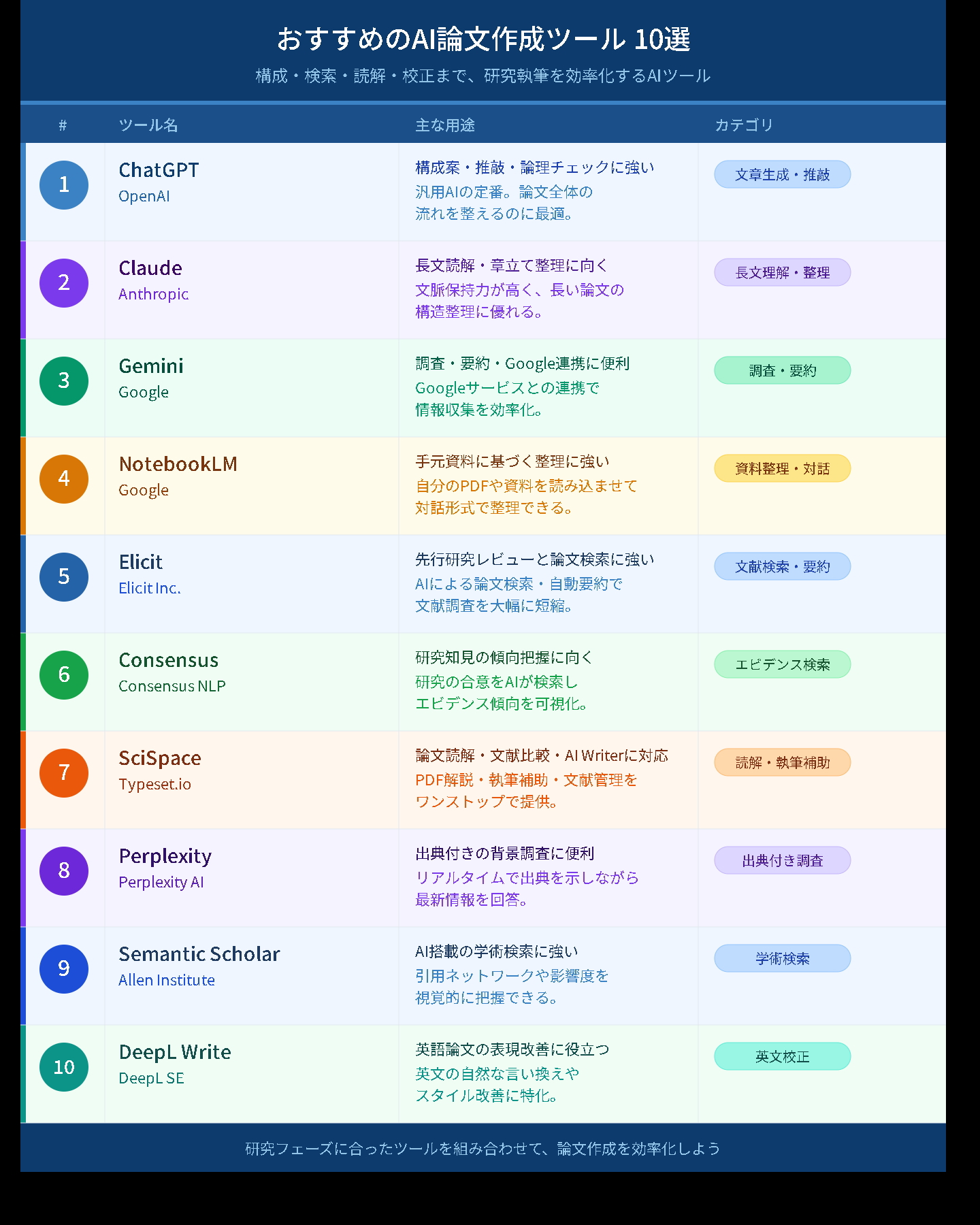
10 Recommended AI Tools for Paper Writing
The spread of generative AI has significantly changed the paper-writing process. In addition to general-purpose AI systems such as ChatGPT, Claude, and Gemini, research-support tools such as NotebookLM, Elicit, Consensus, SciSpace, and Semantic Scholar can now assist with literature searches, summaries, issue organization, structuring, and improvement of English expression.
However, AI paper-writing tools do not automatically complete a valid paper. The researcher remains responsible for the validity of the research topic, careful reading of previous studies, selection of methodology, interpretation of results, originality of the discussion, citation accuracy, and compliance with submission guidelines. Adopting AI output unchanged can lead to fabricated references, miscitation, hallucination, plagiarism, or research-ethics violations.
Accordingly, this article is based on the principle that Do not “have AI write the paper”; use AI to organize research work, while a person takes responsibility for completing it.the following approach should be used when applying the 10 tools to graduation theses, master’s theses, doctoral papers, submitted manuscripts, conference presentations, English papers, and literature-review reports.
What Are AI Paper-Writing Tools?
AI paper-writing tools are a broad category of AI tools that support tasks such as organizing research topics, literature searching, reviewing previous studies, structuring papers, revising prose, improving English expression, and checking possible citations. In recent years, tools have expanded beyond simple text generation to include systems linked with academic-paper databases that assist with summarizing papers, comparing studies, and organizing research gaps.
AI paper-writing tools have different strengths and limitations. ChatGPT and Claude are strong for outlining and prose revision, but care is needed when verifying whether cited sources actually exist. Elicit, Consensus, and SciSpace are suited to literature reviews, but their summaries should never replace checking the original text. NotebookLM is strong for organizing materials you provide, but its answers are limited by the scope of those materials.
Therefore, rather than selecting only one AI paper-writing tool, Use different tools for different stages of the research process.the following is important. Combining tools suited to each stage—literature searching, reading materials, structuring, prose revision, English editing, and citation management—can improve both efficiency and quality.
The main conclusion first
| Purpose | Recommended tools | How to use them |
|---|---|---|
| Paper structure and revision | ChatGPT、Claude、Gemini | Use for checking chapter structure, problem framing, leaps in logic, and wording |
| Organizing your own materials | NotebookLM | Load lecture materials, PDFs, previous studies, and your own notes to organize key points |
| Literature Review | Elicit、Consensus、SciSpace | Use for searching, summarizing, and comparing previous studies and organizing research gaps |
| Academic search | Semantic Scholar、Perplexity | Find related papers and background information, then proceed to verification of the original sources |
| English expression | DeepL Write | Use to improve wording in English papers, abstracts, cover letters, and response letters |
How to Choose AI Paper-Writing Tools
When choosing an AI paper-writing tool, do not select it simply because it is famous or produces natural prose. Paper writing requires consideration of accuracy, source verification, fit with the discipline, long-text processing, PDF reading, citation management, English-language support, and handling of personal information or unpublished data.
A particularly important question is whether the evidence behind an AI answer can be verified. In a paper, claims and evidence must correspond clearly. Even when a tool provides sources, check whether the linked content actually matches the AI summary and whether the methods, participants, and results of the paper have been interpreted correctly.
The required level also differs among graduation theses, master’s theses, doctoral papers, and submitted manuscripts. A graduation thesis may focus mainly on assistance with topic development and organizing previous studies, while a submitted manuscript requires stricter checking of research design, statistical analysis, peer-review responses, submission guidelines, ethics review, figures and tables, and citation style.
Basic Principles for Using AI in Paper Writing
Research ethics is the most important consideration when using AI in paper writing. Do not submit AI output unchanged as your own discussion, cite nonexistent literature, or make definitive claims based on unverified information. Some universities and publication venues may require disclosure of AI use or specification of how it was used.
A safe approach is to position AI as an assistant. Ask AI to generate possible issues, outlines, summaries, revision perspectives, or candidate English expressions, while people make the final decisions and perform source verification, citation, discussion, and conclusion writing.The goal is not merely to polish AI prose, but to ensure that the research can be explained and defended.is important.
10 Recommended AI Tools for Paper Writing
The following sections introduce 10 AI tools that can be useful in practical paper writing. They are organized as candidates for different purposes rather than as a simple ranking.
| Tool | Area of strength | Situations where it is particularly useful |
|---|---|---|
| ChatGPT | Outlining, revision, and logical organization | Improving drafts of graduation theses, master’s theses, and submitted manuscripts |
| Claude | Long-text organization, chapter structure, and natural expression | Checking the logic of long materials or multiple chapters |
| Gemini | Research, summarization, and Google integration | Background research and issue organization |
| NotebookLM | Summarization and question answering based on your own materials | Organizing PDFs, lecture materials, and previous studies |
| Elicit | Academic-paper searching and literature review | Reviewing previous studies and organizing research gaps |
| Consensus | Understanding broad trends in research findings | Overviewing research results related to a specific question |
| SciSpace | Paper reading, literature comparison, and AI Writer support | Reading English papers and creating literature tables |
| Perplexity | AI search with source links | Background research, terminology organization, and checking recent developments |
| Semantic Scholar | AI-assisted academic search | Finding related papers and checking citation relationships |
| DeepL Write | English expression, grammar, and tone adjustment | Improving wording in abstracts, English body text, and peer-review responses |
1. ChatGPT | Strong for outlines, revision, and logic checks
ChatGPT is one of the most versatile AI paper-writing tools. It can be used across many stages, including organizing research topics, preparing a preliminary research background, building chapter structures, shaping an introduction, examining the logic of a discussion, revising prose, and drafting possible responses to peer-review comments.
It is particularly effective when used as an aid to analysis and improvement rather than being asked to generate the paper from a blank page. Examples include: “Organize the issues in this research topic,” “Identify weak points in the problem framing of this introduction,” and “Point out leaps in logic in the discussion.”
One caution is that bibliographic and citation information supplied by ChatGPT can contain errors. Always verify source titles, authors, DOIs, page numbers, and publication years through Google Scholar, CiNii, J-STAGE, PubMed, publisher websites, or other appropriate sources.
2. Claude | Suited to long-text reading and organizing chapter structures
Claude is suited to organizing long materials, checking structures across multiple chapters, and improving natural expression. For documents such as master’s and doctoral papers, where relationships among chapters and overall logical consistency matter, it can be useful as an aid to structural review.
For example, you can ask, “Check the connection from Chapter 1 through Chapter 5,” “Identify whether the research purpose and discussion correspond,” or “Extract places where the same explanation is repeated.” It can also assist with checking the logic of long text and making overly stiff prose easier to read.
However, Claude does not guarantee the validity of the research content. Interpretation within the discipline, the meaning of statistical results, research ethics, and citation style must all be checked by a person.
3. Gemini | Convenient for research, summarization, and Google integration
The source describes Gemini as suited to background research, terminology organization, identifying issues, summarization, and work that benefits from integration with Google-related services. For topics in social science, education, management, tourism, healthcare, IT, and similar fields where recent information or institutional developments matter, it can be used as an entry point for research.
Possible paper-writing uses include asking, “Organize the main issues related to this research topic,” “Suggest Japanese and English search keywords,” or “Organize this passage naturally as research background.”
However, web information varies in reliability. Content obtained through Gemini should be checked against government materials, academic-society materials, academic papers, specialist books, and university-library databases, and replaced with evidence that is academically citable.
4. NotebookLM | Strong for organizing information based on your own materials
NotebookLM is an AI research tool that can summarize and answer questions based on uploaded materials. Loading lecture materials, PDFs, previous studies, notes, questionnaires, and interview records can make it easier to organize information grounded in those materials.
For graduation and master’s theses, you can load assigned readings or previous studies and ask, “Organize the commonalities and differences among these sources,” “Create a table of research purpose, methods, results, and limitations,” or “Organize their relationship to my research topic.”
NotebookLM’s strength is that its responses can be grounded in the materials you provide. However, it depends on the scope of those materials, so incomplete materials can also produce biased answers. Do not use summaries as a substitute for checking the originals.
5. Elicit | Strong for reviewing previous studies and searching papers
Elicit is a research-support tool suited to searching academic papers with AI and organizing summaries, research purposes, methods, and results. It can be useful for reviews of previous studies, initial organization for systematic reviews, and identifying research gaps.
For paper writing, Elicit is suited to tasks such as finding previous studies related to a topic, classifying literature by research method, and creating comparison tables of sample size, participants, key results, and limitations. It can be particularly useful in fields such as medicine, psychology, education, and the social sciences, where organizing previous studies is important.
Elicit’s summaries are convenient, but they do not necessarily capture every nuance of the original paper. Before citing a study, read the paper itself and personally verify the participants, methods, results, and limitations.
6. Consensus | Suited to understanding broad trends in research findings
Consensus is an AI search tool for understanding broad patterns in findings from academic papers related to a specific question. It is suited to questions such as “Is X effective?” or “Are A and B associated?” and can help identify relevant research and obtain an overview of its findings.
At the early stage of a literature review, it can help establish an overall picture of a research area. In fields with accumulated empirical evidence—such as educational effects, psychological scales, medical interventions, health behavior, and organizational behavior—it can serve as an entry point for organizing trends in previous studies.
However, it is risky to draw a conclusion from Consensus alone. A paper’s discussion remains insufficient unless you also examine research design, participants, measurement scales, effect sizes, statistical significance, publication bias, and study limitations.
7. SciSpace | Supports paper reading, literature comparison, and AI Writer functions
SciSpace is a research-support tool with functions for paper searching, PDF reading, literature review, and AI-assisted writing. It can be used to clarify difficult expressions or technical terminology in English papers and to compare multiple sources.
If you find English papers difficult to read, useful prompts include, “Explain the meaning of this paragraph,” “Organize the methods and results of this study,” and “Compare commonalities and differences across these papers.”
Even when using AI-assisted writing functions, do not automatically generate body text and use it unchanged. Revise carefully to fit your own research purpose, methods, and results. Submitted manuscripts also require checking submission guidelines, citation style, ethics rules, and author responsibility.
8. Perplexity | Convenient for source-linked background research
Perplexity combines AI search with generated answers and often provides references with its responses. It is suited to background research, terminology organization, checking institutional or market developments, and obtaining an overview of recent topics.
In paper writing, it can be used to organize recent issues related to a topic, find information from public agencies or research institutions, or check definitions of technical terms. It can be convenient when you need to consult not only academic papers but also white papers, statistical materials, and industry documents.
However, a source presented by Perplexity is not necessarily appropriate for academic citation. Blog posts and news articles may be useful for background explanation but insufficient as core evidence. Where necessary, trace the information back to official materials or peer-reviewed papers.
9. Semantic Scholar | Strong for AI-assisted academic searching
Semantic Scholar is an AI-assisted academic literature-search tool suited to finding related papers, checking citation relationships, and identifying major papers in a field. Used alongside Google Scholar, it can help broaden the search for previous studies.
For paper writing, it can help find later studies that cite a particular paper, locate highly related papers, or expand keywords associated with a research topic. In a literature review, it is useful for expanding from one important paper to related research.
However, search results should not all be given equal weight. Check whether the paper is peer reviewed, the journal in which it appears, its research methods, citation count, publication year, and relevance to your study population before deciding whether it is truly needed for your research.
10. DeepL Write | Useful for improving expression in English papers
DeepL Write is an AI writing-support tool that can help improve English expression, grammar, tone, and word choice. It can be used to refine the Abstract, Introduction, Discussion, Cover Letter, and Response Letter of an English paper.
It is particularly useful for making literal-sounding English more natural, simplifying verbose wording, and considering more academic formulations. It can be effective as a preliminary step before professional English editing to improve text you have written yourself.
However, DeepL Write can change meaning. For statistical results, medical terminology, legal terminology, scale names, and methodological explanations, accuracy of meaning takes priority over stylistic naturalness. Before adopting a revision, check that it matches the intended meaning of the original.
Recommended Tools by Purpose: Comparison
AI paper-writing tools are most effective when selected by purpose. The following table organizes recommended tools and precautions by research stage.
| Research stage | Recommended tools | Points of caution |
|---|---|---|
| Topic Development | ChatGPT、Claude、Gemini | Do not adopt an AI proposal unchanged; check research feasibility and availability of materials |
| Searching previous studies | Elicit、Semantic Scholar、Consensus | Use multiple keywords and multiple databases to reduce missed literature |
| Literature summarization | NotebookLM、SciSpace、Elicit | Do not cite from a summary alone; read and verify the full text |
| Creating the structure | ChatGPT、Claude | Check consistency with assignment requirements, research purpose, methods, and results |
| Revising the main text | ChatGPT、Claude、Gemini | Do not have AI rewrite everything; use it to identify problems |
| English expression | DeepL Write、Grammarly | Check that the meaning has not changed and that technical terminology is correct |
| Background research | Perplexity、Gemini | Connect news and web information to official materials and academic literature |
Practical Workflow for AI-Assisted Paper Writing
When using AI paper-writing tools, it is important to follow the research process rather than generate the body text immediately. The following workflow helps preserve research reliability while using AI as an aid.
Step 1: Organize the Research Topic and Question
First, use ChatGPT, Claude, or Gemini to organize issues, related concepts, and researchable questions. AI-proposed topics may be too broad or lack sufficient materials, so narrow them after checking the population, period, region, method, and availability of sources.
Step 2: Search previous studies
Next, use Elicit, Consensus, Semantic Scholar, or SciSpace to find related papers. Combine English and Japanese keywords and also check Google Scholar, CiNii, J-STAGE, PubMed, university-library databases, and other relevant sources.
Step 3: Create a literature-review table
After reading previous studies, organize their research purpose, participants, methods, results, limitations, and relationship to your own study in a table. NotebookLM, Elicit, or SciSpace can streamline the initial organization, but the final table should always be corrected on the basis of checking the original papers.
Step 4: Build the chapter structure and logical flow
Organize the relationships among research purpose, previous studies, methods, results, discussion, and conclusion. Asking ChatGPT or Claude to check whether the research purpose corresponds to the conclusion and whether there are leaps in logic can help identify structural weaknesses.
Step 5: Have a person write the main text and use AI for checking
The main text should fundamentally be written on the basis of your own understanding. AI can then be asked to identify leaps in logic, insufficient evidence, unnatural wording, duplication, and passages that need citations. It is generally safer to ask for points needing improvement than to have AI rewrite the entire text.
Step 6: Check citations, references, and submission guidelines
Finally, check citation style, the reference list, DOIs, page numbers, figure and table numbering, submission guidelines, ethical requirements, and whether AI use must be disclosed. AI-generated formatting can contain errors, so compare it with the official journal or university requirements.
Prompt Examples You Can Use Directly
To use AI paper-writing tools safely, make the role and scope explicit in the prompt. The following examples are useful for assisting paper writing.
| purpose | Prompt examples | Points of caution |
|---|---|---|
| Organizing the research topic | For the following research topic, list five researchable questions and organize the advantages and difficulties of each. Do not draft the paper; organize the issues only. | Check the availability of materials and research methods yourself. |
| Review of previous studies | Using the following literature notes, create a table organized by research purpose, methods, results, limitations, and relationship to my own study. | Compare the AI summary with the original text. |
| Structure check | For the following chapter structure, identify whether the research purpose corresponds to the conclusion, whether there are leaps in logic, and whether there is duplication. | Do not leave the entire structure to AI. |
| Revising the main text | For the following passage, identify insufficient evidence, generic discussion, weak claims, and passages that require citations. Do not rewrite the entire text. | Maintain your own writing style and claims. |
| English expression | For the following English abstract, improve the wording so that it is natural for an academic paper without changing the meaning. Also explain the changes. | Check technical terminology and the meaning of expressions describing results. |
| peer review response | For the following peer-review comments, organize a response strategy by separating points that should be rebutted, points that should be revised, and points that require additional explanation. | Ensure that the actual revisions match the response letter. |
Precautions When Using AI Paper-Writing Tools
AI paper-writing tools are convenient, but misuse can damage the reliability of a paper. Particular concerns include fabricated references, miscitation, plagiarism, research-ethics violations, entry of confidential information, and content drifting into generalities.
Hallucinations and fabricated references
AI may produce nonexistent paper titles, incorrect author names, fabricated DOIs, or statistical values that do not exist. Particular care is needed when asking AI to generate a reference list. Always verify references against original sources and confirm their existence through publisher websites or appropriate databases.
Plagiarism, copyright, and citation problems
Even AI-generated prose can resemble existing literature or web articles. When using another person’s ideas or data, citations are still required. It is unsafe to assume that AI-generated wording never requires attribution.
Entering unpublished data or personal information
Before entering interview records, patient information, internal corporate materials, or unpublished collaborative-research data into an AI tool, check the terms of use, information-management rules, research ethics, and confidentiality obligations. Even anonymized data may still be restricted by institutional or contractual rules.
AI-use disclosure and submission guidelines
Universities, academic societies, publishers, and journals differ in how they treat generative AI. Some require disclosure, some explicitly state that AI cannot be listed as an author, and some require the scope of AI use to be specified. Always check the latest submission guidelines before submission.
Support Available from iBooks Academic Support
iBooks Academic Support provides assistance with graduation theses, master’s theses, doctoral papers, submitted manuscripts, university reports, MBA papers, and papers in nursing, welfare, education, psychology, management, and healthcare, including topic organization, structural planning, source verification, citation formatting, prose revision, English-expression review, and pre-submission checking.
Even when AI paper-writing tools are used, a person should check whether the writing has become overly generic, whether references actually exist, whether citation style is correct, whether the research purpose corresponds to the conclusion, whether submission guidelines are met, and whether a peer-review response is appropriate.
AI-assisted reviews of previous studies, discussions, abstracts, peer-review responses, and figure/table explanations may look polished while still containing insufficient evidence or overly strong wording when examined by a specialist.Careful human review after AI use is the final step in protecting the reliability of a paper..
Summary | AI is an aid; people retain responsibility for the research
Recommended AI paper-writing tools include ChatGPT, Claude, Gemini, NotebookLM, Elicit, Consensus, SciSpace, Perplexity, Semantic Scholar, and DeepL Write. These tools can assist with literature searches, summarization, structuring, revision, and improvement of English expression.
However, AI paper-writing tools do not take responsibility for the paper in place of the researcher. The validity of the research topic, methodology, interpretation of results, originality of the discussion, citation accuracy, and compliance with ethical rules must all be checked by a person.
What matters in paper writing in the AI era is Use AI to streamline routine work, and use the time saved for human source verification, logic checking, and deeper discussion.the following. Used appropriately, AI can make paper writing not only faster but also easier to check carefully.
If you have used an AI paper-writing tool but are unsure whether the content is correct, want a literature review checked, need AI-assisted prose revised academically, or want wording suitable for a submitted manuscript, you can consult iBooks Academic Support. We support writing for submission through source verification, citation formatting, logic checks, and structural review required in the AI era.
Points to Check to Improve the Reliability of This Article
When applying the article “10 Recommended AI Tools for Paper Writing” to a graduation thesis, master’s thesis, doctoral paper, or submitted manuscript, do not accept the AI explanations uncritically. Check each tool’s official information, the rules of your university or publication venue, and the actual full text of the literature.
| ConfirmItem | What to Check | How to apply this to paper writing |
|---|---|---|
| Official information about the tool | Check features, terms of use, data use, pricing, supported languages, and whether sources are displayed. | Determine whether research data or unpublished materials may be entered. |
| Existence of references | Verify that AI-provided paper titles, author names, DOIs, journals, and publication years actually exist. | Prevent fabricated references and miscitation, and prepare the reference list accurately. |
| Research ethics | Check AI-use rules, disclosure requirements, and author responsibility at the university, academic society, or publication venue. | Keep a record of the scope of AI use and ensure transparency when required. |
| Originality / Discussion | Check that the writing goes beyond generic AI discussion and is connected to your own research purpose, methods, results, and limitations. | Make the research claim and contribution clear rather than stopping at a simple summary. |
References and official information
The following are official, public, and academic-search resources that should be checked when using AI paper-writing tools. Terms and functions may change, so confirm the latest information before actual use.
- OpenAI「A Student's Guide to Writing with ChatGPT」: Official information that can be consulted when considering how to use ChatGPT as an aid for learning and writing.
- Anthropic「Introducing Claude」: Official information describing Claude and features such as text generation and summarization.
- Google Gemini official page: Google’s AI assistant for writing, planning, brainstorming, and related tasks.
- Google NotebookLM official page: An AI research tool for summarization and question answering based on materials you provide.
- Elicit Official Website: An AI research-support tool for searching academic papers, summarizing them, extracting data, and supporting literature reviews.
- Consensus official page: An AI search service for searching peer-reviewed literature and understanding broad patterns in research findings.
- SciSpace official page: A research-support tool with paper searching, literature-review, PDF-reading, and AI Writer functions.
- Perplexity official page: An AI search and answer engine that often provides source-linked responses.
- Semantic Scholar official page: An AI-assisted academic literature-search tool.
- DeepL Write official page: An AI writing-support tool for improving English expression, tone, grammar, and clarity.
- Ministry of Education, Culture, Sports, Science and Technology: “Handling of Generative AI in Teaching and Learning at Universities and Colleges of Technology”: Official information for checking basic considerations regarding generative-AI use in university education.
- Agency for Cultural Affairs: “AI and Copyright”: A public source to consult when considering AI-generated content, copyright, and risks of similar expression.
Related Services / Internal Links
Even when AI paper-writing tools are used, final source verification, citation formatting, logic checking, and compliance with submission guidelines remain necessary. Please also review the related pages.
AI Report / Paper ConsultationUniversity Report SupportGraduation Thesis / Master's Thesis Writing SupportAcademic Paper and Literature SearchStatistical Analysis and Manuscript Submission SupportFree Quote / Consultation
FAQ
Can AI paper-writing tools automatically complete a paper?
No. AI can assist with literature searching, summarization, structuring, revision, and English expression, but people remain responsible for research validity, source verification, interpretation of results, discussion, citations, and compliance with submission guidelines.
Can AI tools be used for graduation or master’s theses?
This depends on the rules of the university, course, and supervisor. Before use, check the syllabus, institutional portal, and supervisor’s instructions, and keep a record of the scope of AI use if necessary.
Can references generated by AI be trusted?
It is risky to accept AI-provided references without verification. Because nonexistent sources or incorrect bibliographic information may be included, check them through Google Scholar, CiNii, J-STAGE, PubMed, publisher websites, university-library databases, or other appropriate sources.
Contact
To date, we have supported clients throughout Japan and overseas.over 10,000 casesof academic support requests. Experienced consultants carefully listen to your needs and provide prompt, appropriate support at reasonable fees.
Ibooks members across Japan will support you responsibly.
We send the profile of the responsible staff member when you apply.
When orders are busy, phone lines may be difficult to connect. We will reply in order, so urgent inquiries should be sent by
