
How to Write an Undergraduate Thesis Plan (Humanities and Sciences) | Complete Guide to Topic Setting, Research Purpose, Methods, and Structureblog
How to Write an Undergraduate Thesis Plan (Humanities and Sciences) | Complete Guide to Topic Setting, Research Purpose, Methods, and Structure
An undergraduate thesis plan is the "blueprint" that can determine the quality of the final thesis. It is not merely a document that states a title; it explains what problem you identify, what you aim to clarify, what materials, data, and methods you will use, and how you intend to organize the study into a paper. This article explains how to write an undergraduate thesis plan in both humanities and science fields, covering topic setting, problem awareness, research purpose, research questions, previous studies, research methods, chapter structure, schedule, references, and pre-submission checks.
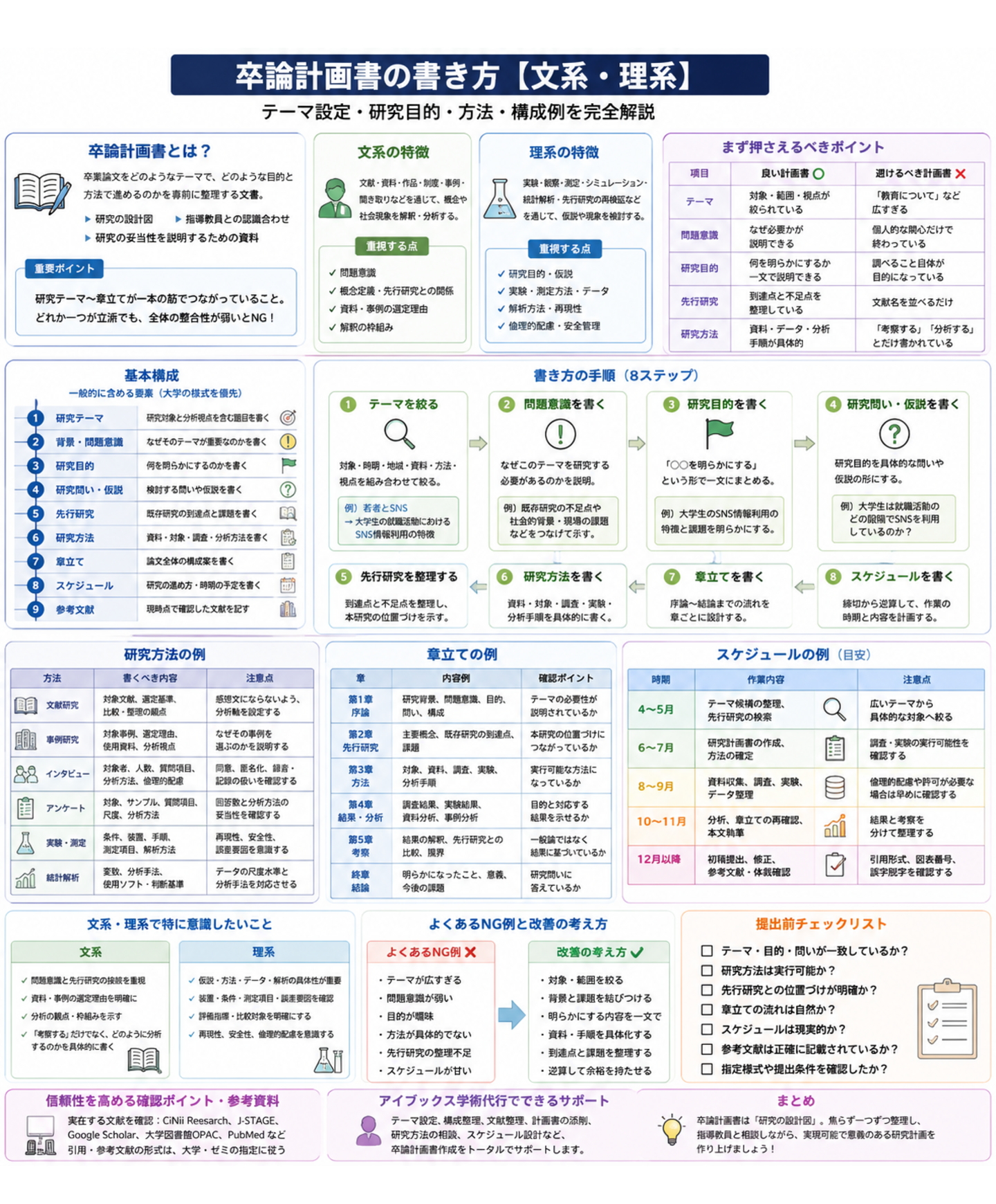
How to Write an Undergraduate Thesis Plan (Humanities and Sciences) | Complete Guide to Topic Setting, Research Purpose, Methods, and Structure
An undergraduate thesis plan is a document that organizes in advance the topic, purpose, and method of the thesis. Depending on the university or seminar, it may be called an "undergraduate thesis plan," "research proposal," "thesis concept paper," or "thesis topic report," but its core role is the same.
What matters in an undergraduate thesis plan is not writing it as if it were a completed manuscript. The important point is: The research topic, problem awareness, research purpose, research questions, previous studies, research methods, and chapter structure should connect along one coherent line.Even if one element is strong, weak consistency across the whole plan can lead a supervisor to comment that "the topic is too broad," "the method is unclear," or "it is not clear what you intend to clarify."
Humanities theses often interpret and analyze concepts or social phenomena through literature, documents, works, institutions, cases, or interviews. Science theses often examine hypotheses or phenomena through experiments, observation, measurement, simulation, statistical analysis, or re-examination of previous studies. In either case, the plan must explain why the research is needed and how it will be conducted.
What is an undergraduate thesis plan?
An undergraduate thesis plan is a document used before full thesis writing begins to confirm the direction of the research. It is not merely a schedule; it is a blueprint for explaining the validity of the study and a document for aligning expectations with the supervisor.
If the initial thesis topic is too broad, problems may arise later: relevant literature may be hard to collect, data may be unobtainable, the discussion may remain generic, or the conclusion may become vague. The planning stage should therefore narrow the target, period, region, materials, analytical perspective, and method.
An undergraduate thesis plan is also something that will be revised as the research develops. It does not need to be perfect at the time of submission, but it should clarify: What is currently known, what remains undecided, and what you will investigate next.what is required.
Key points to understand first
| Item | A strong undergraduate thesis plan | An undergraduate thesis plan to avoid |
|---|---|---|
| Topic | The target, scope, and perspective are sufficiently narrowed. | It is too broad, such as "about education" or "about environmental problems." |
| Problem awareness | It explains why the topic needs to be addressed. | It ends with personal interest alone. |
| research purpose | What the study will clarify can be explained in one sentence. | The act of investigating becomes the purpose itself. |
| previous studies | It organizes what existing research has established and what remains insufficiently examined. | It merely lists source titles without explaining their relationship. |
| Research method | The materials, data, and analytical procedures are specific. | It says only "consider" or "analyze." |
Basic structure of an undergraduate thesis plan
The required format varies by university and seminar, but an undergraduate thesis plan generally includes the research topic, background and problem awareness, research purpose, research question or hypothesis, previous studies, research methods, chapter structure, schedule, and references. If your university provides a required template, always follow that format first.
| Component | What to include | Points to check |
|---|---|---|
| Research topic | Write a title that includes the research target and analytical perspective. | Check that it is not too broad and can be handled within the thesis period. |
| Background and problem awareness | Explain why the topic is important. | Check whether the social background, academic background, or practical problem is explained. |
| research purpose | State what the study aims to clarify. | Check whether it is focused enough to explain in one sentence. |
| Research question or hypothesis | State the question or hypothesis to be examined. | Check whether it can be examined using available materials or data. |
| previous studies | Describe what existing research has established and what issues remain. | Check whether this leads logically to the position of the present study. |
| Research method | Describe the materials, participants or targets, survey, experiment, and analytical method. | Check whether the method is feasible and valid. |
| Chapter structure | Write an outline of the entire thesis. | Check whether the flow from the introduction to the conclusion is natural. |
| Schedule | Write a schedule for literature review, data collection, analysis, writing, and revision. | Check whether the plan works backward from the deadline. |
| reference | List the references that have been verified at the current stage accurately. | Check that author names, years, titles, publishers or journal names, and other bibliographic details are correct. |
Differences in emphasis between humanities and sciences
Humanities and science fields place somewhat different emphasis on thesis plans. In the humanities, important elements include problem awareness, definition of concepts, relationships with previous studies, reasons for selecting materials or cases, and the interpretive framework. In education, sociology, literature, history, law, and management, for example, you need to explain which materials or cases will be examined and from what perspective, in light of previous studies.
In the sciences, important elements include the research purpose, hypotheses, experimental, observational, or measurement methods, data acquisition, analysis, reproducibility, ethical considerations, and safety management. In engineering, information science, life sciences, quantitative psychology, nursing, and medical research, clearly specifying the target, conditions, data, and analytical procedures is necessary to judge whether the study is feasible.
Steps for writing an undergraduate thesis plan
An undergraduate thesis plan is easier to prepare if you divide the work into steps rather than trying to write the entire document at once. The following sections explain the process from narrowing the topic to the final pre-submission check.
1. Narrow the topic
Do not simply use your broad area of interest as the topic. Narrow it by combining the research target, period, region, materials, method, and perspective. For example, "young people and social media" is too broad, whereas "characteristics of social-media information use in university students' job searches" limits the target and context and makes data collection and literature organization easier.
| Topic that is too broad | Example of a narrowed topic | How to narrow it |
|---|---|---|
| Tourism | Challenges of community-based tourism products in regional cities | Limit the region, form of tourism, and specific problem. |
| Educational inequality | The effect of home-learning support on junior-high-school students' career awareness | Limit the target, type of support, and effect examined. |
| Renewable energy | Examination of a power-generation forecasting model for solar-PV deployment | Limit the technology, indicators, and analytical method. |
| Health | Association between sleep duration and perceived stress among university students | Limit the population, variables, and relationship. |
2. Write the problem awareness
The problem-awareness section explains why the topic needs to be researched. Personal interest can be included, but personal interest alone is too weak for an undergraduate thesis plan. Connect social background, academic background, practical problems, and points not sufficiently explained by existing research.
In humanities fields, problem awareness may arise from institutional change, social problems, cultural context, or biases in previous discussions. In science fields, it may arise from limitations of existing methods, measurement accuracy, unexplained phenomena, insufficient data, or implementation problems.
3. Write the research purpose
The research purpose is the central sentence of the entire thesis. Stating it in the form "The purpose of this study is to clarify XX" makes the focus clear. If there are multiple objectives, separate the primary objective from secondary objectives so that the thesis does not lose direction.
| Weak wording | Improved example | What has been improved |
|---|---|---|
| Investigate young people's use of social media. | The purpose of this study is to clarify the characteristics and challenges of social-media information use in university students' job searches. | The target, context, and content to be clarified are specified. |
| Consider sleep. | The purpose of this study is to examine the association between sleep duration and perceived stress among university students using a questionnaire survey. | The variables and method are clear. |
| Study regional revitalization. | The purpose of this study is to identify factors associated with the continuation of event-based regional-revitalization initiatives in local shopping districts through case analysis. | The target, initiative, and analytical method are specified. |
4. Write the research question or hypothesis
A research question turns the research purpose into a specific question. Humanities studies may use questions such as "how," "why," or "what characteristics." Science and quantitative studies may require testable questions or hypotheses such as "Does A affect B?", "Are A and B associated?", or "Does outcome Y change under condition X?"
| research purpose | Examples of research questions and hypotheses | Suitable methods |
|---|---|---|
| Clarify the characteristics of social-media information use in university students' job searches. | At what stages of job searching do university students use social media? | Questionnaire survey, interviews, literature review |
| Clarify factors associated with continuation of event-based initiatives in local shopping districts. | What characteristics of organizational structure are found in shopping-district events that have continued over time? | Case study, interviews, document analysis |
| Examine the association between sleep duration and perceived stress. | Test the hypothesis that students with shorter sleep duration have higher perceived stress. | Questionnaire survey, statistical analysis |
| Examine the relationship between heating conditions and material strength. | Test whether differences in heating temperature produce statistically significant differences in tensile strength. | Experiment, measurement, analysis of variance, etc. |
5. Organize previous studies
The previous-studies section is not simply a place to list references. It should organize what existing research has clarified, what remains insufficiently examined, and where your undergraduate thesis is positioned.
You do not need to complete a full literature review at the planning stage, but you should at least verify literature on the major concepts, relevant previous studies, and research methods. Use CiNii Research, J-STAGE, Google Scholar, university-library OPACs, and, where appropriate, PubMed to confirm that the sources actually exist.
6. Write the research method
The research-method section is one of the most important parts of an undergraduate thesis plan. Do not write only "I will consider" or "I will analyze." Specify what materials or data will be used and the procedure by which they will be analyzed.
| Research method | What to describe | Points of caution |
|---|---|---|
| Literature-based research | Target literature, selection criteria, and perspectives for comparison and organization | Set analytical axes so that the work does not become a personal reflection. |
| Case study | Target case, reason for selection, materials used, and analytical perspective | Explain why the case was selected. |
| Interview study | Participants, number of participants, interview questions, analytical method, and ethical considerations | Check consent, anonymization, and handling of recordings and records. |
| Questionnaire survey | Population, sample, questionnaire items, scales, and analytical method | Check whether the expected number of responses and analytical method are appropriate. |
| Experiment or measurement | Conditions, equipment, procedures, measurement items, and analytical method | Consider reproducibility, safety, and sources of measurement error. |
| statistical analysis | Variables, analytical methods, software, and decision criteria | Match the analytical method to the measurement level of the data. |
7. Write the chapter outline
The chapter outline shows the flow of the undergraduate thesis. Writing it helps you check whether the research purpose, previous studies, methods, results, discussion, and conclusion connect coherently. Humanities theses often follow a structure such as Introduction, Previous Studies, Theoretical Framework, Materials or Case Analysis, Discussion, and Conclusion. Science theses more commonly follow Introduction, Previous Studies, Methods, Results, Discussion, and Conclusion.
| Chapter | Example content | Points to check |
|---|---|---|
| Chapter 1: Introduction | Research background, problem awareness, purpose, questions, and thesis structure | Check whether the need for the topic is explained. |
| Chapter 2: Previous Studies | Major concepts, what existing research has established, and remaining issues | Check whether this leads logically to the position of the present study. |
| Chapter 3: Methods | Participants or target, materials, survey, experiment, and analytical procedures | Check whether the method is feasible. |
| Chapter 4: Results and Analysis | Survey results, experimental results, document analysis, and case analysis | Check whether the results correspond to the research purpose. |
| Chapter 5: Discussion | Interpretation of results, comparison with previous studies, and limitations | Check that the discussion is grounded in the results rather than generic statements. |
| Final Chapter: Conclusion | What was clarified, the significance, and future issues | Check whether the research question is answered. |
8. Write the schedule
The schedule should work backward from the submission deadline and include literature review, finalizing the method, survey or experiment, data organization, analysis, writing, supervisor review, revision, and submission. Because an undergraduate thesis requires time for revision near the end, it is risky to plan to finish the first draft immediately before the deadline.
| Period | Tasks | Points of caution |
|---|---|---|
| April-May | Organize candidate topics and search previous studies. | Narrow a broad area into a specific research target. |
| June-July | Prepare the research proposal and finalize the method. | Check the feasibility of the survey or experiment. |
| August-September | Collect materials, conduct the survey or experiment, and organize data. | If ethical approval or other permission is required, check it early. |
| October-November | Analyze the data, review the chapter structure, and draft the manuscript. | Organize results and discussion separately. |
| December onward | Submit the first draft, revise, and check references and formatting. | Check citation style, figure and table numbering, and typographical errors. |
How to write by field: humanities and sciences
The following points summarize writing considerations that are particularly important in humanities and science fields. In either case, follow any specific requirements set by your university or seminar.
Undergraduate thesis plans in the humanities
In humanities thesis plans, the connection between problem awareness and previous studies is important. In education this may involve problems in schools or policy; in sociology, changes in social phenomena; in literature, interpretive perspectives on texts; in history, the positioning of historical sources; in law, conflicts among case law, institutions, and legal theories; and in management, changes in corporate behavior or market conditions.
In humanities fields, research methods can easily become vague. Writing only "I will read literature and discuss it" is insufficient. Specify which literature will be examined, from what perspective, and how it will be compared. For case studies, clarify why the case was selected, what types of materials will be used, and what analytical axes will be applied.
Undergraduate thesis plans in the sciences
In science thesis plans, specificity of hypotheses, methods, data, and analytical procedures is important. For experiments or measurements, check the equipment, conditions, samples, measurement items, sources of error, and safety management. In information science and engineering, specify the data, algorithms, evaluation metrics, and comparison targets.
Reproducibility is also important in science. At the proposal stage, clarify the conditions, what will be measured, and the criteria used to interpret the results; this creates a clear bridge to the Methods and Results chapters of the final thesis.
Ready-to-use structure template
The following is a basic template for an undergraduate thesis plan. When using it, adapt it to the required university or seminar format, length, and submission conditions.
| 1. Research Topic | This study examines XX as the research target from the perspective of XX in order to investigate XX. |
|---|---|
| 2. Background and Problem Awareness | In recent years, XX has been observed. However, XX has not been sufficiently examined. It is therefore necessary to clarify XX. |
| 3. research purpose | The purpose of this study is to clarify XX. |
| 4. Research Question or Hypothesis | This study asks, "What characteristics does XX have?" For a quantitative study, it tests the hypothesis that "XX affects XX." |
| 5. previous studies | Previous studies have clarified XX. However, an issue remains regarding XX. The present study focuses on this point. |
| 6. Research Method | This study uses XX as materials or data and analyzes them using XX methods. |
| 7. Chapter Structure | Chapter 1 presents the research background, Chapter 2 reviews previous studies, Chapter 3 explains the methods, Chapter 4 presents the analysis, Chapter 5 discusses the findings, and the final chapter presents the conclusion. |
| 8. Schedule | Complete the literature review by Month X, survey or experiment by Month X, analysis by Month X, first draft by Month X, and revisions in Month X. |
| 9. References | Follow the required university or seminar style and accurately list author names, years, titles, publishers or journal names, volume and issue numbers, pages, and other necessary details. |
Common problems in undergraduate thesis plans
Common causes of weak undergraduate thesis plans include an overly broad topic, vague methods, insufficient previous studies, and inconsistency between the research purpose and chapter structure. Checking the following points makes it easier to respond to revision requests from your supervisor.
Typical poor examples
| Poor example | Problem | How to improve it |
|---|---|---|
| The topic is too broad, such as "educational problems in Japan." | The target, scope, and method are unclear. | Limit the target grade level, region, institution, survey method, or similar factors. |
| The research purpose is only "to investigate" or "to consider." | It is unclear what the study will clarify. | Write it as "to clarify XX." |
| The previous-studies section is only a reference list. | The relationship to existing research is not explained. | Describe what has been established, what remains insufficiently examined, and how the present study relates to that gap. |
| The research method says only "analyze." | The materials, data, and procedures are unclear. | Specify the target, data, analytical axes, and procedures. |
| The chapter structure does not correspond to the research purpose. | The overall flow of the paper is unclear. | Check whether each chapter contributes to answering the research question. |
How to improve them
To improve an undergraduate thesis plan, first check whether you can state the research purpose in one sentence. Then confirm, in order, whether there is a research question that examines that purpose, a method capable of answering the question, and materials or data that make the method feasible.
When revising a plan, structural revision is more important than polishing individual sentences. If the purpose is too broad, narrow the topic; if the method is vague, specify the target and data; if previous studies are insufficient, expand the search keywords and locate additional relevant literature.
Pre-submission checklist
| ConfirmItem | Checklist content |
|---|---|
| Required format | Does it comply with the university or seminar's required items, length, and submission format? |
| Topic | Are the target, scope, perspective, and method sufficiently narrowed? |
| Problem awareness | Does the plan include a social or academic background rather than personal interest alone? |
| research purpose | Is it clear what the study aims to clarify? |
| Research question or hypothesis | Check whether it can be examined using available materials or data. |
| previous studies | Are what previous research has established and what remains insufficiently examined clearly organized? |
| Research method | Are the target, materials, data, and analytical procedures specific? |
| Chapter structure | Does the overall flow lead to an answer to the research purpose? |
| reference | Are real sources listed with accurate bibliographic information? |
Support Available from iBooks Academic Support
iBooks Academic Support assists with undergraduate-thesis plans, undergraduate theses, research proposals, reports, master's theses, and submitted manuscripts, including topic setting, organization of problem awareness, clarification of research purpose, development of research questions and hypotheses, organization of previous studies, consideration of research methods, chapter outlining, reference verification, and prose revision.
For undergraduate thesis plans in particular, whether the topic is too broad, whether the research purpose corresponds to the method, whether the research procedure is appropriate for the humanities or sciences, and whether the structure can be clearly explained to the supervisorit is important to verify these points. We can also assist with organization before the first submission, responses to revision instructions from supervisors, restructuring of chapter outlines, and renewed literature searches.
Summary | An undergraduate thesis plan is the blueprint for the entire thesis
The most important principle in writing an undergraduate thesis plan is consistency among the research topic, problem awareness, research purpose, research questions, previous studies, research methods, and chapter structure. In the humanities, clarify how materials, cases, and theoretical frameworks will be used. In the sciences, specify hypotheses, experimental, measurement, and analytical procedures, and how data will be handled.
A plan is not a completed undergraduate thesis manuscript; it is a document that shows the outlook for the research ahead. Even if some points remain undecided at submission, the plan becomes more persuasive if it states what is undecided and how those points will be verified or determined later.
If you are researching how to write an undergraduate thesis plan, do more than fill in a template. Specify the target, method, materials, and analytical perspective for your own research topic. A well-designed plan stabilizes the later process of writing the thesis, consulting the supervisor, and making the final submission.
Points to Check to Improve the Reliability of This Article
When checking how to write an undergraduate thesis plan, do not rely only on generic templates. Always confirm your university, faculty, and seminar's required format, research-ethics requirements, literature-search expectations, and citation style. Because practices vary considerably among universities, the supervisor's instructions should ultimately take priority.
| ConfirmItem | What to Check | How to apply this to an undergraduate thesis plan |
|---|---|---|
| University and seminar requirements | Check the required format, length, deadline, required items, and citation style. | Organize the topic, purpose, method, and references according to the required items. |
| Existence of references | Verify author names, years, titles, publishers or journal names, DOIs, and other bibliographic details. | Cross-check them using CiNii, J-STAGE, Google Scholar, university-library OPACs, and similar sources. |
| Research ethics | Check requirements relating to interviews, questionnaires, personal information, experiments, and safety management. | Reflect participant explanations, consent, anonymization, data management, and similar matters in the methods section. |
| Research feasibility | Check the available time, access to materials, sample size, experimental environment, and analytical skills required. | Work backward from the undergraduate thesis deadline and revise the plan so that it is realistic. |
Reference Materials / Verification Sources
The following are official information sources and research-support tools useful for literature searches, checking legal requirements, managing references, and confirming research-ethics requirements while preparing an undergraduate thesis plan. If you cite them, format them according to the requirements of your submission destination.
- e-Gov Laws and Regulations Search: "Degree Regulations": A basic legal reference point for requirements concerning academic degrees.
- CiNii Research: Can be used to search Japanese academic papers, research data, books, and related information.
- J-STAGE: Can be used to search and view academic papers published by Japanese academic societies and related organizations.
- Google Scholar: Can serve as an entry point for searching academic literature across Japan and overseas.
- PubMed: Can be used for literature searches in medicine, life sciences, nursing, and public health.
- Zotero Official Website: official information on a reference-management tool used to collect, organize, cite, and share references.
Related Services / Internal Links
In an undergraduate thesis plan, evaluation is directly affected by consistency among topic setting, previous studies, research methods, and chapter structure. Review the related pages as well.
Graduation Thesis / Master's Thesis Writing SupportUniversity Report SupportAcademic Paper and Literature SearchMixed-Methods Research / Survey Designstatistical analysisFree Quote / Consultation
FAQ
How long should an undergraduate thesis plan be?
The required length depends on the university, faculty, and seminar. If no length is specified, use enough space to communicate the research topic, problem awareness, purpose, method, chapter structure, and references without significant omissions or unnecessary detail.
Is a hypothesis always required in an undergraduate thesis plan?
Not necessarily. Quantitative and experimental studies often require hypotheses, whereas literature-based, case-study, and qualitative research may be organized primarily around research questions. Follow the supervisor's policy and the needs of the chosen research method.
What should I do if I have few references at the undergraduate thesis planning stage?
Expand the search keywords by separating them into major concepts, related fields, and research methods, and search CiNii, J-STAGE, Google Scholar, university-library OPACs, and similar sources. If very little literature appears, the topic may be too narrow or the search terms may not be appropriate.
Contact
To date, we have supported clients throughout Japan and overseas.over 10,000 casesof academic support requests. Experienced consultants carefully listen to your needs and provide prompt, appropriate support at reasonable fees.
Ibooks members across Japan will support you responsibly.
We send the profile of the responsible staff member when you apply.
When orders are busy, phone lines may be difficult to connect. We will reply in order, so urgent inquiries should be sent by
