
How to Choose an Undergraduate Thesis Topic | For University Students Who Cannot Decide on a Topicblog
How to Choose an Undergraduate Thesis Topic | For University Students Who Cannot Decide on a Topic
Choosing an undergraduate thesis topic requires more than selecting a subject you like. There must be researchable sources, a connection to previous studies, and consistency with the supervisor's expertise and submission requirements. This article explains how students who cannot decide on a topic can turn a broad interest into a viable research topic.
How to Choose an Undergraduate Thesis Topic | For University Students Who Cannot Decide on a Topic
A common reason students cannot decide on a thesis topic is that their interest is too broad. Large themes such as "education," "tourism," "welfare," "social media," or "regional revitalization" are difficult to use as research topics without narrowing the population, period, region, materials, and method.
A good undergraduate thesis topic is not only interesting; relevant materials exist, it can be expressed as a research question, and it is small enough to address within the available time and word count.
Starting point for choosing a topic
Begin by listing your interests, course content that stood out to you, literature discussed in the seminar, and social problems that concern you. Do not use these directly as the final topic; convert them into a question about what you want to clarify.
For example, "I am interested in social media" is too broad. A question such as "How does the use of social-media information in university students' job searches affect decision-making?" is much closer to a researchable thesis topic.
| Area of interest | Direction for turning it into a research topic | Point to check |
|---|---|---|
| Education | Narrow it to learning support, ICT, family environment, or a similar issue. | Are there accessible participants or sources? |
| Tourism | Narrow it by region, period, policy, or visitor group. | Are statistics or cases available? |
| Welfare | Narrow it by institution, service users, support providers, or region. | Pay attention to ethical issues. |
| SNS | Narrow it by purpose of use, population, and effect. | Is a feasible research method available? |
How to narrow the topic
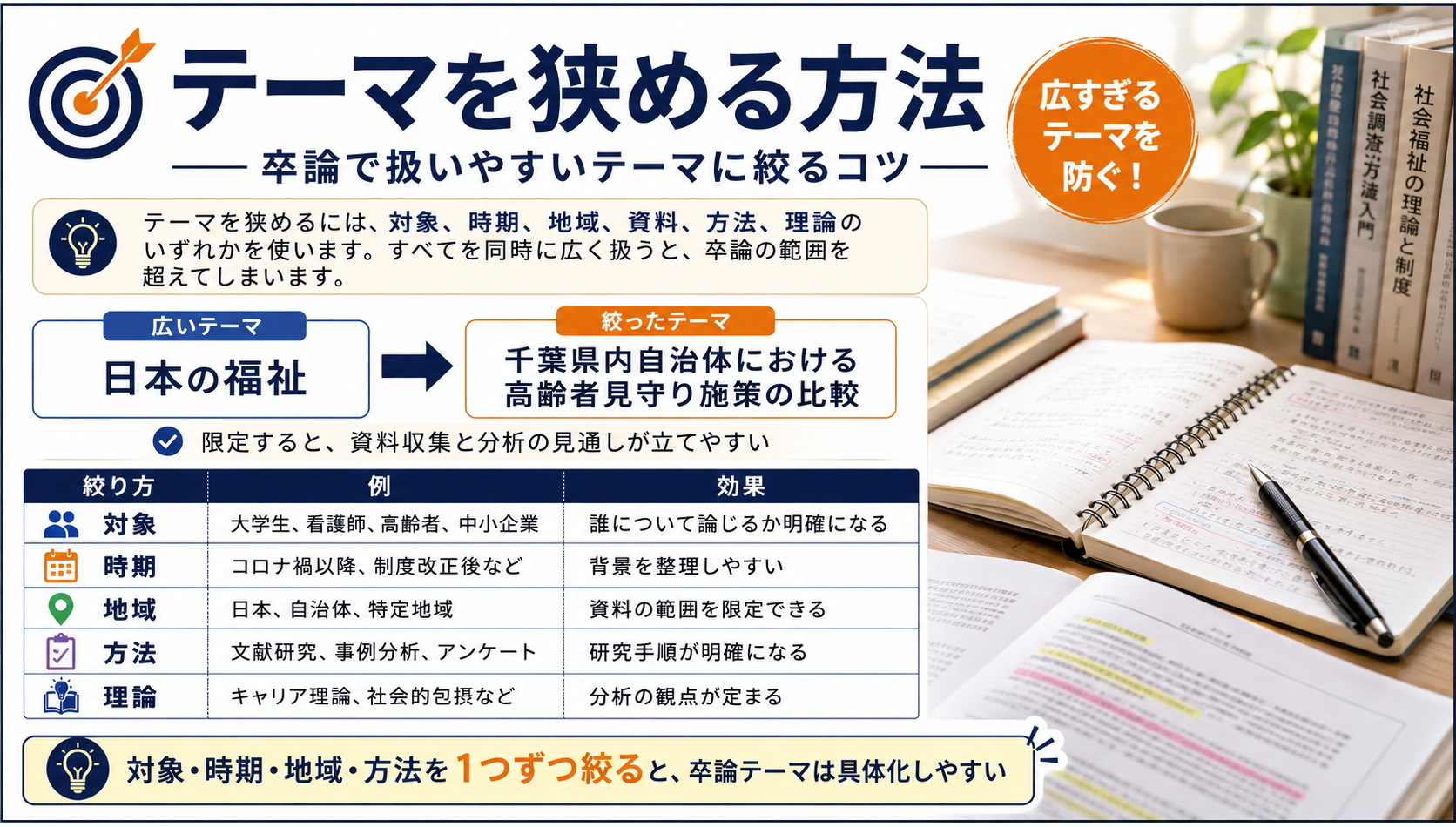
To narrow a topic, use dimensions such as population, period, region, materials, method, or theory. Trying to address all of these broadly at the same time can exceed the scope of an undergraduate thesis.
For example, "welfare in Japan" can be narrowed to "a comparison of elderly-monitoring policies among municipalities in Chiba Prefecture," which gives a clearer outlook for source collection and analysis.
| How to narrow the topic | Example | Effect |
|---|---|---|
| Population or target | University students, nurses, older adults, small and medium-sized enterprises | Clarifies who or what the thesis is about. |
| Period | Since the COVID-19 pandemic, after a policy reform, etc. | Makes the background easier to organize. |
| Region | Japan, a municipality, a specific region | Limits the scope of the source materials. |
| methods | Literature review, case analysis, questionnaire survey | Makes the research procedure clearer. |
| Theory | Career theory, social inclusion, etc. | Defines the analytical perspective. |
Checking research feasibility
Even an interesting topic is difficult to sustain as an undergraduate thesis if there are no sources, data cannot be collected, or the work cannot be completed within the available period. Research feasibility means checking whether the study can actually be carried out in terms of necessary materials, methods, time, and ethics.
If you plan interviews or questionnaires in particular, check early whether participants can be recruited, whether ethics review or informed consent is required, and how personal information will be handled.
| ConfirmItem | What to examine | Points of caution |
|---|---|---|
| Sources | Are papers, statistics, or primary sources available? | A topic for which searches reveal no usable sources is risky. |
| methods | Literature-based research or empirical research | Does the method fit the research question? |
| Time | Can it be completed by the deadline? | Data collection and analysis may require considerable time. |
| Ethics | Does the study involve personal information or burdens on participants? | Confirm this with the supervisor. |
Relationship to previous studies
An undergraduate thesis topic should be connected to previous studies. It does not need to be completely new, but you should identify what existing research has already established and what issues remain.
Reading previous studies helps you identify alternative wording for the topic, theoretical frameworks, research methods, and useful keywords. Before finalizing the topic, check related literature using CiNii Research, Google Scholar, and similar databases.
| ConfirmContent | purpose | Example |
|---|---|---|
| Whether existing research is available | Check whether the topic can be established as academic research. | Are there papers on the same or closely related topic? |
| Research gap | Position your own question in relation to the gap. | Does the population or region differ from previous research? |
| methods | Consider methods that you can actually use. | Literature review, case analysis, survey, etc. |
| Keywords | Expand the search terms. | Japanese terms, English terms, and related words |
Topics to avoid
Topics to avoid include those that are too broad, lack sources, assume the conclusion in advance, end only in value judgments, or require access to participants or data that you cannot obtain.
A topic chosen only because it is currently in the news may also lack sufficient academic literature. Even when studying a new issue, connect it to relevant theories and existing research.
| Example to avoid | Problem | How to revise |
|---|---|---|
| Educational problems in Japan | Too broad | Limit the target and institutional context. |
| Is social media bad? | Likely to become a value judgment | Specify the type of effect and the population. |
| Success factors of a famous company | Available sources may be biased toward promotional information. | Decide which public materials and analytical perspective will be used. |
| A topic no one has ever studied | Difficult to connect with previous studies | Search for adjacent or related research. |
Preparing to consult the supervisor
Before consulting your supervisor, prepare two or three candidate topics rather than only one and organize the research question, target, sources, method, and possible references for each. This makes it easier to receive specific advice.
Instead of asking, "What should I write about?", it is more productive to say, "I would like to analyze XX from the perspective of YY, but I am concerned about the sources and method." This turns the consultation into a concrete research-planning discussion.
| Materials to prepare | Content |
|---|---|
| Candidate topics | Prepare two or three options. |
| Research question | Write in one sentence what you want to clarify. |
| Possible sources | Papers, statistics, cases, and primary sources |
| methods | Literature review, case analysis, survey, etc. |
| Points of uncertainty | Insufficient sources, scope, method, ethical issues, etc. |
Topic-selection checklist
Before finalizing the topic, check whether the question is clear, relevant sources are available, the study can be completed within the available period, and the topic is not far outside the supervisor's field of expertise.
The topic may be refined during the thesis process. It is more important to formulate a viable research question than to create a perfect title from the beginning.
| ConfirmItem | Checklist content |
|---|---|
| Question | Can it be explained in one sentence? |
| Population or target | Is it clear who or what will be studied? |
| Sources | Are previous studies or relevant data available? |
| methods | Can the research procedure be explained? |
| Scope | Does it fit the available word count and schedule? |
Support Available from iBooks Academic Support
iBooks Academic Support assists with organizing candidate undergraduate-thesis topics, searching previous studies, clarifying research questions, developing chapter-outline options, and preparing materials for consultation with supervisors. Please contact us if the topic is too broad, sources cannot be found, or the research method remains undecided.
Summary | Turn your interest into a researchable undergraduate-thesis question
An undergraduate thesis topic should not be chosen on interest alone. It should be decided in light of previous studies, available sources, feasible methods, time, and the available supervisory structure. Narrow a broad interest by population or target, period, region, and method, and convert it into a researchable question.
If you cannot decide on a topic, it is useful to prepare several candidates, conduct a literature search, and consult your supervisor with specific questions.
Points to Check to Improve the Reliability of This Article
This article organizes principles of academic writing, citation and reference checks, and pre-submission review that apply to both university reports and undergraduate theses. For actual submission, always give top priority to the required format of your university, course instructor, seminar, faculty or graduate school, or target journal or university bulletin.
| ConfirmItem | What to Check | How to apply this in the main text |
|---|---|---|
| Submission requirements | Check the word count, format, citation method, submission-file format, and deadline. | Make the main-text structure, notes, references, and figure and table numbering consistent. |
| Supporting sources | Distinguish course materials, assigned textbooks, academic papers, official materials, and primary sources. | Make the relationship between claims and evidence explicit. |
| Citations and references | Verify author names, publication years, titles, publishers, journal names, volume and issue numbers, pages, URLs, and other required information. | Avoid plagiarism and incomplete sourcing and improve reliability. |
| Pre-Submission Review | Check typographical errors, logical leaps, duplicate headings, and omissions from the reference list. | Bring the report to a level of completeness that is clear to the reader. |
Reference Materials / Verification Sources
When verifying literature and formatting, do not rely solely on search-result snippets. Check real academic databases, university libraries, publishers, and primary information from government agencies and other authoritative bodies.
- CiNii Research: Can be used to search Japanese academic papers, books, research data, and related materials.
- J-STAGE: Can be used to search and view academic papers published by Japanese academic societies and related organizations.
- Google Scholar: Can serve as an entry point for searching academic literature across Japan and overseas.
- National Diet Library Search: Can be used to check holdings information for books, journals, doctoral dissertations, and related materials.
Related Services / Internal Links
In reports and undergraduate theses, evaluation can be affected by the quality of the structure, previous studies, citations, references, discussion, and pre-submission checks. Review the related pages as well.
University Report SupportGraduation Thesis / Master's Thesis Writing SupportAcademic Paper and Literature SearchAI Report / Paper ConsultationFree Quote / Consultation
FAQ
I cannot decide on an undergraduate thesis topic at all. Where should I begin?
List course content that interested you, seminar readings, and social issues you care about, then convert them into a question about what you want to clarify.
Should I avoid topics with few previous studies?
Not necessarily, but an undergraduate thesis still needs a connection to previous studies. Search adjacent fields and related concepts for relevant literature.
Can I change my undergraduate thesis topic partway through?
This depends on the university or seminar schedule. Major changes can create a large workload, so consult your supervisor as early as possible.
What makes a good undergraduate thesis topic?
A clear question, available sources, an explainable method, and a scope that can be handled within the available time.
Contact
To date, we have supported clients throughout Japan and overseas.over 10,000 casesof academic support requests. Experienced consultants carefully listen to your needs and provide prompt, appropriate support at reasonable fees.
Ibooks members across Japan will support you responsibly.
We send the profile of the responsible staff member when you apply.
When orders are busy, phone lines may be difficult to connect. We will reply in order, so urgent inquiries should be sent by
