
How to Write an Undergraduate Thesis | From Topic Setting to Previous Studies and Chapter Structureblog
How to Write an Undergraduate Thesis | From Topic Setting to Previous Studies and Chapter Structure
An undergraduate thesis is longer than an ordinary report and requires consistency among topic setting, previous studies, research methods, analysis, discussion, and conclusion. Rather than writing in the order ideas occur to you, it is important to design the thesis backward from the research question. This article explains the basic process step by step.
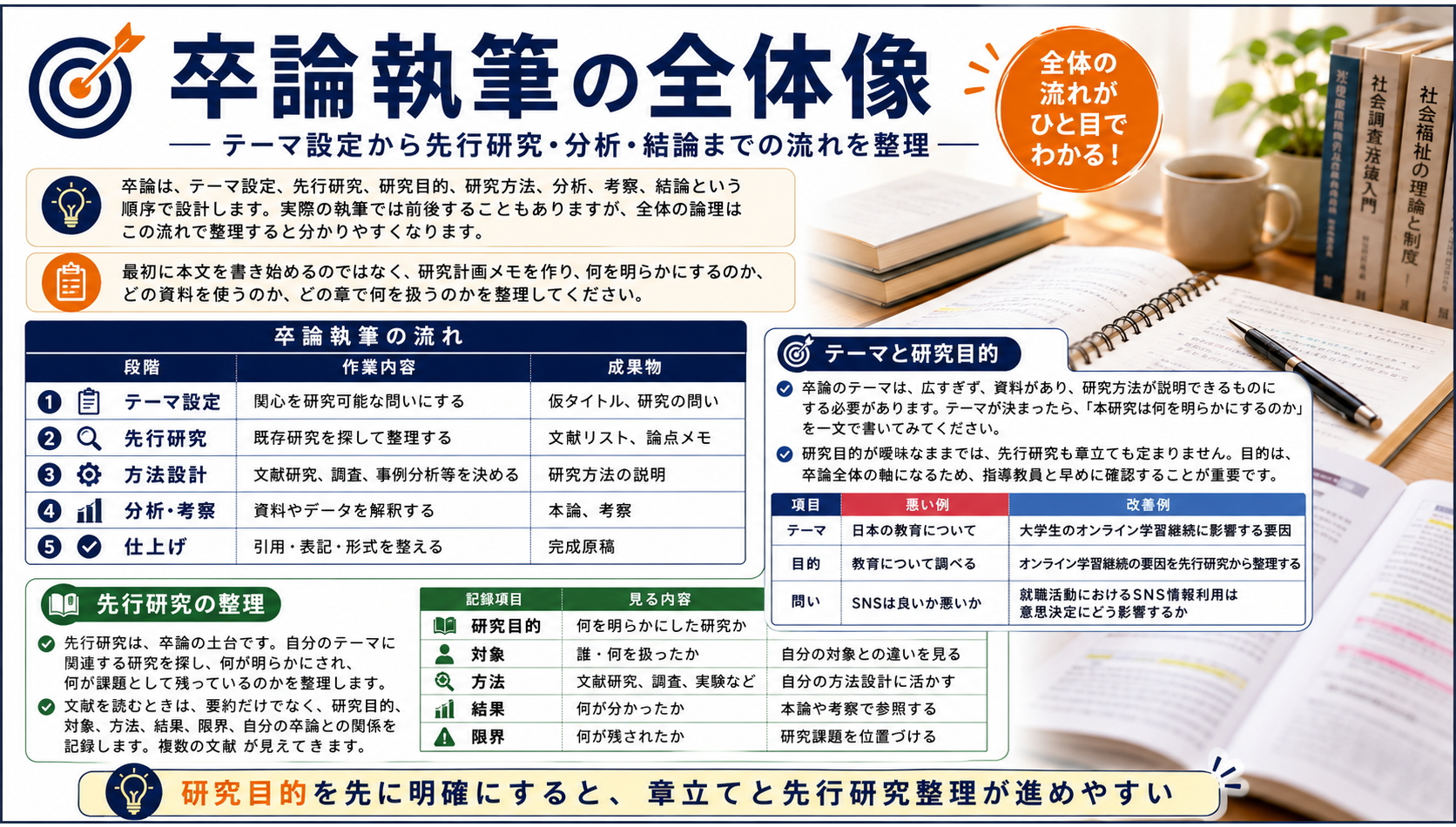
How to Write an Undergraduate Thesis | From Topic Setting to Previous Studies and Chapter Structure
An undergraduate thesis is often positioned as the culmination of university study and is more than simply a long report. You are expected to set your own topic, review previous studies, analyze materials or data, and present a discussion and conclusion.
A common difficulty is that the topic, previous studies, method, and chapter structure start moving in different directions. Creating an overall design at the beginning reduces uncertainty during drafting.
Overview of the undergraduate thesis process
An undergraduate thesis can be designed in the sequence of topic setting, previous studies, research purpose, research methods, analysis, discussion, and conclusion. The actual writing order may differ, but organizing the logic in this sequence makes the overall study easier to understand.
Do not begin by writing the full body. First prepare a research-planning memo that states what you aim to clarify, which sources you will use, and what each chapter will address.
| Stage | Tasks | Output |
|---|---|---|
| Topic Development | Turn an interest into a researchable question. | Provisional title and research question |
| previous studies | Find and organize existing research. | Literature list and issue notes |
| Method design | Decide on literature-based research, survey, case analysis, or another method. | Description of the research method |
| Analysis and discussion | Interpret the materials or data. | Main analysis and discussion sections |
| Finalization | Standardize citations, notation, and formatting. | Completed manuscript |
Topic and research purpose
An undergraduate thesis topic should not be too broad, should have accessible sources, and should permit a research method that can be clearly explained. Once you have a topic, try writing one sentence that answers, "What will this study clarify?"
If the research purpose remains vague, neither the previous-studies section nor the chapter structure will settle into place. Because the purpose is the central axis of the thesis, confirm it with the supervisor early.
| Item | Weak example | Improved example |
|---|---|---|
| Topic | Education in Japan | Factors affecting university students' continuation of online learning |
| purpose | Investigate education. | Organize factors affecting continuation of online learning using previous studies. |
| Question | Is social media good or bad? | How does the use of social-media information in job searching affect decision-making? |
Organizing previous studies
Previous studies form the foundation of an undergraduate thesis. Find research related to your topic and organize what has been clarified and what issues remain.
When reading literature, record not only a summary but also the research purpose, population or target, method, results, limitations, and relationship to your own thesis. Comparing multiple sources helps reveal the development of the research field.
| Item to record | What to examine | How to use it |
|---|---|---|
| research purpose | What did the study aim to clarify? | Compare it with your own purpose. |
| Population or target | Who or what did it study? | Identify differences from your own target. |
| methods | Literature review, survey, experiment, etc. | Use it when designing your own method. |
| results | What did the study find? | Refer to it in the body and discussion. |
| Limitation | What issues remained? | Position your research question in relation to them. |
Research methods and chapter structure
The research method must fit the research purpose. Check whether the question can be answered through a literature review or whether a questionnaire, interview, case analysis, or other method is needed.
Create the chapter structure so that the research purpose, previous studies, methods, results, discussion, and conclusion connect naturally. Order the chapters so that the reader can follow the research process.
| Chapter | Main content | Points of caution |
|---|---|---|
| Chapter 1: Introduction | Background, purpose, question, and structure | Do not allow the topic to become too broad. |
| Chapter 2: Previous Studies | Organization of existing research | Show the issues, not summaries alone. |
| Chapter 3: Methods | Materials, participants or target, and analytical method | Explain why the method is appropriate. |
| Chapter 4: Analysis | Results from materials or data | Ensure that figures and tables correspond to the text. |
| Chapter 5: Discussion and Conclusion | Answer to the question, limitations, and future issues | Make them correspond to the research purpose. |
How to proceed with drafting
You do not need to write an undergraduate thesis perfectly from Chapter 1 onward. It can be effective to draft sections that are ready—such as previous-study notes, methods, or analytical results—and adjust the introduction and conclusion later.
Regardless of writing order, make the purpose of each chapter clear. At the beginning of each chapter, state what it addresses, and at the end summarize what was established; this improves readability.
| Task | How to proceed | Points of caution |
|---|---|---|
| Literature notes | Record key points for each source. | Keep the quotation location and page number. |
| Draft by chapter | Write each chapter with a defined purpose. | Avoid repeating the same content across chapters. |
| Create figures and tables. | Organize the analytical results. | State the source or method of creation. |
| Revision | Check the connections among chapters. | Make the introduction and conclusion correspond. |
Pre-submission checks
Before submitting an undergraduate thesis, check both content consistency and formatting. Verify that the research purpose corresponds to the conclusion, previous studies are actually used in the text, and no references are missing from the bibliography.
Also check formal details such as typographical errors, figure and table numbers, notes, page numbers, table of contents, cover page, and file name.
| ConfirmItem | Checklist content |
|---|---|
| Purpose and conclusion | Does the conclusion answer the research purpose? |
| previous studies | Does the thesis show the relationship between previous research and your own study? |
| methods | Does it explain the target, sources, and analytical procedures? |
| quotation | Do in-text citations match the reference list? |
| Format | Have you checked the table of contents, page numbers, cover page, and figure and table numbering? |
Support Available from iBooks Academic Support
iBooks Academic Support assists with organizing thesis topics, searching previous studies, developing chapter structures, checking consistency between research purpose and methods, revising the manuscript, formatting citations and references, and conducting pre-submission checks. We can also assist with responding to supervisor revisions or restructuring the thesis after an interim presentation.
Summary | Write an undergraduate thesis backward from the research question
An undergraduate thesis is not an exercise in filling a long document. It is the process of answering a research question through previous studies, methods, analysis, and discussion. Design the topic, purpose, method, and chapter structure as an integrated whole.
During drafting, keep literature notes, clarify the role of each chapter, and finally check the overall consistency and formatting.
Points to Check to Improve the Reliability of This Article
This article organizes principles of academic writing, citation and reference checks, and pre-submission review that apply to both university reports and undergraduate theses. For actual submission, always give top priority to the required format of your university, course instructor, seminar, faculty or graduate school, or target journal or university bulletin.
| ConfirmItem | What to Check | How to apply this in the main text |
|---|---|---|
| Submission requirements | Check the word count, format, citation method, submission-file format, and deadline. | Make the main-text structure, notes, references, and figure and table numbering consistent. |
| Supporting sources | Distinguish course materials, assigned textbooks, academic papers, official materials, and primary sources. | Make the relationship between claims and evidence explicit. |
| Citations and references | Verify author names, publication years, titles, publishers, journal names, volume and issue numbers, pages, URLs, and other required information. | Avoid plagiarism and incomplete sourcing and improve reliability. |
| Pre-Submission Review | Check typographical errors, logical leaps, duplicate headings, and omissions from the reference list. | Bring the report to a level of completeness that is clear to the reader. |
Reference Materials / Verification Sources
When verifying literature and formatting, do not rely solely on search-result snippets. Check real academic databases, university libraries, publishers, and primary information from government agencies and other authoritative bodies.
- CiNii Research: Can be used to search Japanese academic papers, books, research data, and related materials.
- J-STAGE: Can be used to search and view academic papers published by Japanese academic societies and related organizations.
- Google Scholar: Can serve as an entry point for searching academic literature across Japan and overseas.
- National Diet Library Search: Can be used to check holdings information for books, journals, doctoral dissertations, and related materials.
Related Services / Internal Links
In reports and undergraduate theses, evaluation can be affected by the quality of the structure, previous studies, citations, references, discussion, and pre-submission checks. Review the related pages as well.
University Report SupportGraduation Thesis / Master's Thesis Writing SupportAcademic Paper and Literature SearchAI Report / Paper ConsultationFree Quote / Consultation
FAQ
Where should I start when writing an undergraduate thesis?
First organize the research topic and question and search for previous studies. Before writing the body, determine the research purpose, method, and chapter structure.
How should I create the chapter structure of an undergraduate thesis?
A common structure is Introduction, Previous Studies, Methods, Analysis or Results, Discussion, and Conclusion. However, always give priority to the conventions of your field and your supervisor's instructions.
How many previous studies are needed for an undergraduate thesis?
The number varies by field and university. What matters is not quantity alone but your ability to explain how each source relates to the research purpose.
What should be included in the conclusion of an undergraduate thesis?
Concisely summarize the answer to the research purpose, what was clarified, the limitations, and future issues.
Contact
To date, we have supported clients throughout Japan and overseas.over 10,000 casesof academic support requests. Experienced consultants carefully listen to your needs and provide prompt, appropriate support at reasonable fees.
Ibooks members across Japan will support you responsibly.
We send the profile of the responsible staff member when you apply.
When orders are busy, phone lines may be difficult to connect. We will reply in order, so urgent inquiries should be sent by
