
How to Find Previous Studies | Using Google Scholar and CiNiiblog
How to Find Previous Studies | Using Google Scholar and CiNii
When searching for previous studies, it is important to use academic-paper databases rather than ordinary search engines alone. Using Google Scholar, CiNii Research, J-STAGE, and university libraries for different purposes can make it easier to find literature suitable for undergraduate theses and reports. This article explains everything from keyword design to source recording.
How to Find Previous Studies | Using Google Scholar and CiNii
Previous studies are important evidence for undergraduate theses and reports. Ordinary internet searches often return explanatory articles and blogs, making it difficult to reach academic papers.
To find academic literature, use Google Scholar, CiNii Research, J-STAGE, university-library OPACs, and similar tools while broadening or narrowing keywords as needed.
Main tools for searching previous studies
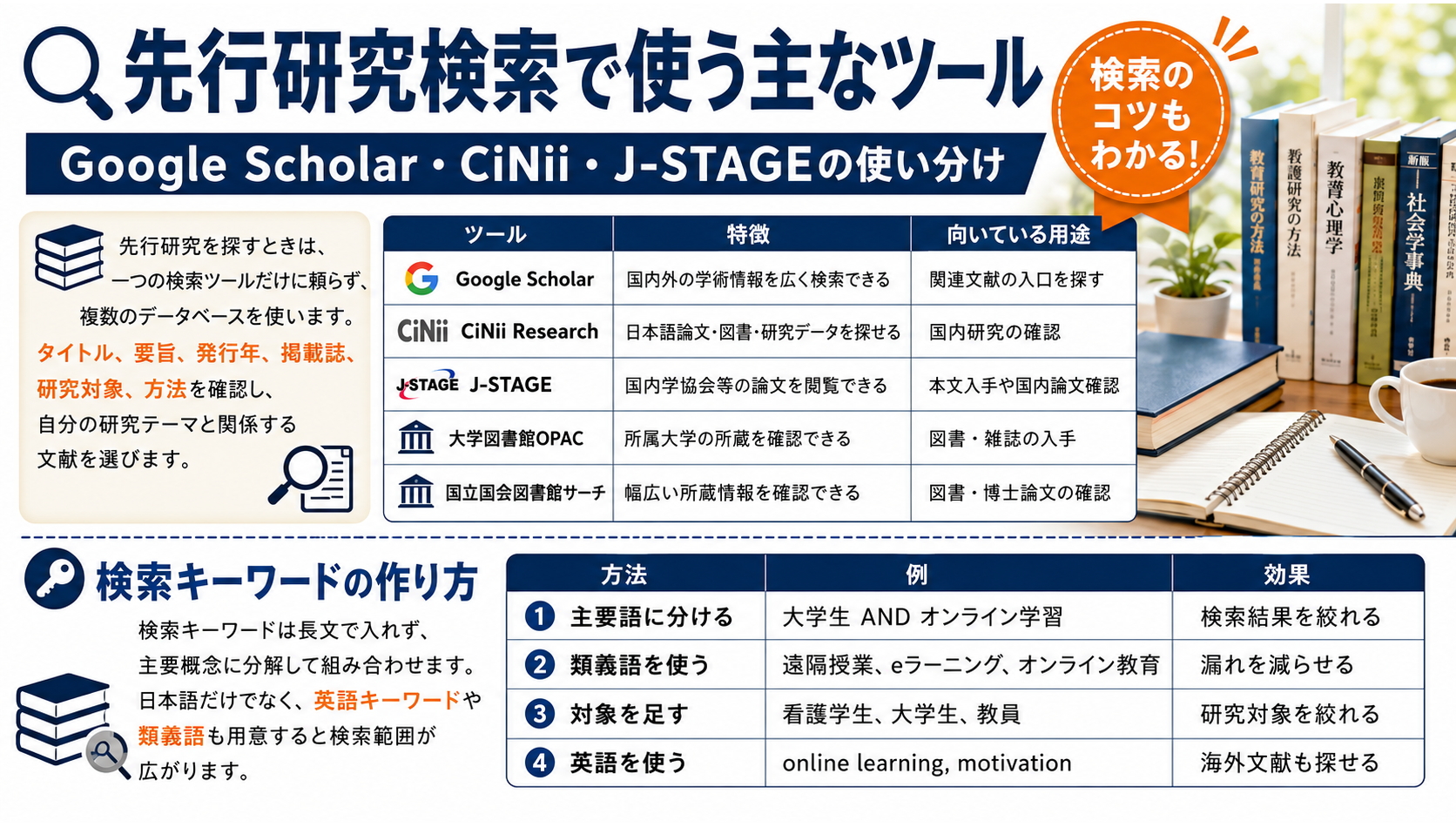
Do not rely on a single search tool when looking for previous studies. CiNii Research and J-STAGE are useful for Japanese papers, Google Scholar for broad domestic and international searches, and university libraries or National Diet Library Search for books and doctoral dissertations.
Not every source returned in search results is appropriate. Check the title, abstract, publication year, journal, research target, and method, then select sources that relate to your research topic.
| Tool | Feature | Suitable uses |
|---|---|---|
| Google Scholar | Can broadly search academic information in Japan and overseas | Useful for finding an entry point to related literature |
| CiNii Research | Can search Japanese papers, books, and research data | Useful for checking domestic research |
| J-STAGE | Can view papers from Japanese academic societies and related organizations | Useful for obtaining full text and checking domestic papers |
| University-library OPAC | Can check holdings at your university | Useful for obtaining books and journals |
| National Diet Library Search | Can check a wide range of holdings information | Useful for checking books and doctoral dissertations |
How to design search keywords
Do not enter the entire research topic as one long search string. Break it into key concepts and combine them. For example, "factors affecting university students' continuation of online learning" can be divided into "university students," "online learning," "continuation," and "motivation."
Preparing English keywords in addition to Japanese broadens the search range. Organizing synonyms, broader concepts, and narrower concepts also makes related literature easier to find.
| methods | Example | Effect |
|---|---|---|
| Break the topic into key terms. | university students AND online learning | This narrows the search results. |
| Use synonyms. | remote instruction, e-learning, online education | This reduces omissions. |
| Add the target population. | nursing students, university students, teachers | This narrows the research population. |
| Use English terms. | online learning, motivation | This also allows you to search international literature. |
How to select literature
When selecting literature from search results, do not judge by the title alone. Read the abstract and check the target, method, results, and relationship to your topic.
Older literature is not automatically poor. Theories and classic studies may remain important even when old. For topics involving institutions, technology, or changing social conditions, however, newer sources should also be checked.
| ConfirmItem | What to examine | Selection criterion |
|---|---|---|
| Relevance | Does it relate to your research question? | Check the title, abstract, and keywords. |
| Reliability | Is it published in an academic journal, academic-society publication, university bulletin, or similar venue? | Check the publisher or issuing body. |
| Recency | Consider the publication year in light of the topic. | For institutional and technology-related topics, also check recent sources. |
| Accessibility | Can you read the full text? | Check PDF availability, library access, or interlibrary loan. |
How to record literature
Record literature you find even if you are not yet sure whether it will be used. Create a list containing the title, author, publication year, journal, URL, DOI, abstract, and relationship to your topic.
Without records, you may later have to search for the same source again or discover that bibliographic information is missing when preparing the reference list. For an undergraduate thesis, we recommend creating a literature-management table.
| Item to record | Content | Use |
|---|---|---|
| Bibliographic information | Author, year, title, journal name, etc. | Preparing the reference list |
| URL and DOI | Access location and identifier | Rechecking or sharing |
| Abstract | Research purpose, method, and results | Organizing previous studies |
| Relevance | How the source relates to your own study | Writing the literature review |
| Potential quotation | Page or passage you may want to use | Drafting the main text |
Common mistakes
Common mistakes include using search terms that are too broad, ending with ordinary Google search alone, citing without reading the full text, failing to verify that a source exists, and not recording the information needed for the reference list.
A source appearing near the top of search results is not necessarily the best source for an undergraduate thesis. Check both its quality and relevance.
| Mistake | Problem | How to correct it |
|---|---|---|
| Search terms are too broad. | Too many irrelevant results appear. | Add the population, method, or theory. |
| Using only web articles | Academic support is weak. | Check papers, books, and official materials. |
| Citing from the abstract alone | The study is not sufficiently understood. | Read the full text. |
| Not recording bibliographic information | This creates problems when preparing the reference list. | Record the source in a literature-management table. |
Checks after searching
After finding a source, check its relationship to the research topic, which parts could be cited, whether the full text is available, and whether the bibliographic information is accurate. For an undergraduate thesis in particular, identify not only that you read the source but where and how it will be used in your own study.
Collecting many previous studies is not enough. Use them to organize the development of the field, points of disagreement, unresolved issues, and the position of your own research.
| ConfirmItem | Checklist content |
|---|---|
| Fit with the topic | Does it relate to your research question? |
| Full-text check | Have you read the full text rather than the abstract alone? |
| Bibliographic information | Have you verified the author, year, journal name, and pages? |
| Positioning | Can you explain how the source will be used in your own study? |
| Missing perspectives | Have you also checked opposing views or literature from adjacent fields? |
Support Available from iBooks Academic Support
iBooks Academic Support assists with searching previous studies for undergraduate theses and reports, designing search keywords, preparing literature lists, summarizing papers, organizing literature reviews, and checking potential citation sources. Please contact us if you cannot find literature, do not know what search terms to use, or cannot organize the sources you have collected.
Summary | Literature searches depend on keyword design and good records
When looking for previous studies, use Google Scholar, CiNii Research, J-STAGE, university libraries, and similar tools rather than relying only on ordinary Google search.
Break search terms into major concepts, prepare synonyms and English keywords, and record bibliographic information and abstracts for the literature you find.
Points to Check to Improve the Reliability of This Article
This article organizes principles of academic writing, citation and reference checks, and pre-submission review that apply to both university reports and undergraduate theses. For actual submission, always give top priority to the required format of your university, course instructor, seminar, faculty or graduate school, or target journal or university bulletin.
| ConfirmItem | What to Check | How to apply this in the main text |
|---|---|---|
| Submission requirements | Check the word count, format, citation method, submission-file format, and deadline. | Make the main-text structure, notes, references, and figure and table numbering consistent. |
| Supporting sources | Distinguish course materials, assigned textbooks, academic papers, official materials, and primary sources. | Make the relationship between claims and evidence explicit. |
| Citations and references | Verify author names, publication years, titles, publishers, journal names, volume and issue numbers, pages, URLs, and other required information. | Avoid plagiarism and incomplete sourcing and improve reliability. |
| Pre-Submission Review | Check typographical errors, logical leaps, duplicate headings, and omissions from the reference list. | Bring the report to a level of completeness that is clear to the reader. |
Reference Materials / Verification Sources
When verifying literature and formatting, do not rely solely on search-result snippets. Check real academic databases, university libraries, publishers, and primary information from government agencies and other authoritative bodies.
- CiNii Research: Can be used to search Japanese academic papers, books, research data, and related materials.
- J-STAGE: Can be used to search and view academic papers published by Japanese academic societies and related organizations.
- Google Scholar: Can serve as an entry point for searching academic literature across Japan and overseas.
- National Diet Library Search: Can be used to check holdings information for books, journals, doctoral dissertations, and related materials.
Related Services / Internal Links
In reports and undergraduate theses, evaluation can be affected by the quality of the structure, previous studies, citations, references, discussion, and pre-submission checks. Review the related pages as well.
University Report SupportGraduation Thesis / Master's Thesis Writing SupportAcademic Paper and Literature SearchAI Report / Paper ConsultationFree Quote / Consultation
FAQ
Can I search for previous studies using Google alone?
Ordinary search may make academic papers difficult to find. Use Google Scholar, CiNii Research, J-STAGE, and university-library resources as well.
What should I do if I cannot find previous studies?
Broaden the search terms, use synonyms and English keywords, change the target or theoretical perspective, or search adjacent fields.
Should I avoid old literature?
Not necessarily. Older theoretical and foundational studies may remain important. For institutions, technology, and other changing topics, also check recent materials.
How should I organize the literature I find?
Record the author, year, title, journal, URL, abstract, and relationship to your own research in a table.
Contact
To date, we have supported clients throughout Japan and overseas.over 10,000 casesof academic support requests. Experienced consultants carefully listen to your needs and provide prompt, appropriate support at reasonable fees.
Ibooks members across Japan will support you responsibly.
We send the profile of the responsible staff member when you apply.
When orders are busy, phone lines may be difficult to connect. We will reply in order, so urgent inquiries should be sent by
