
How to Write a Research Proposal | Basic Structure for Undergraduate and Master's Thesesblog
How to Write a Research Proposal | Basic Structure for Undergraduate and Master's Theses
A research proposal is a blueprint for research that has yet to be completed. It needs to organize the topic, background, purpose, previous studies, methods, ethical considerations, and schedule, and show that the research is feasible. This article explains the basic structure and writing approach for research proposals common to undergraduate and master's theses.
How to Write a Research Proposal | Basic Structure for Undergraduate and Master's Theses
A research proposal is a document that explains what you will study, why you will study it, and how you will investigate it before the research is complete. For undergraduate and master's theses, submission may be required before the research begins or at an interim stage.
A good research proposal shows not only interest and motivation, but also an issue grounded in previous studies, a clear purpose, feasible methods, and a realistic schedule.
Basic structure of a research proposal
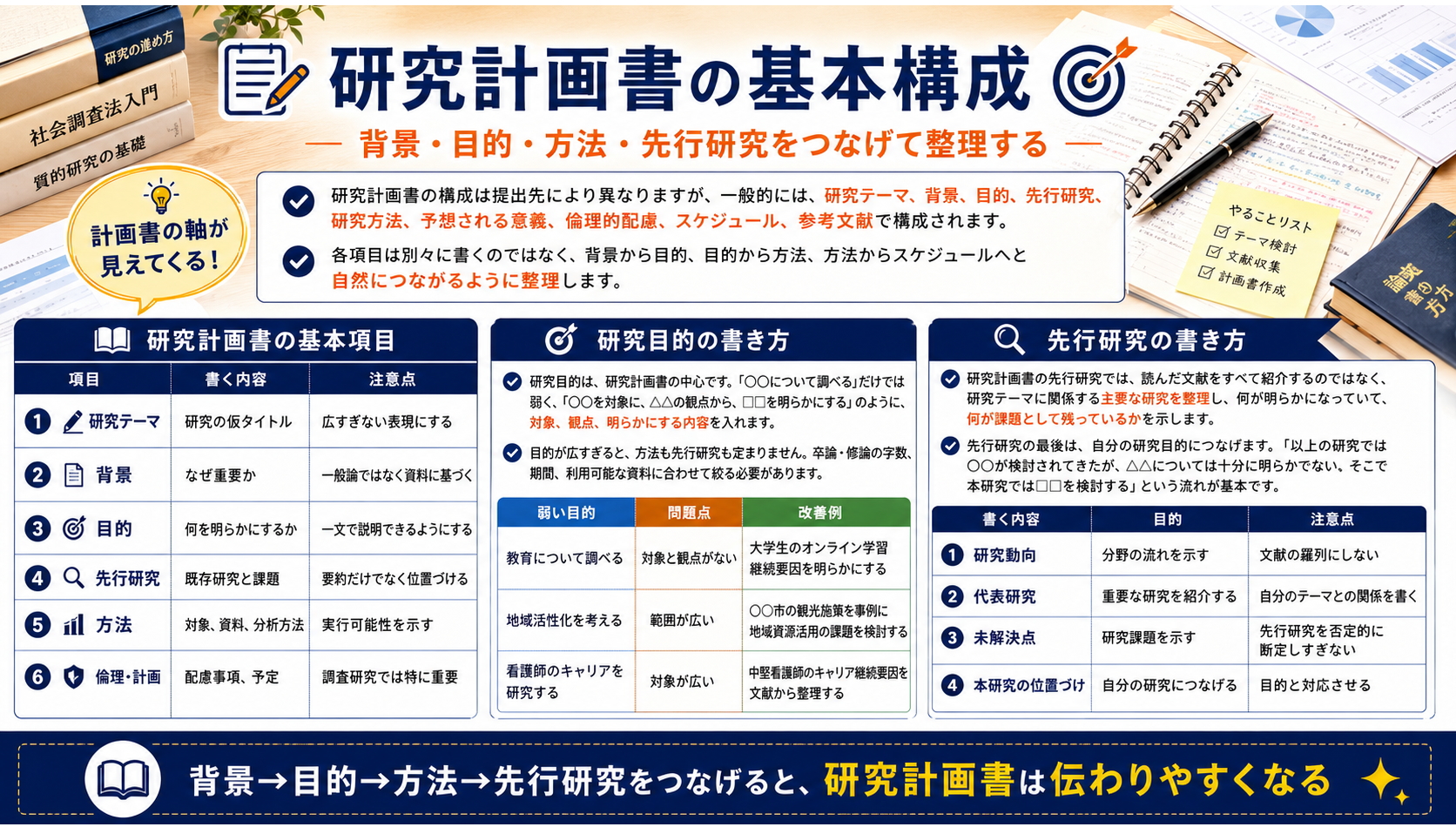
The structure of a research proposal varies by submission destination, but generally includes the research topic, background, purpose, previous studies, research methods, expected significance, ethical considerations, schedule, and references.
These items should not be written as isolated sections; organize them so that the background leads naturally to the purpose, the purpose to the methods, and the methods to the schedule.
| Item | What to include | Points of caution |
|---|---|---|
| Research topic | Provisional research title | Avoid wording that is too broad |
| background | Why it matters | Base it on evidence rather than general statements |
| purpose | What the study aims to clarify | Make it explainable in one sentence |
| previous studies | Existing research and remaining issues | Position the studies rather than merely summarizing them |
| methods | Participants or materials, data, and analytical methods | Show feasibility |
| Ethics and planning | Considerations and schedule | Especially important for research involving surveys or participants |
How to write the research purpose
The research purpose is the core of a research proposal. Simply saying “to investigate X” is too vague. Include the target, perspective, and what you intend to clarify, as in “to clarify □□ by examining X from the perspective of △△.”
If the purpose is too broad, neither the methods nor the previous studies can be defined clearly. It needs to be narrowed according to the word limit, available time, and materials available for the undergraduate or master's thesis.
| Weak purpose | Problem | Improved example |
|---|---|---|
| Investigate education. | No clear target or perspective | Clarify the factors associated with continued online learning among university students |
| Consider regional revitalization | Scope is too broad | Examine challenges in utilizing local resources through a case study of tourism initiatives in City X |
| Study nurses' careers | Target population is too broad | Review the factors associated with career continuation among mid-career nurses based on the literature |
How to write the previous studies section
In the previous studies section of a research proposal, do not introduce every source you have read. Organize the major studies relevant to the research topic and show what is already known and what issues remain unresolved.
The end of the previous studies section should lead to your research purpose. A standard flow is: “Previous studies have examined X, but △△ has not been sufficiently clarified. Therefore, this study examines □□.”
| What to include | purpose | Points of caution |
|---|---|---|
| Research trends | Show the development of the field | Do not make it a list of references |
| Representative research | Introduce important studies | Explain their relationship to your topic |
| Unresolved issues | Present the research question | Avoid making overly categorical negative claims about previous studies |
| Positioning of the present study | Connect it to your own research | Make them correspond to the research purpose. |
Research methods and ethics
In the research methods section, explain what materials or data will be used and how they will be analyzed. Choose methods such as literature review, case analysis, questionnaires, interviews, or statistical analysis according to the research purpose.
For research involving people, you need to check requirements for informed consent, anonymization, protection of personal information, data management, and research ethics review. Follow the instructions of your university and supervisor.
| methods | Research for which it is suitable | Points of caution |
|---|---|---|
| Literature-based research | Review of theories, systems, and previous studies | State the criteria used to select literature |
| Case analysis | Detailed examination of a specific case | Do not overgeneralize from a single case |
| Questionnaire survey | Identify trends and associations | Clarify the questionnaire items and target participants |
| Interview study | Understand experiences and meanings in depth | Ethical considerations are important |
| statistical analysis | Analysis of quantitative data | Check levels of measurement and assumptions |
Schedule
A research proposal includes a schedule to show that the research is feasible. Work backward from the deadline to plan literature collection, survey preparation, data collection, analysis, writing, revision, and the final pre-submission check.
The schedule should include some allowance for delays rather than reflecting an ideal scenario only. Research that requires data collection or ethics review generally needs more preparation time than literature-based research.
| Stage | Task | Points of caution |
|---|---|---|
| Preparation | Organize the topic, purpose, and previous studies | Consult your supervisor early |
| Design | Develop the methods, target population, and questionnaire items | Check ethical considerations |
| Collection | Collect literature, materials, and data | Keep records |
| Analysis | Organize results and develop the discussion | Make them correspond to the research purpose. |
| Writing | Prepare the main text, references, and formatting | Review before submission |
Pre-submission checks
Before submitting a research proposal, check whether the research purpose corresponds to the methods, whether the previous studies lead logically to the research question, and whether the description of ethical considerations is sufficient.
Also check the title, headings, references, notation, word count, and required format. Because a proposal is the blueprint for the research, it should contain enough information for the reader to assess whether the study is feasible.
| ConfirmItem | Checklist content |
|---|---|
| Topic | Is the topic sufficiently focused and researchable? |
| purpose | Can it be explained in one sentence? |
| previous studies | Are the issue and the study's position clearly stated? |
| methods | Are the methods appropriate for the purpose? |
| Ethics | Have you checked issues concerning participants, personal information, and informed consent? |
| Schedule | Can the research realistically be completed by the deadline? |
Support Available from iBooks Academic Support
iBooks Academic Support provides support for undergraduate and master's thesis research proposals, including topic organization, clarification of the research purpose, searches for previous studies, methodological design, descriptions of ethical considerations, scheduling, and reference formatting. Clarifying the research direction at the proposal stage makes the later writing process easier to manage.
Summary | A research proposal is the blueprint for a study
A research proposal is a blueprint showing what you will study, why you will study it, and how you will conduct the research. The topic, background, purpose, previous studies, methods, ethics, and schedule need to be presented as a coherent sequence.
Check whether the purpose and methods correspond, whether the materials or survey are feasible, and whether the need for your research is adequately explained on the basis of previous studies.
Points to Check to Improve the Reliability of This Article
This article organizes principles of academic writing, citation and reference checks, and pre-submission review that apply to both university reports and undergraduate theses. For actual submission, always give top priority to the required format of your university, course instructor, seminar, faculty or graduate school, or target journal or university bulletin.
| ConfirmItem | What to Check | How to apply this in the main text |
|---|---|---|
| Submission requirements | Check the word count, format, citation method, submission-file format, and deadline. | Make the main-text structure, notes, references, and figure and table numbering consistent. |
| Supporting sources | Distinguish course materials, assigned textbooks, academic papers, official materials, and primary sources. | Make the relationship between claims and evidence explicit. |
| Citations and references | Verify author names, publication years, titles, publishers, journal names, volume and issue numbers, pages, URLs, and other required information. | Avoid plagiarism and incomplete sourcing and improve reliability. |
| Pre-Submission Review | Check typographical errors, logical leaps, duplicate headings, and omissions from the reference list. | Bring the report to a level of completeness that is clear to the reader. |
Reference Materials / Verification Sources
When verifying literature and formatting, do not rely solely on search-result snippets. Check real academic databases, university libraries, publishers, and primary information from government agencies and other authoritative bodies.
- CiNii Research: Can be used to search Japanese academic papers, books, research data, and related materials.
- J-STAGE: Can be used to search and view academic papers published by Japanese academic societies and related organizations.
- Google Scholar: Can serve as an entry point for searching academic literature across Japan and overseas.
- National Diet Library Search: Can be used to check holdings information for books, journals, doctoral dissertations, and related materials.
Related Services / Internal Links
In reports and undergraduate theses, evaluation can be affected by the quality of the structure, previous studies, citations, references, discussion, and pre-submission checks. Review the related pages as well.
University Report SupportGraduation Thesis / Master's Thesis Writing SupportAcademic Paper and Literature SearchAI Report / Paper ConsultationFree Quote / Consultation
FAQ
What should I include in a research proposal?
Include the research topic, background, purpose, previous studies, research methods, ethical considerations, schedule, references, and other required elements. Give priority to the format specified by the institution receiving the proposal.
How should I write the research purpose?
It becomes clearer if you state it in one sentence that includes the target, perspective, and what you intend to clarify.
I cannot decide on a research method. What should I do?
Consider whether a literature review, case analysis, questionnaire, interview, or statistical analysis is most appropriate for the research purpose. Consulting your supervisor is also important.
Does a research proposal need references?
In many cases, yes. Citing previous studies and supporting materials helps explain the positioning and feasibility of the research.
Contact
To date, we have supported clients throughout Japan and overseas.over 10,000 casesof academic support requests. Experienced consultants carefully listen to your needs and provide prompt, appropriate support at reasonable fees.
Ibooks members across Japan will support you responsibly.
We send the profile of the responsible staff member when you apply.
When orders are busy, phone lines may be difficult to connect. We will reply in order, so urgent inquiries should be sent by
