
How to Write English EssaysHow to write your English Essay
What Is an English Essay?
An English essay is a piece of writing that organizes the writer's ideas, opinions, or information about a particular topic. Essays are often written for academic or school assignments, although they may also describe personal experiences or reflections. English essays generally require a clear structure consisting of an introduction, body, and conclusion. The introduction presents the topic or central claim, the body develops analysis and argument, and the conclusion summarizes or reaffirms the main points. Logical organization and appropriate use of information and citations are also important. Following the steps below can help produce a clear and persuasive essay.Step 1: Choosing a Topic
Choosing a topic is the first step toward a successful English essay. When selecting a topic, consider three elements: interest, existing knowledge, and research feasibility. Each is explained below.
Choose a Topic That Interests You
It is important to select an issue or phenomenon that genuinely interests you. Interest helps sustain motivation during research and writing and can support deeper understanding and original insight. Topics connected to your own experiences or previous learning can be particularly workable.
Choose a Topic You Know Something About
Choosing a topic for which you already have some knowledge can make deeper analysis easier. Expanding existing knowledge may also be more efficient than starting in an entirely unfamiliar field. If an assignment requires you to explore a new area, begin with foundational research.
Choose a Topic That Can Be Researched
Confirm that sufficient research materials and reliable sources are available for the topic. A topic with too little information may make it difficult to build a well-supported argument. Conduct preliminary searches in libraries, online databases, and academic journals to determine whether the necessary information can be obtained.
Narrow and Refine the Topic
It can be effective to begin with a broad theme and gradually make the topic more specific as research progresses. If the topic is too broad, narrowing it makes the essay easier to manage and allows deeper discussion. If it is too narrow, sufficient information may be difficult to obtain, so an appropriate balance is important.
Because topic selection strongly influences the overall quality of an essay, it should be done carefully. Confirm that the chosen topic fits your interests, knowledge, and ability to conduct research.
Step 2: Research and Source Collection
Research and source collection are essential for developing a deep understanding of the topic and building effective arguments in an English essay. The process is explained below.
1. Plan the Research
First, define the purpose and scope of the research. Decide specifically what you need to know, what information is required, and how that information will be used. This improves efficiency and keeps the research focused on the essay's purpose.
2. Select Reliable Sources
Use authoritative sources such as academic journals, books, reports from public institutions, reliable news sources, and reputable online databases. Verify the source, consider the author's expertise, and evaluate the credibility of the publisher or organization.
3. Search with Keywords
Effective research requires appropriate keywords. List the main terms related to the topic and keywords for related subtopics, then use combinations of those terms to find more relevant information.
4. Organize the Information
Organize collected information so that it can be referenced easily during writing. Take notes on key points, passages you may want to cite, and evidence relevant to the argument. Classify information by theme and create summaries or notes as needed.
5. Evaluate the Sources
Assess whether the collected materials provide sufficient support for the essay's arguments. Consider how current the information is, whether the reasoning is consistent, and whether the source may contain bias. Select the sources most appropriate for maintaining the quality of the essay.
6. Identify Gaps
As research progresses, you may discover areas where information is insufficient. Identify these gaps and conduct additional research or adjust the direction of the essay as necessary.
7. Use Sources Ethically
When using researched information, follow citation and referencing rules and respect the work of the original authors. Avoid plagiarism and always identify the sources used.
Effective research and source collection greatly influence the quality of an English essay. By gathering information carefully and systematically, you can build a strong foundation for a persuasive piece of writing.
Step 3: Structure of an English Essay
A clear and effective structure is essential when planning an English essay. Good organization helps readers follow the argument and understand the main points. A standard structure can be planned as follows.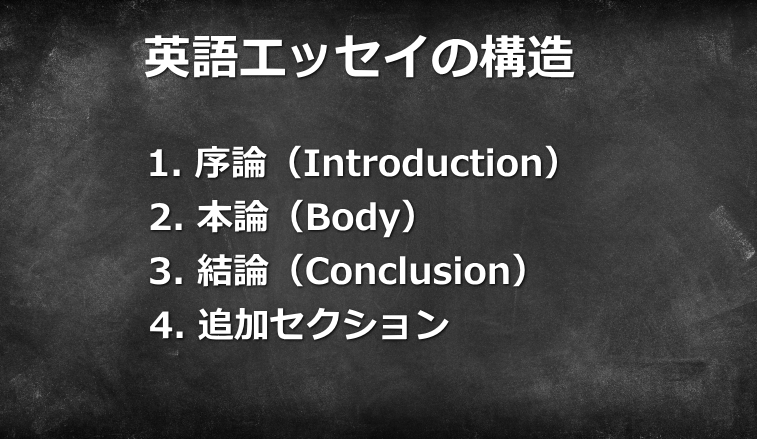
1. Introduction
Set the purpose: Clearly state the purpose of the essay and indicate what readers should expect.
Hook: Use an interesting fact, quotation, question, or statistic to attract the reader's attention and lead into the essay.
Provide background information: Briefly explain the background or context of the topic so readers have the information needed to understand the discussion.
Thesis statement: Clearly state the central claim or argument of the essay. This claim should be supported and examined throughout the essay.
2. Body
Paragraph structure: The body usually consists of several paragraphs. Each paragraph should focus on one main idea and support the thesis statement.
Topic sentences: Place a topic sentence near the beginning of each paragraph to introduce its main idea.
Supporting information: Use specific evidence, examples, and quotations to support the topic sentence. Data, research findings, and expert opinions can strengthen the argument.
Logical flow: Ensure smooth and logical transitions between paragraphs so that the overall discussion remains coherent. Use appropriate transition words and phrases.
3. Conclusion
Summary: Briefly summarize the main ideas and evidence presented in the body. Avoid introducing new information and focus on synthesizing what has already been discussed.
Restate the thesis: Reaffirm the essay's central claim and make clear how it has been supported.
Provide insight: Offer a final idea or implication for readers to consider, such as the significance of the findings, directions for future research, or possible approaches to solving the problem.
4. Additional Sections
Considering counterarguments: When appropriate, include a section that addresses opposing views or concerns and responds to them. This can make the essay more persuasive and balanced.
When planning an essay, combine these elements appropriately to create a logical and persuasive piece of writing. A clear structure helps readers follow and understand the content.
Contact
To date, we have supported clients throughout Japan and overseas.over 10,000 casesWe have supported a wide range of academic requests, including graduation/master’s thesis research and report/paper support. Our experienced consultants work closely with clients to meet their needs. We provide prompt and accurate support at reasonable prices, and our Ibooks team members throughout Japan take responsibility for assisting each client.
We send the profile of the responsible staff member when you apply.
For Undergraduate / Master's Thesis Research Support, Report Support, and Paper Support, choose iBooks Academic Support!
0476-85-7930
When orders are busy, phone lines may be difficult to connect.
We will reply in order; if urgent, please contact us byEmail please contact us by this method.
When orders are busy, phone lines may be difficult to connect.
We will reply in order; if urgent, please contact us by
