
What Is an AI Watermark?AI text watermarking, Claude, SynthID-Text and academic writing
What does Claude's “invisible watermark” mean? This beginner-friendly guide explains how AI-generated text works, the EU AI Act, the latest OpenAI developments, and points to note when writing papers and reports.
An AI watermark is a technology that gives AI-generated or AI-processed content a machine-verifiable clue about its provenance.
Images can use pixels or metadata, but text watermarks can useLeave statistical patterns in word/token selectionmethods that are researched and implemented in the text-generation process.
What Is an AI Watermark? Beginner-Friendly Explanation of the “Invisible Marker” in Claude Text and How AI-Generated Text Works
Article OverviewIn August 2026, Anthropic announced a policy of adding machine-readable watermarks to AI-generated text in supported Claude models. One background factor is the transparency requirements of the EU AI Act. However, a watermark does not automatically prove that “AI wrote the entire text” or that “a student cheated.” This article explains the topic for readers without an IT background. How AI generates text, Claude's SynthID-Text approach, the principles of detection, technical limitations, OpenAI's current status, and points to note in university reports, undergraduate theses, master's theses, and journal manuscriptsWe organize these points in an accessible way.
What an AI Watermark Is
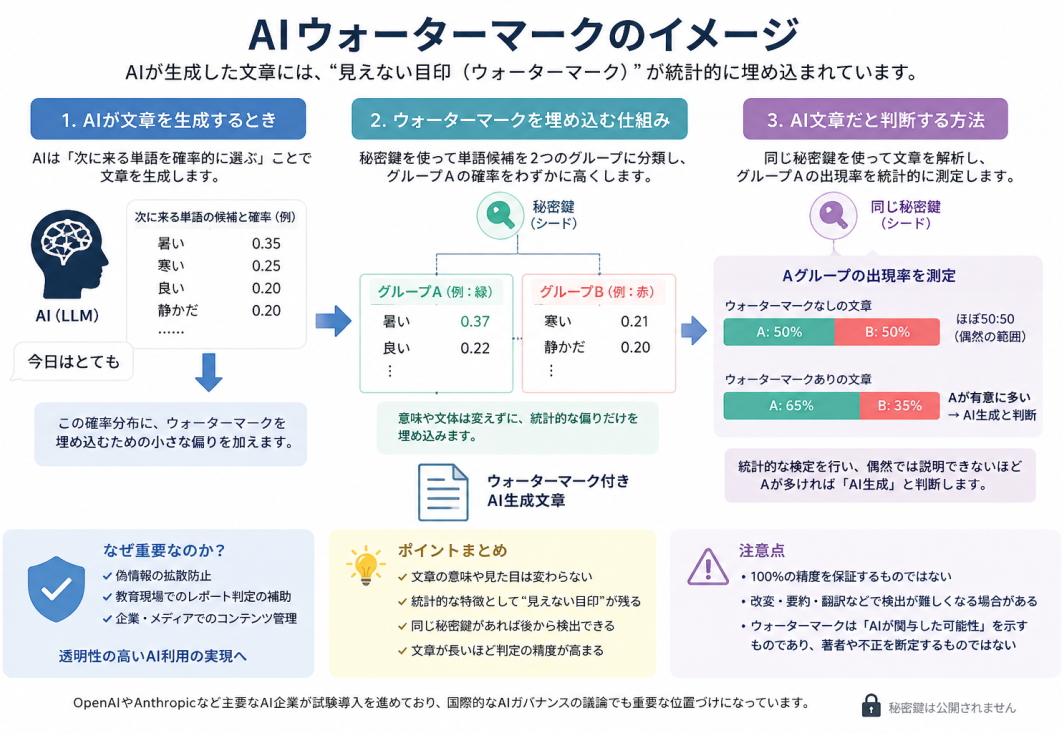
Leave traces in the “generation process,” not in the visual appearanceA watermark is a technology used to verify the provenance of content later. For images, an imperceptible signal can be embedded in the image itself, or provenance metadata can be attached to the file. Ordinary text, however, has no pixels like an image. For AI-generated writing, Use a key to create a statistical pattern in probabilistic word selection during generationthis leads to a different approach.
An important point is that the text watermark described by Claude is not a mechanism that inserts “invisible special characters” into the text. Anthropic explains that it does not add hidden characters or extra tokens, but instead modifiesHow Randomness Is Generatedthe way randomness is used in selecting words while preserving meaning.
Why AI Watermarks Are Attracting Attention
As generative AI becomes widespread, it becomes increasingly difficult to determine the source of text, images, audio, and other content using human observation alone. Watermarks and provenance metadata are therefore attracting attention “Additional information that can help machines check whether AI may have been involved”as an additional source of information.
| Area | Expected Role | Points of caution |
|---|---|---|
| Misinformation / Information Distribution | Use as supplementary evidence for checking the provenance of synthetic content. | A watermark alone cannot determine whether the content itself is true or false. |
| Education & Academia | Use as supplementary information when checking whether AI may have been involved in generating or editing text. | Detection results alone should not be used to conclude that a student cheated or to determine authorship. |
| Enterprise Content Management | Use for managing AI-generated content, transparency at publication, and provenance checks. | It must be used together with internal rules, laws, and platform specifications. |
| Content Authentication | Combine with metadata such as C2PA to increase clues about generation and editing history. | Metadata and embedded watermarks have different characteristics. |
How Do AI Large Language Models Generate Text in the First Place?
Continuously select the “next token”Large language models such as ChatGPT and Claude assign probabilities to candidate next words or groups of characters (tokens) based on the input context, then continue generating text by selecting from those candidates.
For example, after the phrase “Today is very,” several natural continuations may be possible, such as “hot,” “cold,” “quiet,” or “pleasant.” The strongest candidates depend on the context, but in some situations several expressions can be similarly natural without materially changing the meaning or quality of the sentence.Text watermarks use situations with this kind of “room for choice” to leave a statistical feature.
How Is Claude's Watermark Embedded?
An Approach Based on SynthID-TextIn its official explanation dated August 14, 2026, Anthropic stated that Claude's text watermark applies an approach based onSynthID-Texta method published by Google DeepMind in Nature in 2024.
Beginner-friendly explanations of watermarking sometimes describe it as “dividing candidate words into two groups such as A/B or green/red and making one group slightly more likely to be selected.” This is a useful simplified model for understanding statistical watermarking. However, Anthropic's explanation of Claude is not simply a 50:50 two-group classification. Anthropic explains that its system uses a secret key and the preceding context to modify the source of randomness used when choosing words, making it possible to later test whether the text is statistically consistent with generation using that key.
| Point | Content |
|---|---|
| Is the marker visible? | It is not visible to ordinary readers. Claude's approach does not work by adding hidden characters to the text. |
| What changes? | When choosing among multiple meaning-preserving candidates, the randomness is given a statistical pattern associated with a key. |
| How is it detected? | The system statistically evaluates how strongly the text contains patterns corresponding to the key used during generation. |
| Text Length | Short text provides fewer clues, while longer text generally provides more statistical evidence. |
| Exact Facts & Code | Where there is essentially only one correct answer, there is little freedom in word selection and therefore less room to embed a watermark. |
How Can the System Judge That AI Was Involved in a Text?
Assess Statistical Consistency between the Secret Key and the TextThe detection side examines how closely the sequence of words or tokens matches the pattern corresponding to the key used during generation. If the match accumulates to a degree that is difficult to explain by chance, the system can assess that Claude was likely involved in generating or processing the text.
Watermark detection is therefore not a one-shot rule such as “this word appears, therefore it is AI” or “A and B are not 50:50, therefore it is AI.” The evaluation takes into account the key used by the relevant method and model, the amount of text, the strength of the statistical signal, and other factors.
In August 2026, Anthropic Announced Claude Text Watermarking
In response to EU AI Act transparency requirements, Anthropic announced that new Claude models offered in the EU from August 2, 2026 would, where supported, include machine-readable watermarks in generated text. Its support information states that marking applies across several surfaces, including Claude, the Claude Platform (API), and Claude Code, and that because there is no robust way to restrict the system by region, the initial rollout would apply globally.
For supported image, SVG, and related files, Anthropic states that it uses a separate mechanism from text watermarking: C2PAsigned provenance metadata based on an open standard.
| Item | Explanation as of August 2026 |
|---|---|
| Population or target | Text generated by supported Claude models. Anthropic also states that support for existing models will be expanded over time. |
| Method | A text-watermarking approach based on Google DeepMind's SynthID-Text. |
| Hidden Characters | Anthropic states that hidden characters are not used. The system does not work by inserting extra characters into the text. |
| Personal Tracking | Anthropic states that the watermark does not contain information identifying an individual, organization, or chat. |
| Detection | Anthropic has announced plans to provide a dedicated detection API. |
| Limitation | Signals may be weak for short text, fact-heavy text, or light editing, and detection alone cannot establish authorship or misconduct. |
What Is the Status of OpenAI Watermarking?
Provenance Signals Are in Use for Images and Audio, with a Goal of Expanding to TextAs of August 2026, OpenAI explains in its official help materials that supported generated images useC2PA Content Credentials and SynthIDand supported generated audio usesSynthIDfor provenance signals. OpenAI also states that, in line with its commitment to the Code of Practice on transparency for AI-generated content in the EU, The stated goal is to expand provenance signals across all modalities, including text.it is pursuing broader provenance signals.
Accordingly, it would not be accurate to say that “OpenAI has already deployed the same type of text watermark as Claude across the board.” Support varies by content type, product, model, and output method, so the latest official information should be checked.
What Does the EU AI Act Require for AI-Generated Text?
Transparency Obligations Apply from August 2, 2026Article 50(2) of the EU AI Act (Regulation (EU) 2024/1689) requires providers of AI systems that generate synthetic audio, image, video, or text content to make those outputsMark outputs in a machine-readable format so they can be detected as AI-generated or manipulated.machine-readable and detectable as artificially generated or manipulated, using effective, interoperable, robust, and reliable techniques to the extent technically feasible. The provision also defines circumstances in which the marking obligation does not apply, such as systems that perform only standard editing assistance or do not substantially alter the input data or its meaning.
Article 50(4), meanwhile, contains disclosure obligations for certain AI-generated or manipulated text published on matters of public interest and also provides exceptions where human review or editorial control is present and a natural or legal person bears editorial responsibility.However, this does not mean that “a human-reviewed text does not need an AI watermark.” The provider-side marking obligation and the publisher-side disclosure obligation should be understood separately.
Note: This article provides a general explanation of technology and regulation and does not constitute legal advice on the EU AI Act or any individual matter.
AI Watermarking and “AI Text Detectors” Are Not the Same Thing
| Comparison | Watermark Detection | General AI-Text Detection |
|---|---|---|
| Signal Used | A keyed statistical signal intentionally embedded during generation. | An estimate of “AI-like” writing based on style, vocabulary, predictability, and similar features. |
| Required Information | A detection method corresponding to the watermarking scheme or key is required. | Usually estimated from the text alone. |
| What the Result Means | A clue that a particular model or system may have been involved in generation or processing. | An estimate of whether writing appears AI-generated; it does not directly prove involvement by a specific service. |
| Points of caution | Signals may weaken in short or heavily edited text. | Because false positives and other errors are possible, such results should not be used alone to determine misconduct or authorship. |
A Watermark Is Not an “Indelible Mark”
Text watermarks have technical limitations. Anthropic itself explains that signals may be weaker in short passages, fact-heavy writing, or light proofreading, and detectability can decline when the text is substantially changed.
However, intentionally removing a watermark for the purpose of concealing AI use may create problems under the rules of an educational institution, employer, journal, or research-ethics framework. This article therefore does not provide procedures for bypassing watermarks, but instead emphasizes Understand what the technology can and cannot show, and if AI is used, maintain transparency in accordance with the applicable rules.the following principle.
The Most Important Points for University Reports, Undergraduate Theses & Master's Theses
It Is Not Enough to Think “As Long as the AI Detector Does Not Flag It”Rules at universities, graduate schools, and academic societies vary: some prohibit AI use entirely, some allow auxiliary use, and some require disclosure of where AI was used or what prompts were used. Therefore, submissions should not be judged solely by the presence or absence of a watermark; the first step is to review the AI-use policy of the relevant institution, course, or academic society.
- Do the references actually exist, and do the claims in the paper match the original sources?
- Do quoted passages correspond correctly to the reference list?
- Has AI altered statistical results or numerical values?
- Do the research objective, methods, results, discussion, and conclusion connect logically?
- If AI was used, does the work follow the disclosure method required by the university, academic society, or other relevant body?
Especially in papers and research reports, “natural-sounding language” and “academic correctness” are different things. Even if AI produces fluent prose, it does not automatically guarantee the existence of the cited literature, accuracy of citations, appropriateness of the research method, or interpretation of statistical analysis.
In the Age of AI Watermarks, iBooks Academic Support Emphasizes “Human Review”
Individual Support by Specialist Staff Who Review the Materials Rather Than Leaving Everything to AI
At iBooks Academic Support, our academic assistance places particular emphasis onA human-centered process in which staff individually review writing, structure, logic, citations, references, and data descriptions based on the materials providedhuman verification. We do not treat AI-generated text as automatically ready for submission; instead, we review its content and evidence and provide the editing, organization, and research support needed.
The key to reassurance is not “removing” an AI watermark, but having a human process that checks the evidence, content, and compliance with relevant rules.If your university, graduate school, academic society, or research institution has AI-use rules, those rules should take priority, and any required disclosure and source management should be followed.
| ConfirmItem | What We Emphasize in Manual Review |
|---|---|
| Writing & Structure | We review the topic, research objective, role of each chapter, and logical connections between paragraphs. |
| Citations and references | We review the correspondence between in-text citations and the reference list, source notation, and—where verifiable—bibliographic information. |
| Statistics & Data | We review whether the analysis results match the text and whether there are contradictions in numerical values or interpretation. |
| Points to Note When Using AI | We do not focus on bypassing AI detection; instead, we organize the work in light of the AI-use rules and research ethics of the submission or publication destination. |
| Final Check | Human staff review typographical errors, expression, formatting, logic, and consistency with required materials. |
FAQ about AI Watermarks
Q. What Is an AI Watermark?
A general term for technologies that give AI-generated content a marker or statistical signal so its provenance can later be checked by machines. In text, some approaches use statistical patterns in the generation process, such as word selection.
Q. Does Claude Insert Invisible Characters into Its Text?
According to Anthropic's explanation, Claude's text watermark does not work by adding hidden characters. Instead, it introduces a keyed pattern into the randomness used when selecting words.
Q. If a Watermark Is Detected, Does That Prove AI Wrote the Entire Text?
No. Anthropic explains that the watermark indicates only that Claude may have been involved in generating or processing the text; it does not determine the author or establish misconduct.
Q. Can Short Text Be Detected Accurately?
Short text contains less statistical evidence, so it is generally more difficult to judge. Anthropic also explains that longer text provides more information for detection.
Q. Does OpenAI Add Watermarks to Text?
As of August 2026, OpenAI uses C2PA and SynthID for supported images and SynthID for supported audio. It has stated a goal of expanding provenance signals to all modalities, including text, but its current text support is not identical to image and audio support.
Q. Is It Safe to Submit a Report If I Remove the AI Watermark?
That is not an appropriate way to think about it. For submitted work, what matters is not simply whether a watermark is present but whether you follow the AI-use rules of the university or academic society, maintain academic integrity, manage citations and sources correctly, and ensure the content is accurate.
Q. Is There Any Value in Having a Human Edit or Review the Work?
Human review still has value. Separate from watermarking or AI detection, it is necessary to verify that references exist, citations are accurate, statistical results are correct, the research objective is aligned with the paper, and the structure is coherent. iBooks Academic Support emphasizes human-centered review of these points.
Summary | An AI Watermark Is a Clue to AI Involvement, Not an All-Purpose Detection Device
SummaryText watermarking is a technology that leaves statistical patterns in AI word selection and related generation processes so that AI involvement can be examined later.Claude has announced an approach based on SynthID-Text, introduced in the context of compliance with EU AI Act transparency requirements. However, signals may be weak in short texts or writing where the correct wording is narrowly constrained, and detection results alone cannot prove that “AI wrote the entire text” or that “misconduct occurred.”
What matters in reports and papers in the AI era is not an endless “cat-and-mouse game” with detection technology, but Human reviewers should check sources, data, logic, and research ethics, and when AI is used, users should follow the rules of their institution.careful human review. iBooks Academic Support emphasizes human verification and provides case-by-case academic support.
References & Primary Sources
- Anthropic: How Claude’s text watermark works (August 14, 2026)
- Claude Help Center:How Claude marks AI-generated content
- Nature:Scalable watermarking for identifying large language model outputs(SynthID-Text)
- OpenAI Help Center:Provenance signals (Content Credentials, SynthID) in OpenAI-generated content
- OpenAI:Advancing content provenance for a safer, more transparent AI ecosystem
- EUR-Lex:Regulation (EU) 2024/1689(Artificial Intelligence Act)
- European Commission:Code of Practice on Transparency of AI-generated Content
- declaude.org: How AI text watermarking works (reference / third-party explanation)
Hashtags
#AIWatermark #Claude #AIWriting #Anthropic #SynthID #SynthIDText #EUAIAct #GenerativeAI #AIDetection #AIReport #UndergraduateThesis #MastersPaper #PaperEditing #ResearchEthics #iBooksAcademicSupport
Note: This article is a general-audience summary based on publicly available information from companies and the EU that could be confirmed as of August 25, 2026. Marking specifications, detection methods, supported models, laws, and guidelines may change. Watermarks or AI-detection results alone cannot establish authorship, academic misconduct, copyright status, legal responsibility, or similar matters. Please check the latest rules of your university, academic society, research institution, employer, or other relevant organization.
Related Information:AI Report / Paper Consultation & AI-Written Text Review
Related Information:Undergraduate Thesis & Master’s Thesis Research Support
Related Information:Academic Paper and Literature Search Support
Related Information:Statistical Analysis Support
Related Information:Important Information
Related Information:Free Quote / Research Consultation Form
Contact
Tell us about your needs, such as reviewing AI-assisted writing, editing undergraduate or master’s theses and reports, checking references and citations, research planning, statistical analysis, or qualitative analysis. iBooks Academic Support does not focus on evading AI detection; specialist staff review the materials and manually check the writing, evidence, logic, citations, and data descriptions.
When orders are busy, phone lines may be difficult to connect. We will reply in order, so urgent inquiries should be sent byEmailplease contact us by this method.
