
Writing TechniquesWriting Techniques
Academic Papers and Reports
Writing an academic paper or report requires more than simply arranging information; Communicating logically and clearly to the readerthe content must be communicated logically and clearly to the reader. University reports, undergraduate theses, master's theses, doctoral dissertations, conference scripts, and similar work may address specialized topics, but the writing itself still needs to beA concise and understandable formconcise and easy to understand. Particularly important points include sentence length, the role of each sentence, transitions, and logical consistency.Point 1: Adjust Sentence Length
In academic papers and reports, Keep sentences to an appropriate lengthkeeping sentences to an appropriate length is important. As a general guide, Aim for approximately 30–70 Japanese characters per sentencea sentence of approximately 30–70 Japanese characters can make the content easier to understand. Even when proper nouns, institutional names, theories, or publication titles make a sentence longer, Keep longer sentences to around 80 Japanese characters or lessit is generally preferable to keep it to roughly 80 Japanese characters or less.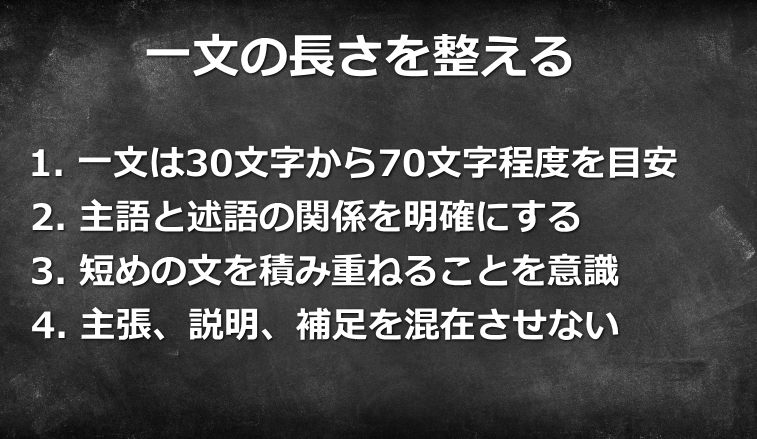
When a sentence becomes too long, the relationship between subject and predicate becomes difficult to see, and readers can lose the meaning partway through. Academic writers sometimes pack too much explanation into a single sentence in an effort to be precise, but this can actually make the argument harder to follow.Build the text from shorter sentencesBuilding the text from shorter sentences can make the relationship between claims and evidence clearer and improve readability.
1. Reduce the Reader's Cognitive Load
Shorter sentences make it easier for readers to understand the content in a single pass. In specialized writing, complexity of syntax alone can increase difficulty, so Adjust sentence lengthis important.
2. Make the Main Point Clear
Keeping a sentence to an appropriate length clarifies what that sentence is trying to say. In an academic paper, claims, explanations, and supplementary information should not be mixed together unnecessarily.
3. Make the Logical Flow Easier to Follow
Dividing sentences helps organize the flow of individual points. As a result, the roles of the introduction, main body, and conclusion also become clearer.
In this way, Be conscious of sentence lengthAdjusting sentence length is not merely a matter of appearance; it is a basic technique for strengthening the logic of academic writing as a whole.
Point 2: Follow the One-Sentence-One-Idea Principle
In academic papers and reports, “One Sentence, One Idea”it is important to follow the “one sentence, one idea” principle. This means placing only one main piece of content, point, or claim in each sentence.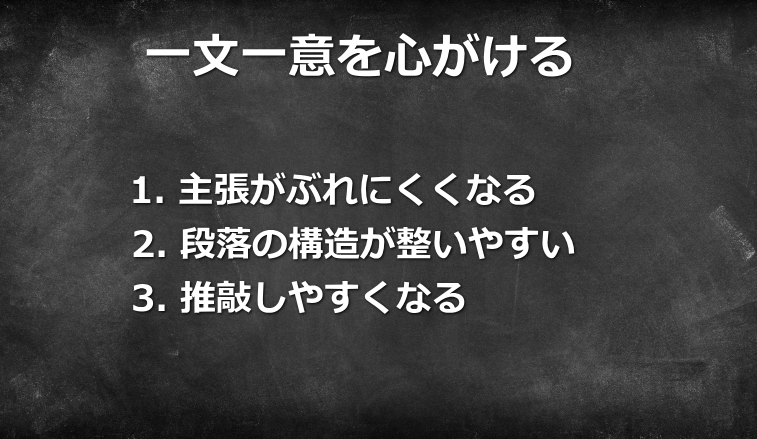
When too much information is packed into one sentence, it becomes difficult to distinguish the main claim from supplementary information. This is especially important when organizing prior studies, explaining analytical results, or writing a discussion. Clarify the role of each sentenceis important.
1. Keep the Claim Focused
When each sentence contains only one core idea, readers can immediately understand its role.
2. Make Paragraph Structure Easier to Organize
Following the one-sentence-one-idea principle also helps organize the logic of each paragraph naturally, because the appropriate order of sentences becomes easier to see.
3. Make Revision Easier
The clearer the meaning of each sentence, the easier it becomes to revise later. Unnecessary sentences and duplicated expressions are also easier to identify.
One sentence, one idea is a basic principle for maintaining logic in academic writing.The one-sentence-one-idea principle is a basic rule of academic writing that improves both readability and persuasiveness.
Point 3: Avoid Overusing “Ga”
In academic papers and reports, Avoid overusing “ga”Avoiding overuse of the Japanese conjunction “ga” is also important. It is a convenient connector, but repeated use can make writing wordy and blur the point.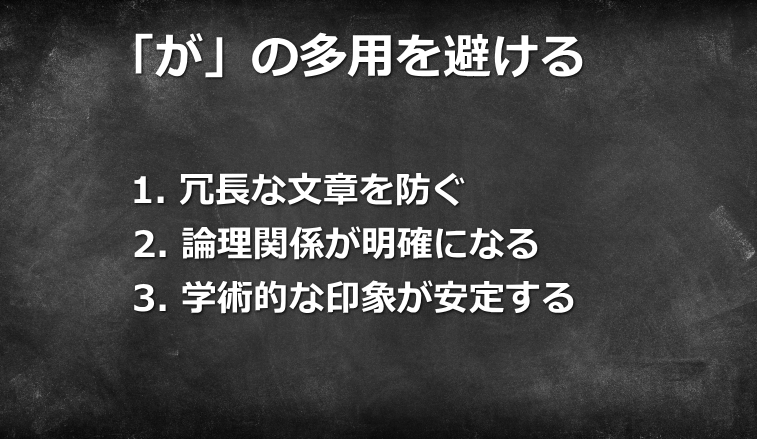
For example, repeatedly chaining expressions equivalent to “but,” “although,” or “however” within the same sentence can stretch out the argument and make the intended point difficult to identify. When necessary, divide the sentence, use a different transition, or make a direct declarative statement.
1. Prevent Wordy Sentences
Overusing “ga” can stack supplementary and contrasting clauses within a sentence and make the text difficult to read.Prefer concise expressionUsing more concise expression tightens the writing.
2. Clarify Logical Relationships
By not relying excessively on “ga” and instead separating sentences appropriately, causal and contrasting relationships become easier for readers to follow.
3. Maintain a Stable Academic Tone
Reducing roundabout phrasing produces concise and clear academic writing and can make the text easier to trust and understand.
Avoid overusing “ga”Avoiding overuse of “ga” may look like a small stylistic detail, but it is important for improving the overall tightness of the prose.
Point 4: Use a Structure That Communicates the Logic
In academic papers and reports, simply shortening individual sentences is not enough. What matters is the order in which sentences are placed and how each one supports the argument.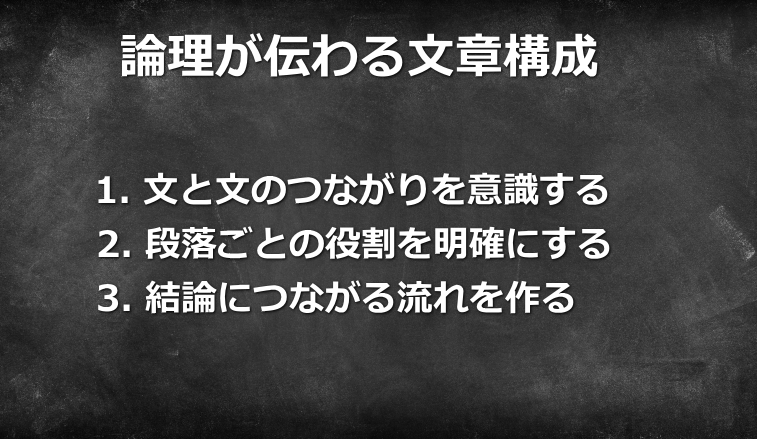
As a basic approach, arranging the text in a flow such as problem statement, explanation, evidence, example, discussion, and conclusion makes the logic easier for readers to follow. Even if individual sentences are readable, a disorganized paragraph or overall structure weakens persuasiveness.
1. Pay Attention to Connections Between Sentences
Sentences should not be completely isolated; each one should develop naturally from the sentence before it.
2. Clarify the Role of Each Paragraph
As a rule, handling one main point per paragraph makes the overall structure easier to organize.
3. Build a Flow Toward the Conclusion
Considering how each sentence and paragraph contributes to the final conclusion improves consistency across the paper.
In academic writing, more important than stylistic beauty is A clear logical flowclear logical flow. During drafting, writers should continually ask, “What purpose does this sentence serve?”
Point 5: Basic Principles for Academic Papers & Reports
In academic papers and reports, Write short, clear, logically connected sentencesWriting short, clear, logically connected sentences is fundamental. The goal is to preserve accuracy while making the text understandable without unnecessary effort from the reader.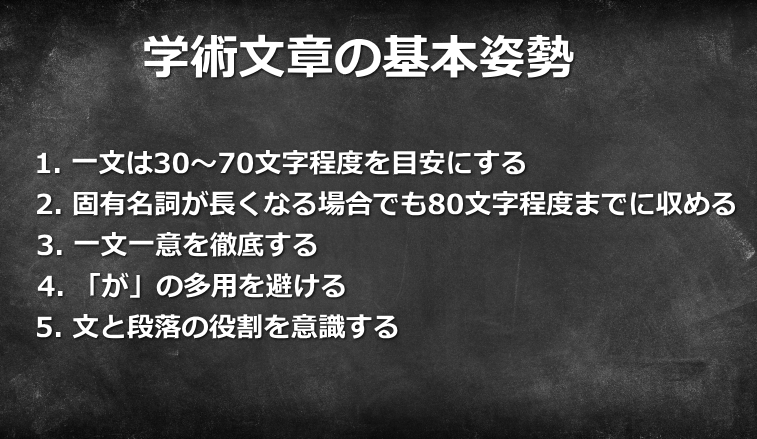
1. Aim for Approximately 30–70 Japanese Characters per Sentence
A basic guideline for maintaining readability and logical clarity.
2. Even with Long Proper Nouns, Aim for Around 80 Japanese Characters or Less
This helps prevent excessively long sentences and keeps the main point clear.
3. Follow the One-Sentence-One-Idea Principle
Keeping one central point in each sentence strengthens persuasiveness.
4. Avoid Overusing “Ga”
Important for preventing wordiness and producing concise, focused prose.
5. Be Aware of the Role of Each Sentence and Paragraph
Writing that reflects the overall logical structure is easier for readers to understand and more likely to communicate effectively.
Applying these principles can substantially improve academic papers and reports. Readable writing supports understanding of the content and helps communicate the significance of the research and the persuasiveness of the discussion more strongly.
Contact
To date, we have supported clients throughout Japan and overseas.over 10,000 casesWe have supported a wide range of academic requests, including graduation/master’s thesis research and report/paper support. Our experienced consultants work closely with clients to meet their needs. We provide prompt and accurate support at reasonable prices, and our Ibooks team members throughout Japan take responsibility for assisting each client.
We send the profile of the responsible staff member when you apply.
For Undergraduate / Master's Thesis Research Support, Report Support, and Paper Support, choose iBooks Academic Support!
0476-85-7930
When orders are busy, phone lines may be difficult to connect.
We will reply in order; if urgent, please contact us byEmail please contact us by this method.
When orders are busy, phone lines may be difficult to connect.
We will reply in order; if urgent, please contact us by
