
Research Proposal: Purpose, Research Problem & Research Questions | How to Distinguish Themblog
Research Proposal: Purpose, Research Problem & Research Questions | How to Distinguish Them
Terms such as research purpose, research problem, and research question are not used identically in every discipline or institution. The key is not to force one vocabulary onto all proposals, but to make the study’s intended contribution, problem, answerable questions, and method logically align.
Research Proposal: Purpose, Research Problem & Research Questions | How to Distinguish Them
“Research Purpose” and “Research Questions” in a Research Proposal
One point that often causes difficulty when students and researchers prepare a research proposal is writing without sufficiently distinguishing between the “research purpose” and the “research questions.” The two are closely related and can easily appear similar. If they are confused, however, the structure of the entire proposal becomes ambiguous and the reader may have difficulty understanding the aim and method of the research. Especially in graduate-school entrance proposals or materials submitted to a supervisor, a clear distinction between the two is often one indicator of the maturity of the research plan.
This article therefore clarifies the difference between “research purpose” and “research questions” and explains concretely how to write them separately.
Research purpose and research questions are easily confused because both concern the core of the study. The research purpose states “what the study seeks to clarify,” while research questions also state “what is being asked.” Writers therefore tend to treat them as almost the same.
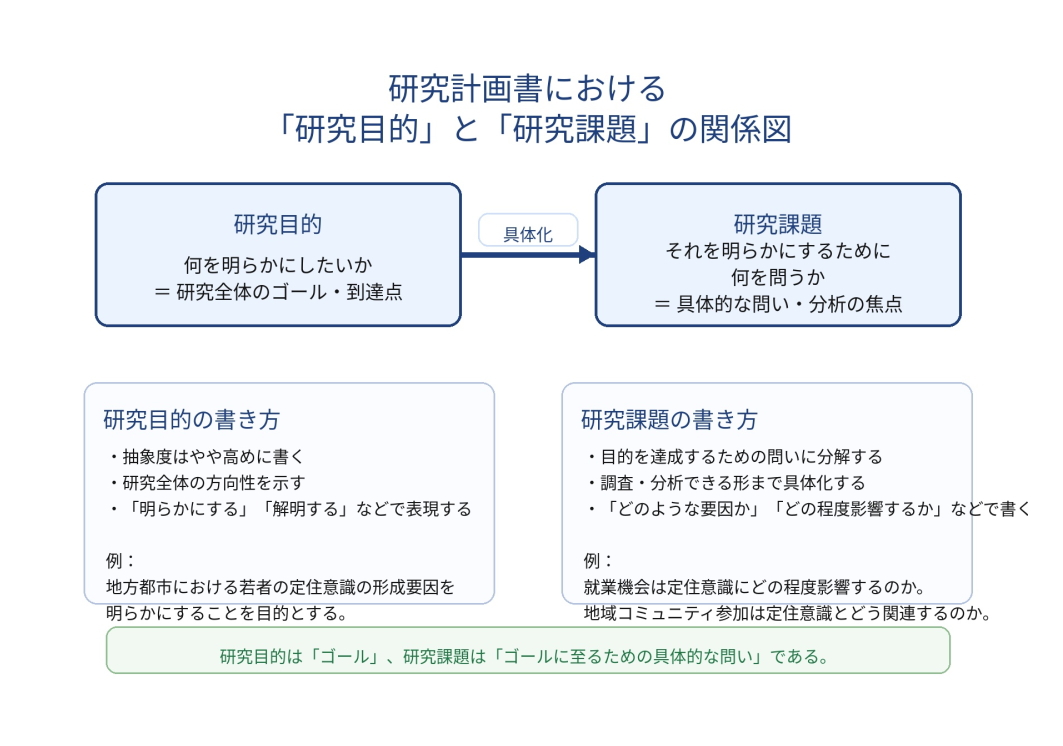
However, they serve different roles. The research purpose indicates what the study as a whole ultimately seeks to clarify—the destination of the research. Research questions are concrete questions established to reach that destination. Put differently, the purpose is the goal, while the questions are the analytical focal points used to reach it. If this distinction remains vague, “why this research is being conducted” and “what specifically will be examined” are not separated, making the proposal feel flat and indistinct.
The research purpose states what the study ultimately seeks to elucidate and what knowledge it aims to obtain. Rather than listing numerous small questions, it should concisely and clearly state the overall direction and aim of the research.
Examples include: “The purpose of this study is to clarify the factors shaping young people’s intentions to settle in regional cities”; “The purpose is to examine factors affecting anxiety among nursing students during clinical practice”; and “The purpose is to clarify the effect of social-media marketing on consumer purchasing behavior.” Each states what object the study addresses and what issue it seeks to clarify.
When writing the research purpose, it is important that the overall picture of the study can be understood at a glance. Trying to include too many things makes the objective unclear. Ideally, the purpose is neither too broad nor too narrow and is stated as a sentence that integrates the study as a whole.
By contrast, research questions are concrete questions set in order to achieve the research purpose.
For example, if the research purpose is “to clarify factors shaping young people’s intentions to settle in regional cities,” the research questions might ask, “How does employment stability relate to settlement intentions?”, “How does attachment to the community affect intentions to remain?”, and “What role do family relationships play?”
Research questions therefore divide the broad research purpose into examinable units. They connect the overall goal with concrete analysis.
research purposeA common mistake is to write the research purpose as a list of questions. For example, “What factors affect purchasing behavior? Does age make a difference? Does income matter?” is not a research purpose but a set of research questions. research questionConversely, another mistake is to make the research questions too broad. Writing only “What is the effect of social-media marketing?” leaves the question too vague to guide concrete analysis.
The key is to assign the overall destination to the research purpose and use research questions to specify the analytical route toward that destination.
A clear relationship is therefore: Research purpose = what the study aims to clarify; research questions = what must be asked in order to clarify it.
For example, if the theme is “the effect of social-media marketing on consumer purchasing behavior,” the research questions might examine how frequency of exposure, perceived credibility, and engagement relate to purchase intention.
The research purpose, on the other hand, should be stated at a higher level, such as “to clarify the effect of social-media marketing on consumer purchasing behavior.”
To avoid confusion, it is effective to write the research purpose first in a single sentence and then ask, “What do I need to ask in order to achieve that purpose?” This procedure makes the division of roles between purpose and questions clear.
Suppose the research purpose is “to clarify factors shaping turnover intention among younger employees in small and medium-sized enterprises.” Research questions can then be formulated such as: “How does workplace communication affect turnover intention?”, “How is perception of the evaluation system related to turnover intention?”, and “Does the outlook for career development affect the strength of turnover intention?”
What matters is that the research questions should not be a random list of ideas. They must converge toward the research purpose, with each question supporting one part of the purpose.
research purpose:To clarify the function of children’s cafeterias as places of belonging in the local community. research question:How do users perceive the children’s cafeteria as a place? What roles do operators expect it to play? What kinds of relationships does it create that differ from those found at school or at home?
Writing in this way allows the reader first to understand the overall aim of the research and then to grasp the perspectives from which analysis will be conducted. The proposal becomes highly readable and logically clear.
To avoid confusing “research purpose” and “research questions” in a research proposal, it is important to be clearly aware of their different roles. The purpose is the overall destination of the study and states “what you want to clarify.” Research questions are concrete questions for reaching that destination and state “what you will ask.”
Simply writing with these two stages in mind greatly improves the logical quality of a research proposal. The research purpose sets the direction, while the research questions establish the path toward it. When writing a proposal, first determine the purpose and then specify the questions needed to achieve it. Following this order is the most reliable way to prevent confusion.
Conclusion:Research purpose means “what you want to clarify”; research questions mean “what you ask in order to clarify it.” Keeping this distinction in mind makes the structure of a research proposal much clearer.
Why Research Proposals Often Confuse These Two Concepts
What Is a Research Purpose?
What Is a Research Question?
The Difference Between Research Purpose and Research Questions in One Sentence
Typical Writing Patterns That Confuse the Two
Practical Ways to Keep Them Distinct
Example of a Clear Distinction
Example Theme: “The Function of Children’s Cafeterias as Places of Belonging”
Summary
Last updated: September 4, 2026
Key Points at a Glance
| Purpose | What the study aims to clarify or contribute overall. |
|---|---|
| Problem | What unresolved issue or gap the study addresses. |
| Research question | What specific answerable question will be examined. |
| Method | What evidence or procedure can answer that question. |
Primary / Academic / Official Sources
Use the submission rules of your university, department, or target journal first. The sources below are verification starting points; read the original material before citing it.
- George Mason University Writing Center, “How to Write a Research Question”
- Purdue OWL, “Articulating a Research Agenda”
Frequently Asked Questions
Are the research purpose and research question the same?
They are often treated as different functions, but terminology varies by institution and discipline. Follow the framework required by your program.
How many research questions do I need?
There is no fixed number. Use only as many as can be answered coherently within the study’s scope and method.
Does the method follow automatically from the question?
No. You still need to identify suitable data, participants or sources, analytic procedures, and feasibility.
Related Articles
- Interim Thesis Presentation
- Literature Search & Review
- How to Write a Discussion
- Thesis Research Support
Related Support
Contact
To date, we have supported clients throughout Japan and overseas.over 10,000 casesof academic support requests. Experienced consultants carefully listen to your needs and provide prompt, appropriate support at reasonable fees.
Ibooks members across Japan will support you responsibly.
We send the profile of the responsible staff member when you apply.
When orders are busy, phone lines may be difficult to connect. We will reply in order, so urgent inquiries should be sent by
