
Undergraduate Thesis Interim Presentation | Slide Structure, Script & Q&A Preparationblog
Undergraduate Thesis Interim Presentation | Slide Structure, Script & Q&A Preparation
An interim thesis presentation is primarily a checkpoint for your research question, method, progress, unresolved issues, and next steps rather than a miniature final defense. Timing and required sections vary by institution, so confirm your department or seminar rules before designing the slides.
An interim thesis presentation is not a venue for reporting a completed study; it is a place to check the research direction, progress, and remaining issues. Presenting the topic, purpose, previous studies, methods, current analysis, and future schedule clearly makes it easier to receive useful advice from the supervisor and seminar members. This article explains how to structure the materials and prepare the presentation script.
Undergraduate Thesis Interim Presentation | Slide Structure, Script & Q&A Preparation
In an interim presentation, a perfect conclusion matters less than whether the research process is appropriate, whether the materials and methods have problems, and how the thesis will be completed. Clearly stating uncertainties at the interim stage is also important.
Presentation materials should allow the audience to follow the study from background to future plans. Before creating slides or handouts, check the allotted presentation time and required items.
Purpose of the interim presentation
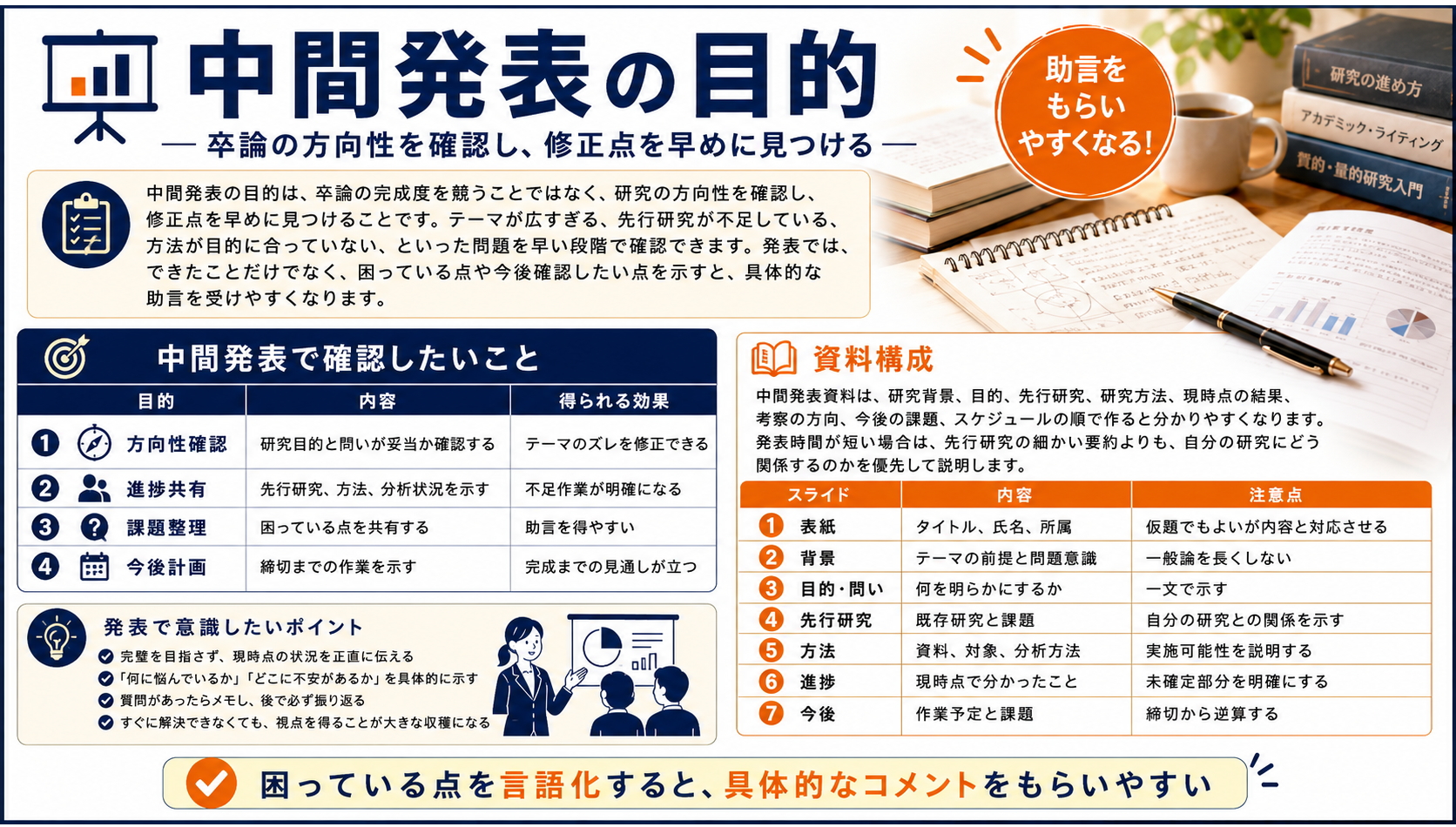
The purpose of an interim presentation is not to compete over how complete each thesis is, but to confirm the research direction and identify revisions early. Problems such as an overly broad topic, insufficient previous studies, or methods that do not fit the purpose can be identified at an early stage.
Present not only what has been completed but also what is difficult and what you want to confirm next. This makes it easier to receive specific advice.
| purpose | Content | Benefit |
|---|---|---|
| Direction check | Check whether the research purpose and question are appropriate. | Correct drift in the topic. |
| Progress sharing | Present the status of previous studies, methods, and analysis. | Remaining work becomes clearer. |
| Issue organization | Share points that are causing difficulty. | Makes it easier to receive advice. |
| Future plan | Show the tasks remaining before the deadline. | Creates a clearer outlook for completion. |
Structure of presentation materials
Interim-presentation materials are easy to follow when organized in the order of research background, purpose, previous studies, research methods, current results, direction of the discussion, future issues, and schedule.
If presentation time is short, prioritize explaining how previous studies relate to your own research rather than summarizing each study in detail.
| Slide | Content | Points of caution |
|---|---|---|
| 1. Title slide | Title, name, affiliation | A provisional title is acceptable, but it should correspond to the content. |
| 2. Background | Premise of the topic and problem awareness | Do not spend too long on general background. |
| 3. Purpose and Question | What the study aims to clarify | State it in one sentence. |
| 4 previous studies | Existing research and remaining issues | Show the relationship to your own study. |
| 5. Methods | Materials, participants or target, and analytical method | Explain the feasibility of the method. |
| 6. Progress | What has been learned so far | Clearly identify points that remain unresolved. |
| 7. Next Steps | Planned tasks and remaining issues | Work backward from the deadline. |
How to prepare the presentation script
A presentation script should not simply read the slide text aloud. Organize the key points for each slide in spoken form. Rather than stating a conclusion too strongly at the interim stage, wording such as "At present, I consider XX to be..." is more appropriate for an interim presentation.
Including the slide number, talking points, and approximate time allocation in the script makes rehearsal easier. Practice aloud in advance to ensure that the presentation stays within the allotted time.
| Item | How to write it | Points of caution |
|---|---|---|
| Opening | State the research topic and the flow of the presentation. | A long greeting is unnecessary. |
| background | Explain why you selected the topic. | Do not make personal interest the only reason. |
| purpose | Clarify the research question | State it in one sentence. |
| Progress | Separate what has been completed from what remains unfinished. | Do not hide weaknesses or unresolved issues. |
| Closing | State the remaining issues. | Tell the audience what you would especially like feedback on. |
Preparing for questions and answers
Questions often concern the scope of the topic, previous studies, the appropriateness of methods and materials, and the future schedule. Prepare likely questions and practice concise answers.
If you do not know the answer, do not force a conclusion. It is more appropriate to say, "I have not yet verified this point, so I will check XX next."
| Likely question | Answer to prepare |
|---|---|
| Why did you choose this topic? | Relationship to the course, previous studies, and social background |
| How does your study differ from previous studies? | Differences in target, method, or perspective |
| Is the method appropriate? | Relationship between the purpose and the method |
| Are the sources sufficient? | Sources already obtained and additional sources planned |
| How will you proceed from here? | Work schedule |
How to show future plans
An interim presentation should include a future work plan. Organize the remaining tasks—additional literature review, survey or experiment, analysis, drafting, revision, and pre-submission checks—by working backward from the deadline.
The schedule does not need to be excessively detailed, but stating what will be completed by when helps demonstrate the feasibility of the research.
| Period | Task | Output |
|---|---|---|
| Immediately after the presentation | Organize comments and feedback. | Prepare a memo on revision strategy. |
| Next two to three weeks | Add literature and revise the method. | Previous-study notes and Methods chapter |
| Analysis period | Organize materials and data. | Analysis results and figures or tables |
| Before submission | Review the full manuscript and verify references. | Completed manuscript |
Pre-presentation checklist
Before the presentation, check typographical errors, slide numbering, references, figures and tables, presentation time, script, and data files. For online presentations, also check screen sharing and PDF conversion.
An interim presentation is an opportunity to receive advice. Rather than hiding unfinished points, clearly identify what you want to consult the audience about.
| ConfirmItem | Checklist content |
|---|---|
| Presentation time | Does it fit within the required time? |
| Structure of presentation materials | Does the presentation flow from background through future plans? |
| reference | Are references listed at the end of the materials? |
| Points for consultation | Have you made clear what you want the audience to comment on? |
| Data and files | Have you checked the PDF, PowerPoint file, and connection environment? |
Support Available from iBooks Academic Support
iBooks Academic Support assists with slide structure, presentation scripts, anticipated questions, organization of research purpose and methods, and revision plans responding to supervisor feedback for undergraduate-thesis interim presentations. We can also assist with short-term adjustments before the presentation and incorporating feedback into the thesis afterward.
Summary | An interim presentation is more about confirming direction than demonstrating completeness
An undergraduate-thesis interim presentation is not a venue for showing the final form of the research. It is a place to check the research direction, progress, issues, and future plan. Organize the topic, purpose, previous studies, methods, progress, and challenges concisely.
When preparing the materials and script, make clear what you want advice on and be ready to incorporate the feedback from questions and answers into the thesis manuscript.
Last updated: September 4, 2026
Key Points at a Glance
| 1. Background & question | State why the study matters and what you are asking. |
|---|---|
| 2. Method & progress | Show what evidence or data you are using and what has been completed. |
| 3. Issues & next steps | Identify unresolved problems, feedback you need, and the next research steps. |
Primary / Academic / Official Sources
Use the submission rules of your university, department, or target journal first. The sources below are verification starting points; read the original material before citing it.
- Keio University Graduate School of SDM, Theme/Interim Presentation Guidance
- Tohoku University GSICS, Presentation Guidance
Frequently Asked Questions
Is it acceptable not to have a final conclusion yet?
Often yes. An interim presentation commonly emphasizes progress and the research plan, but you should check your institution’s own assessment criteria.
How many slides should I use?
There is no universal number. Build the deck around the allotted time and your department’s instructions, while keeping each slide focused.
What if I cannot answer a question?
Do not guess. State what you can support at present and identify what you will verify or investigate next.
Related Articles
- Interim Presentation Slides Article
- Research Purpose & Questions
- How to Write a University Report
- Thesis Research Support
Related Support
Contact
To date, we have supported clients throughout Japan and overseas.over 10,000 casesof academic support requests. Experienced consultants carefully listen to your needs and provide prompt, appropriate support at reasonable fees.
Ibooks members across Japan will support you responsibly.
We send the profile of the responsible staff member when you apply.
When orders are busy, phone lines may be difficult to connect. We will reply in order, so urgent inquiries should be sent by
