
How to Write References for a Report | Books, Journal Articles, Websites & Citationsblog
How to Write References for a Report | Books, Journal Articles, Websites & Citations
A reference list is not merely a list of materials you looked at. It should allow readers to trace the sources actually cited or relied upon in the text. Books, journal articles, and web sources require different bibliographic elements, so verify each item against the original and format it consistently with the required style.
References are an important element supporting the reliability of a report. Problems such as in-text citations that do not match the reference list, ambiguous sources for web pages, or missing page numbers may affect evaluation. This article organizes the basics of quotations, source documentation, and reference lists needed for university reports.
How to Write References for a Report | Books, Journal Articles, Websites & Citations
In a university report, when you use another person's ideas, words, data, figures, or tables, you must identify the source. Citing the source is not merely a formatting requirement; it allows readers to verify which materials support your claims.
Reference styles vary by discipline, course, university, and instructor. This article therefore explains principles common across formats while assuming that the final submission should follow the style specified by the submission destination.
Why references are necessary
The purpose of references is to make the origin of information clear so that readers can verify it. This demonstrates that the claims in the report are based on identifiable evidence.
Without references, it becomes unclear which parts are your own ideas and which come from other people's knowledge. To avoid plagiarism, cited passages must correspond to entries in the reference list.
| purpose | Content | Effect |
|---|---|---|
| Showing the evidence | Identify the source on which a claim is based. | Reliability increases. |
| Verifiability | Readers can verify the source. | Academic transparency increases. |
| Prevention of plagiarism | Distinguish others' knowledge from your own analysis. | This helps avoid inappropriate use. |
Direct and indirect quotation
A direct quotation reproduces the source wording exactly, normally with quotation marks and information such as the author, year, and page number. An indirect quotation summarizes the source content in your own words. In both cases, the source must be identified.
More quotations are not automatically better. Direct quotation is useful for definitions, important wording, and precise language in laws or documents; ordinary explanatory passages are often easier to read when paraphrased with an appropriate citation.
| Type | How to use it | Points of caution |
|---|---|---|
| Direct Quotation | Reproduce the original wording exactly. | Do not alter it, and verify the page number. |
| Indirect Quotation | Summarize the content. | A source citation is still required even when the wording is your own. |
| Summary | Organize information spanning multiple pages. | Make the relevant scope and bibliographic information clear. |
Basics of a reference list
The reference list should contain the sources actually used in the report. Typical information includes author, publication year, title, publisher, journal name, volume and issue, pages, URL, and access date, although the required elements vary by citation style.
If a source cited in the text is missing from the reference list, or a source in the reference list is never used in the text, the report is inconsistent. Before submission, cross-check the in-text citations against the reference list.
| Source type | Main information to include | Where to verify it |
|---|---|---|
| Book | Author, year, book title, publisher | University-library OPAC, National Diet Library Search |
| paper | Author, year, paper title, journal name, volume and issue, pages | CiNii Research、J-STAGE、Google Scholar |
| Web page | Publisher or author, page title, URL, access date | Official website or page of the issuing organization |
| Statistical material | Survey name, year, table number, issuing organization | e-Stat and official government websites |
How to format different source types
Books, papers, web pages, newspaper articles, and statistical materials require different bibliographic details. For example, journal name, volume and issue, and page range are important for papers, while URLs and access dates require particular attention for web sources.
If the submission destination specifies APA, MLA, Chicago, a Japanese citation style, or another format, follow that format. Even when no style is specified, keep the notation consistent throughout the same report.
| Sources | Information to include | Points of caution |
|---|---|---|
| Book | Author, year, book title, publisher | Edition or translator may also be required. |
| paper | Author, year, paper title, journal name, volume and issue, pages | Verify the DOI if one is available. |
| Web | Publisher or author, page title, URL, access date | Prefer official materials to personal blogs. |
| Laws and regulations | Name of the law, provision, and date checked | Pay attention to the latest amendments. |
Points to note for web sources
Web materials are convenient, but their reliability varies. For university reports, prioritize materials whose publisher is clear, such as government agencies, universities, academic societies, research institutes, and publishers.
A URL by itself may be insufficient as a reference. Verify the page title, publisher or author, publication or update date, and access date, and format the entry according to the submission requirements.
Common reference problems
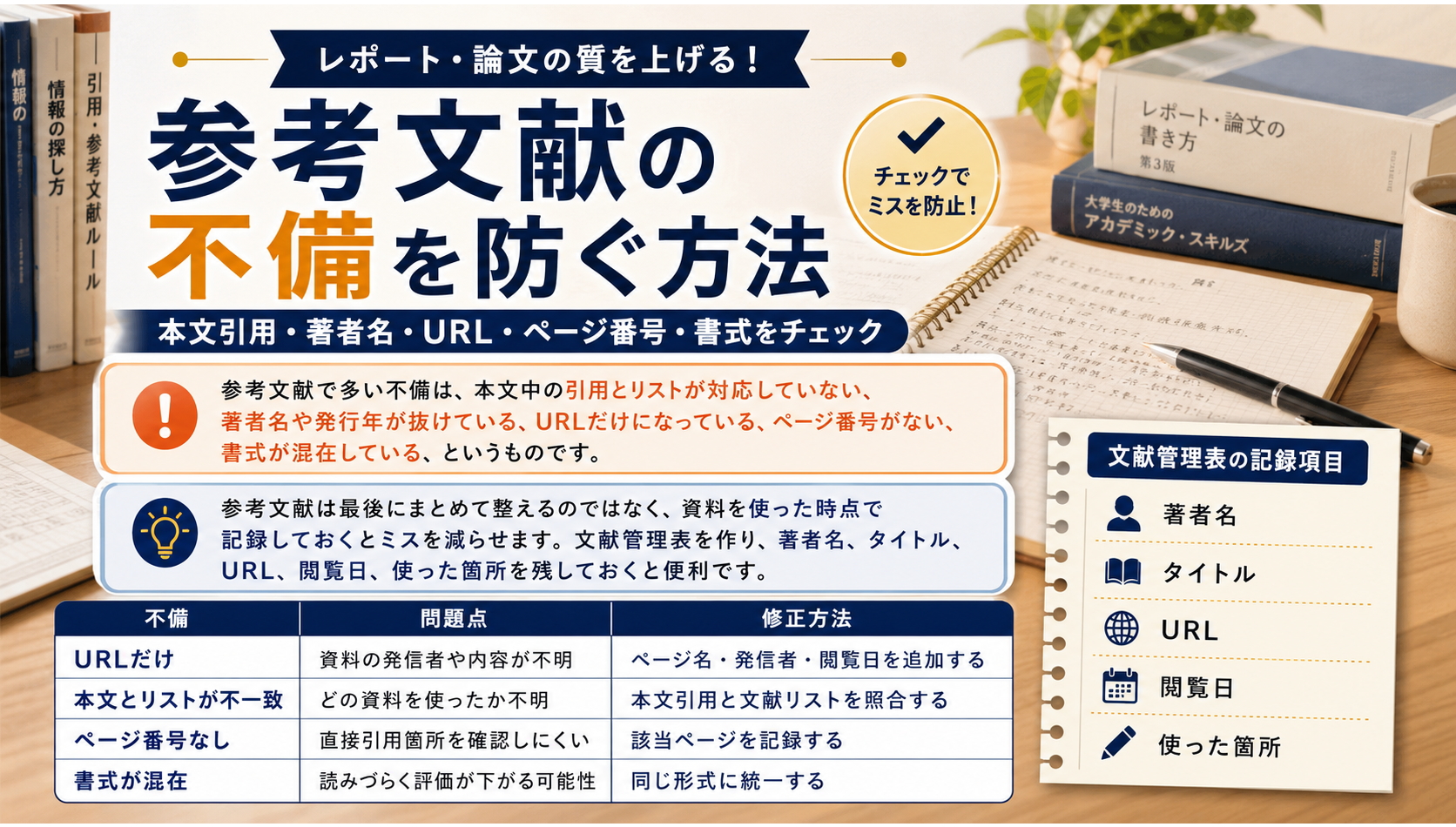
Common reference problems include in-text citations that do not match the reference list, missing author names or publication years, URL-only entries, missing page numbers, and mixed citation styles.
Do not wait until the end to organize references. Recording source details as soon as you use them reduces mistakes. A literature-management table containing author, title, URL, access date, and the passage where the source was used can be useful.
| Problem | Problem | How to correct it |
|---|---|---|
| URL only | The publisher or content of the source is unclear. | Add the page title, publisher or author, and access date. |
| Mismatch between the text and reference list | It is unclear which sources were actually used. | Cross-check the in-text citations and reference list. |
| No page number | The exact location of a direct quotation is difficult to verify. | Record the relevant page number. |
| Mixed citation styles | This can reduce readability and may negatively affect evaluation. | Standardize all entries in the same format. |
Pre-submission checks
Before submission, cross-check in-text citations, notes, the reference list, and sources for figures and tables. Be especially careful with copied source titles and URLs, which are prone to typographical errors and broken links.
If you use bibliographic information suggested by generative AI or a search engine, always verify that the source actually exists. Do not include fabricated references or incorrect page numbers.
| ConfirmItem | Checklist content |
|---|---|
| In-text citations | Where required, are the author, year, and page number provided? |
| Reference list | Does it include every source actually used in the text? |
| Web sources | Have you verified the publisher or author, URL, and access date? |
| Figures and tables | Have you provided the source or explained how they were created? |
| Formatting | Is the same citation style used consistently? |
Support Available from iBooks Academic Support
iBooks Academic Support assists with organizing reference lists for reports and undergraduate theses, cross-checking citation locations, verifying that references actually exist, checking sources for web materials, and adjusting entries to a specified style. Please contact us if you are concerned about missing references or inconsistent formatting.
Summary | References support the reliability of a report
References are not decorative material appended to the end of a report. They are essential for showing the basis of claims and enabling readers to verify the information.
Match cited passages with entries in the reference list, verify the required information for each source type, and standardize the formatting according to the submission requirements.
Last updated: September 4, 2026
Key Points at a Glance
| Book | Author, year, title, publisher, and style-specific details. |
|---|---|
| Journal article | Author, year, article title, journal, volume/issue, pages, DOI where available. |
| Web source | Author/organization, page title, date, URL, and access date if required by the style. |
Primary / Academic / Official Sources
Use the submission rules of your university, department, or target journal first. The sources below are verification starting points; read the original material before citing it.
- Agency for Cultural Affairs, Copyright Text (FY2026)
- Purdue OWL, “In-Text Citations: The Basics”
- APA Style, “Citations”
Frequently Asked Questions
Does every in-text citation need a reference-list entry?
In general, cited or referenced works should match entries in the reference list, subject to the rules of the required citation style.
Should I include both a DOI and a URL?
That depends on the citation style and source type. Follow the current guidance required by your institution or journal.
What if a webpage has no named individual author?
An organization may function as the author. Do not invent a person’s name; use the responsibility information actually shown on the page and follow the required style.
Related Articles
- Citations & References
- How to Write a University Report
- Literature Search & Review
- University Report Support
Related Support
Contact
To date, we have supported clients throughout Japan and overseas.over 10,000 casesof academic support requests. Experienced consultants carefully listen to your needs and provide prompt, appropriate support at reasonable fees.
Ibooks members across Japan will support you responsibly.
We send the profile of the responsible staff member when you apply.
When orders are busy, phone lines may be difficult to connect. We will reply in order, so urgent inquiries should be sent by
