
How to Cite Sources and Write References | Direct Quotes, Paraphrases & Reference ListsHow to cite and reference
Good academic citation lets readers distinguish your own argument from borrowed wording or ideas and trace each claim back to its source. Separate direct quotations, paraphrases, and the final reference list, then follow the citation style required by your course, department, or journal.
Correct Citation Methods
Proper citation involves four basic rules: there must be a legitimate need to quote another person's work; the quoted portion must be clearly distinguished from your own writing, for example by quotation marks; the source must be clearly identified; and the quotation must not be excessively long. When citing websites, it is also necessary to understand why proper citation is required, how to cite correctly, and what points require attention. Mastering correct citation practices helps avoid copyright infringement and supports the creation of reliable content.Below, as specific methods for direct and indirect quotation, we introduce simplified citation methods with reference to Kazuhisa Todayama (2012)“New Edition: The Paper-Writing Classroom—From Reports to Undergraduate Theses”(NHK Publishing, pp. 239–252).
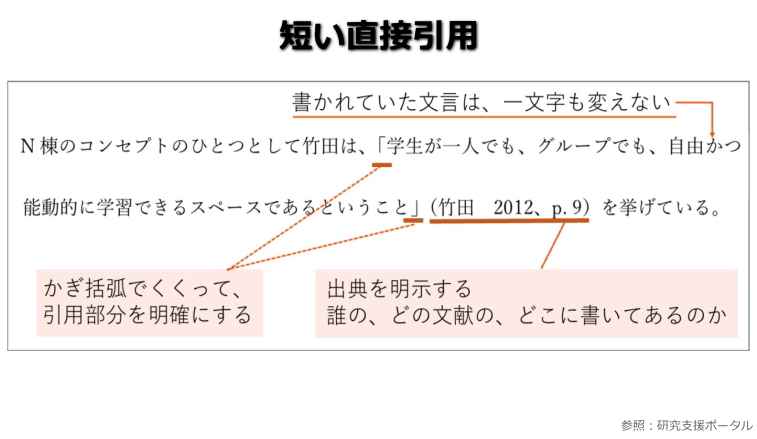
Short Direct Quotation
Enclose the quoted passage in quotation marks.
Insert parentheses at the end of the quoted passage.
Inside the parentheses, include only the author's surname, year of publication, and relevant page number.
Example: Takeda 2012, p. 9
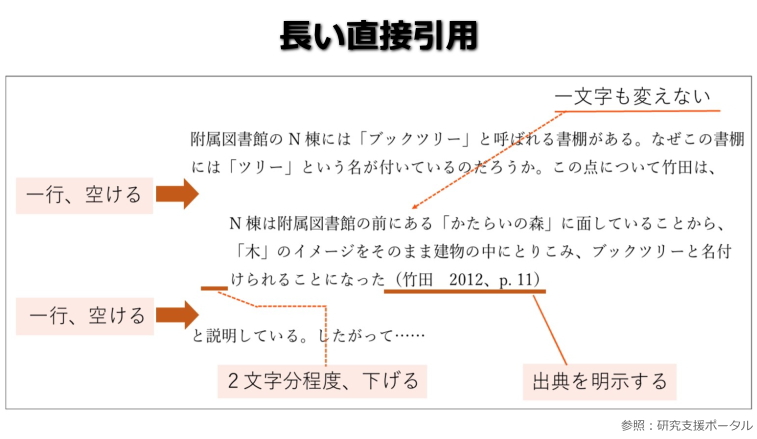
Long Direct Quotation
Leave one blank line before and after the quotation so that it is separated from your own text.
Indent the entire quoted passage by about two characters.
Insert parentheses at the end of the quoted passage.
Inside the parentheses, include only the author's surname, year of publication, and relevant page number.
Example: Takeda 2012, p. 11
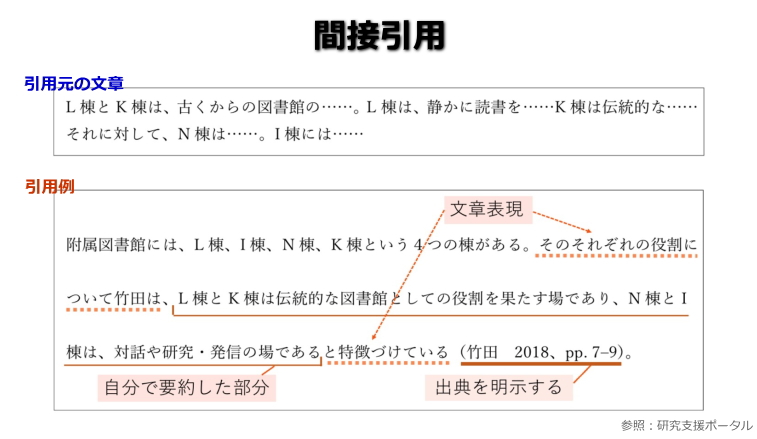
Indirect Quotation
Summarize the source in your own words, taking care not to alter the author's intended meaning.
Use the wording before and after the cited section to make the boundary between your own writing and the source clear.
Insert parentheses at the end of the quoted passage.
Inside the parentheses, include only the author's surname, year of publication, and the relevant page or pages used for the summary.
Example: Takeda 2018, pp. 7–9
Citation styles include methods that do not use footnotes and methods that insert a footnote number at the end of the cited passage and provide bibliographic information in the footnote. When using footnotes, the footnote function in Word or similar software automatically displays footnote numbers and the corresponding note area. This also updates numbering automatically when notes are added, making footnote management more efficient. When citing sources, it is important to identify the source clearly and follow correct citation practices to avoid copyright infringement.
How to Write References
A “reference list” (bibliography, list of literature, or works cited list) is a list placed at the end of a report or paper that provides detailed information about the books, articles, and materials used. With a reference list, only abbreviated source information needs to appear in the main text, while readers can consult the list for full details. A reference list also allows readers to quickly understand what previous research a paper is based on. The required format varies by field and journal. You should confirm the required style with your supervisor and keep a reliable style guide for your field available for reference. One example of how to format references is introduced below.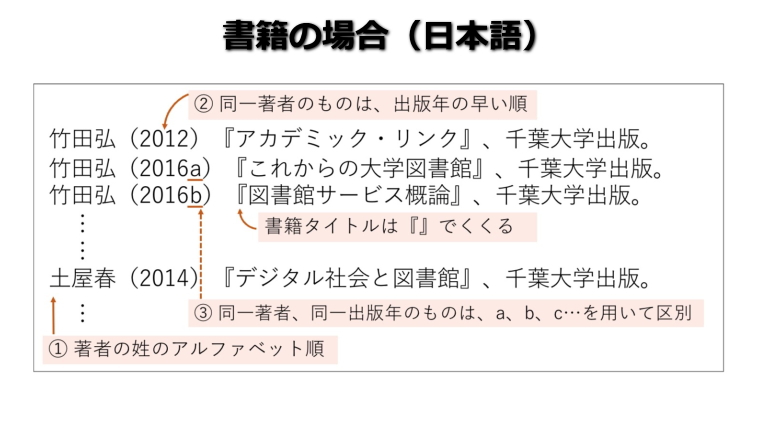
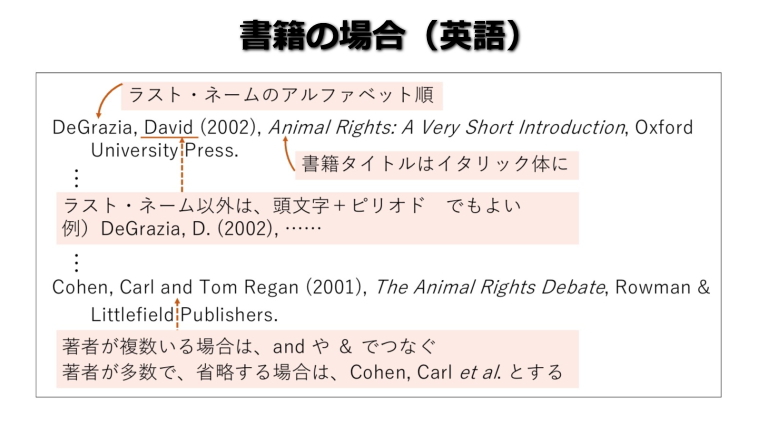
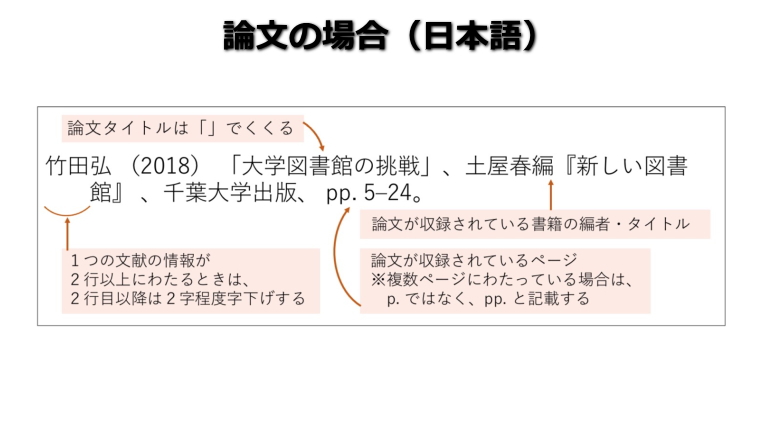
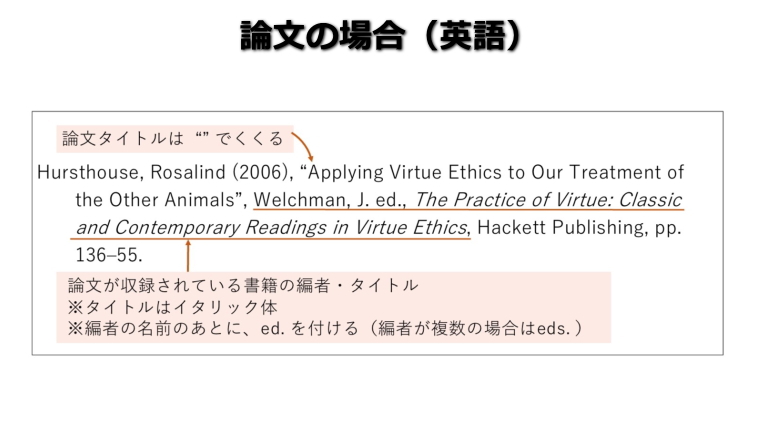
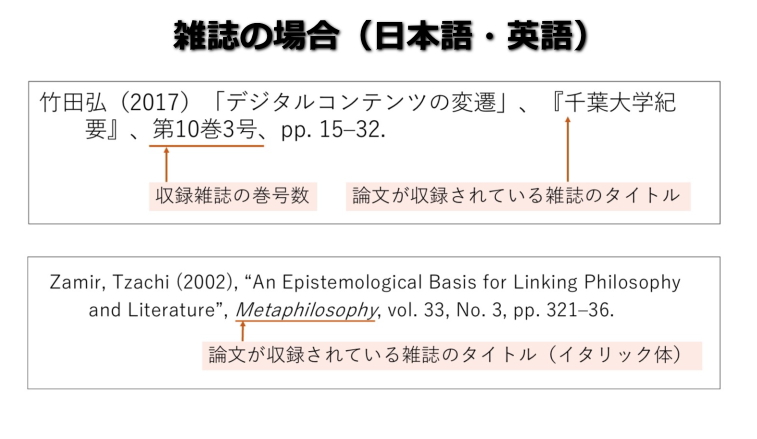
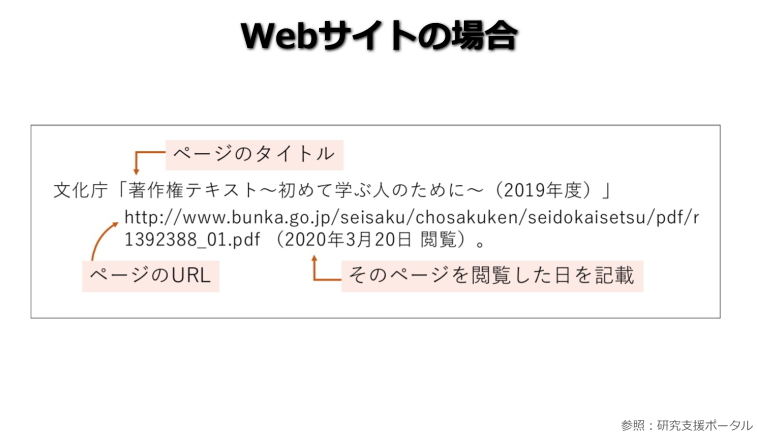
When citing a website, always state the date on which you accessed the page. This is necessary because information on websites may later be deleted or revised.
As in the examples above, bibliographic information uses various symbols such as parentheses, brackets, quotation marks, commas, and periods. The choice of symbols and the order in which information appears also have meaning. Therefore, you should not freely change symbols within the same bibliographic entry or rearrange the information. Because detailed conventions differ by field, consult a guide to bibliographic formatting that is appropriate for your discipline.
Points to note when copying bibliographic information or keeping reading records
As shown above, detailed information about the sources and materials used must be recorded. This creates several practical points to watch. For example, suppose you photocopy only the part of an article that you want to quote. If you copy only those pages, you may lose important details such as the journal issue number and the article's full page range, causing problems later when preparing the reference list.
Similarly, when copying a bibliography or keeping a reading record, it is helpful to record all information needed for the reference list at the same time. For Japanese books, accurate publication information is usually found in the colophon at the end of the book. When making copies, be sure to copy the relevant bibliographic information as well.
How much should be included in the reference list?
When preparing a bibliography, you may wonder how much of what you have read should be included. For example, should an introductory book that you read only to understand the general background of a topic be listed as a reference?
On this point, for example, Akio Sawada (1977)“How to Write an Academic Paper”(Kodansha, p. 148) states that “books used only indirectly in the process of writing a paper are better left out of the bibliography.” This suggests that it may not be necessary to list every source read only to deepen your personal understanding. However, sources that directly influence your writing—for example, sources used to explain the overall picture of a topic—should generally be included. In addition, not only sources quoted directly but all works listed in the references should normally be connected in some way to the main text or notes. In some cases, a simple “reference list” may seem sufficient, but if no connection is shown, readers cannot tell which part of the paper relates to which source. Using other people's research without making that relationship clear may be regarded as inappropriate academic practice.
Last updated: September 4, 2026
Key Points at a Glance
| In the text | Distinguish direct quotations from paraphrases and cite the source at the point of use. |
|---|---|
| In the reference list | Make sure every cited source has a matching reference entry. |
| Before submission | Verify style, author, year, page, URL/DOI, and bibliographic details against the original source. |
Primary / Academic / Official Sources
Use the submission rules of your university, department, or target journal first. The sources below are verification starting points; read the original material before citing it.
- Agency for Cultural Affairs, Copyright Text (FY2026)
- Purdue OWL, “In-Text Citations: The Basics”
- APA Style, “Citations”
Frequently Asked Questions
Should I always use APA style?
No. If your course, university, discipline, or target journal specifies a style, that requirement takes priority.
Do paraphrases still need citations?
Yes. Restating another author’s idea in your own words does not remove the need to identify the source.
Can a website appear in a reference list?
Yes, when appropriate. Verify the author or organization, page title, date, URL, and any access-date requirement specified by your citation style.
Related Articles
- How to Write References
- How to Write a University Report
- Literature Search & Review
- University Report Support
Related Support
Contact
To date, we have supported clients throughout Japan and overseas.over 10,000 casesWe have supported a wide range of academic requests, including graduation/master’s thesis research and report/paper support. Our experienced consultants work closely with clients to meet their needs. We provide prompt and accurate support at reasonable prices, and our Ibooks team members throughout Japan take responsibility for assisting each client.
We send the profile of the responsible staff member when you apply.
For Undergraduate / Master's Thesis Research Support, Report Support, and Paper Support, choose iBooks Academic Support!
When orders are busy, phone lines may be difficult to connect.
We will reply in order; if urgent, please contact us by
