
How to Write a Literature Review | How to Organize Previous Studiesblog
How to Write a Literature Review | How to Organize Previous Studies
A literature review is more than a series of summaries of previous studies. It compares multiple studies, organizes what has been clarified and what remains unresolved, and shows where your own research is positioned. This article explains how to write a literature review for an undergraduate thesis or report.
How to Write a Literature Review | How to Organize Previous Studies
A literature review plays an important role in undergraduate theses and research proposals. By showing the development of existing research, it allows you to explain where your own study is positioned.
Simply listing "A argued X" and "B argued Y" is a weak literature review. You need to organize relationships among sources, commonalities, differences, and remaining issues.
Role of a literature review
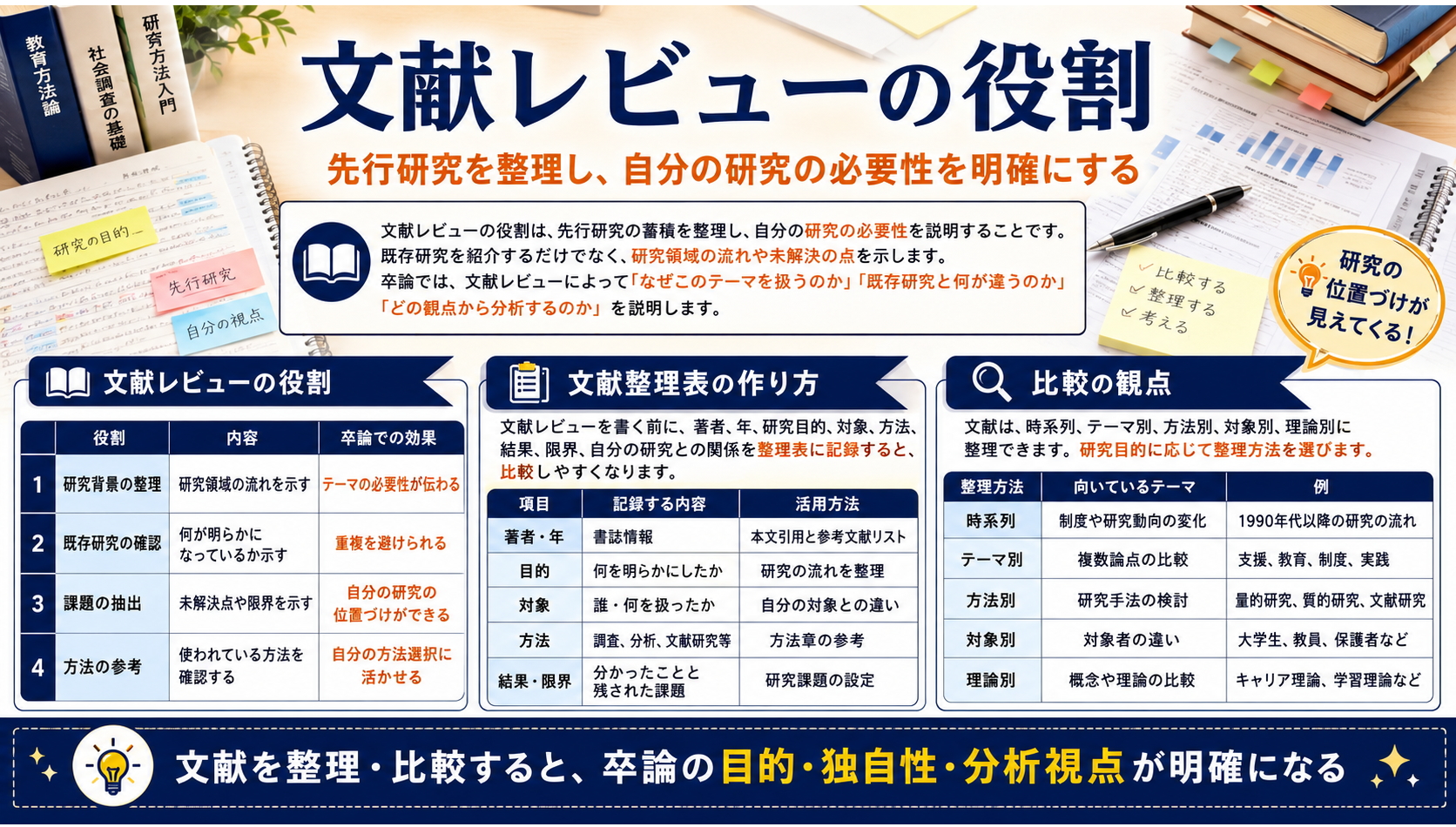
The role of a literature review is to organize the accumulated findings of previous studies and explain why your own research is needed. It should show the development of the field and unresolved points rather than merely introduce existing studies.
In an undergraduate thesis, the literature review helps explain why the topic is being studied, how it differs from existing research, and from what perspective it will be analyzed.
| Role | Content | Benefits in an undergraduate thesis |
|---|---|---|
| Organizing the research background | Show the development of the research field. | The need for the topic becomes clearer. |
| Checking existing research | Show what has already been established. | Avoid unnecessary duplication. |
| Extracting remaining issues | Show unresolved points and limitations. | This allows you to position your own research. |
| Learning from methods | Check which methods previous studies have used. | Use this information when selecting your own method. |
How to create a literature-organization table
Before writing the literature review, create a literature-organization table. Record the author, year, research purpose, population or target, method, results, limitations, and relationship to your own research.
A table makes comparison easier instead of leaving you with isolated summaries. It also helps you decide later which sources to use in each part of the manuscript.
| Item | What to record | How to use it |
|---|---|---|
| Author and year | Bibliographic information | In-text citations and reference list |
| purpose | What the study clarified | Organize the development of the field. |
| Population or target | Who or what did it study? | Differences from your own research target |
| methods | Survey, analysis, literature review, etc. | Reference for the Methods section |
| Results and limitations | What was clarified and what issues remain | Formulating the research question |
Perspectives for comparison
A literature review can organize sources chronologically, thematically, by method, by population, or by theory. The most appropriate system depends on your own research purpose.
For example, chronological organization suits changes in institutions or research trends; thematic organization suits comparison of several arguments; and method-based organization suits examination of differences in research approaches.
| Organization method | Suitable topic | Example |
|---|---|---|
| Chronological | Changes in institutions or research trends | Development of research since the 1990s |
| Thematic | Comparison of multiple issues | Support, education, institutions, practice |
| By method | Examination of research approaches | Quantitative research, qualitative research, literature-based research |
| By population or target | Differences among participant groups | University students, teachers, parents, etc. |
| By theory | Comparison of concepts or theories | Career theory, learning theory, etc. |
How to write the review in the main text
In the main text of a literature review, do not discuss each source separately in sequence. Organize the discussion by issue. Starting with an overview such as "Research on XX can be broadly divided into perspectives A and B" makes the review easier to follow.
Then introduce representative studies, explain their commonalities and differences, and finally identify the issue that leads to your own research.
| How to write it | Content | Example |
|---|---|---|
| Overall organization | Show the development of the research field. | Previous studies can be broadly classified into three groups. |
| Representative research | Introduce important sources. | A clarified XX. |
| Comparison | Show commonalities and differences. | In contrast, B focused on YY. |
| Presenting the remaining issue | Show what remains unresolved. | However, ZZ has not yet been sufficiently examined. |
How to present the research question
At the end of the literature review, identify limitations or unresolved points in existing research. This is not an attempt to dismiss previous studies; it explains which part your own study will address.
A flow such as "Previous studies have clarified XX. However, YY has not been sufficiently examined. The present study therefore examines ZZ" creates a clear connection to the research purpose.
Common mistakes
Common mistakes include summarizing sources one by one, using too many quotations, failing to show the development of the field, and not explaining the relationship to your own research.
Organization and positioning are more important than summary alone. You do not need to give equal space to every source you have read; focus on the literature most important to the topic.
| Mistake | Problem | How to correct it |
|---|---|---|
| Series of isolated summaries | The overall picture is difficult to see. | Classify the literature by issue. |
| Too many quotations | Your own organization is weak. | Add comparison and explanation after quotations. |
| Only old literature | The current situation may not be reflected. | Check recent literature as well. |
| Unrelated to your own study | Your research cannot be positioned clearly. | Explain the relationship to the research purpose. |
Support Available from iBooks Academic Support
iBooks Academic Support assists with paper searches for literature reviews, creation of literature-organization tables, classification of previous studies, extraction of research questions, organization of the review text, and preparation of citations and reference lists. Please contact us if you have collected literature but cannot organize it or if your previous-studies chapter has become only a series of summaries.
Summary | A literature review compares and positions previous studies
A literature review is not merely a section for summarizing previous studies. It organizes the development of the field, commonalities, differences, and unresolved issues.
Creating a literature-organization table, classifying sources by issue, and showing which problem your study addresses can make an undergraduate thesis or research proposal more persuasive.
Points to Check to Improve the Reliability of This Article
This article organizes principles of academic writing, citation and reference checks, and pre-submission review that apply to both university reports and undergraduate theses. For actual submission, always give top priority to the required format of your university, course instructor, seminar, faculty or graduate school, or target journal or university bulletin.
| ConfirmItem | What to Check | How to apply this in the main text |
|---|---|---|
| Submission requirements | Check the word count, format, citation method, submission-file format, and deadline. | Make the main-text structure, notes, references, and figure and table numbering consistent. |
| Supporting sources | Distinguish course materials, assigned textbooks, academic papers, official materials, and primary sources. | Make the relationship between claims and evidence explicit. |
| Citations and references | Verify author names, publication years, titles, publishers, journal names, volume and issue numbers, pages, URLs, and other required information. | Avoid plagiarism and incomplete sourcing and improve reliability. |
| Pre-Submission Review | Check typographical errors, logical leaps, duplicate headings, and omissions from the reference list. | Bring the report to a level of completeness that is clear to the reader. |
Reference Materials / Verification Sources
When verifying literature and formatting, do not rely solely on search-result snippets. Check real academic databases, university libraries, publishers, and primary information from government agencies and other authoritative bodies.
- CiNii Research: Can be used to search Japanese academic papers, books, research data, and related materials.
- J-STAGE: Can be used to search and view academic papers published by Japanese academic societies and related organizations.
- Google Scholar: Can serve as an entry point for searching academic literature across Japan and overseas.
- National Diet Library Search: Can be used to check holdings information for books, journals, doctoral dissertations, and related materials.
Related Services / Internal Links
In reports and undergraduate theses, evaluation can be affected by the quality of the structure, previous studies, citations, references, discussion, and pre-submission checks. Review the related pages as well.
University Report SupportGraduation Thesis / Master's Thesis Writing SupportAcademic Paper and Literature SearchAI Report / Paper ConsultationFree Quote / Consultation
FAQ
Is a literature review different from a summary of previous studies?
Yes. A literature review compares multiple previous studies and organizes the development and unresolved issues of the field.
How many studies should I read for a literature review?
The number depends on the field and assignment. What matters is not the count itself but whether you have appropriately organized literature relevant to your research purpose.
Can I include my own opinion in a literature review?
Yes, but it should be based on comparison of previous studies and an organized account of remaining issues.
My literature review has become a series of summaries. How can I improve it?
Classify the literature thematically, by method, population, or chronology, and explain the commonalities and differences among the groups.
Contact
To date, we have supported clients throughout Japan and overseas.over 10,000 casesof academic support requests. Experienced consultants carefully listen to your needs and provide prompt, appropriate support at reasonable fees.
Ibooks members across Japan will support you responsibly.
We send the profile of the responsible staff member when you apply.
When orders are busy, phone lines may be difficult to connect. We will reply in order, so urgent inquiries should be sent by
