
How to Write ReportsHow to Write Reports
reportWhat is
University study involves more than simply listening to lectures; students are expected to learn and think independently. For this reason, universities often assign reports. A report presents an analysis or discussion based on objective facts or data and differs from the compositions and personal impressions commonly written before university. The process of completing a report involves carefully considering the purpose of the assignment, gathering appropriate data and materials, analyzing them, and then writing the paper. University study also requires students to formulate their own questions and acquire the methods of academic inquiry.The purpose of university lectures is not simply to acquire knowledge, but to learn the distinctive ways of seeing the world developed by academic disciplines. At university, students can choose what they study and build their own schedules by selecting courses. Here, we look at the general process from planning a report to submitting it.
Step 1: Confirm the Report Assignment
When writing a report, the first step is to understand the goal of the assignment and clarify what the report is expected to accomplish. Depending on the assignment, you may be asked to write on a specified topic, choose your own topic and conduct research and discussion, summarize course content, summarize specified materials or literature, or report data obtained from an experiment or practical exercise. It is also important to plan how research and writing will proceed before the deadline. As a rough guide, the introduction often accounts forAbout 10–20%about 10–20% of the report.
Step 2: Preparation—Organizing Ideas
When you receive a report assignment, it is important to begin preparatory work early. Even with the same topic, the issues to address and the way ideas are organized differ from person to person, and organizing ideas can be difficult for many students. Here, we introduce BrainstormingandClusteringtwo methods: brainstorming and clustering. Brainstorming is a method of freely generating ideas and then organizing them to produce new ideas. Clustering is a method of arranging ideas by keywords and linking related concepts. Experience with these methods can also be useful in many educational and job-search settings.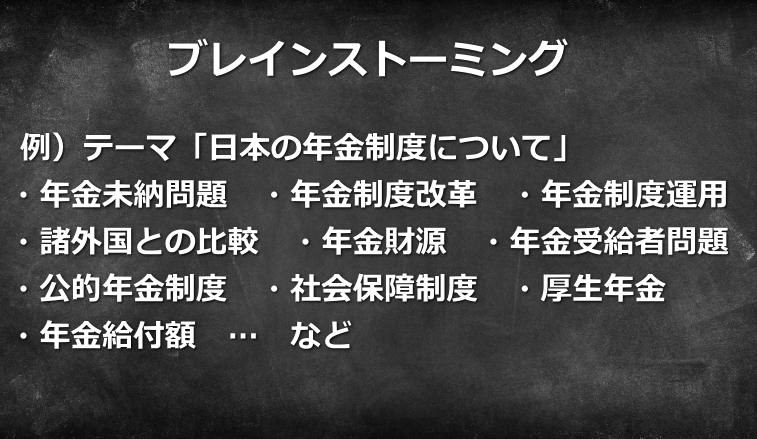
Clustering visually represents the relationships among ideas by circling them and connecting them with lines. First, write the central idea in the middle of the page and circle it. Then write related ideas around it, circle them, and connect them to the central theme. Around ideas narrowed down through brainstorming, add further related ideas and circle them. Clustering can lead to new ideas and helps you see the overall structure of a problem. It may reveal that some initial ideas are unnecessary or that important elements are missing. You can then add or remove ideas to balance the overall structure. Finally, use the completed cluster to create an outline for the report.

Step 3: Report Structure
Unless otherwise specified, reports and degree papers generally followThree-part structure: “Introduction,” “Main Body,” and “Conclusion”a three-part structure of “Introduction,” “Main Body,” and “Conclusion.” As a rough guide, the Introduction is10~20%about 10–20%, the Main Body70~80%about 60–80%, and the Conclusion10%about 10–20%. The specific role of each section varies by field and assignment, but in general they function as follows.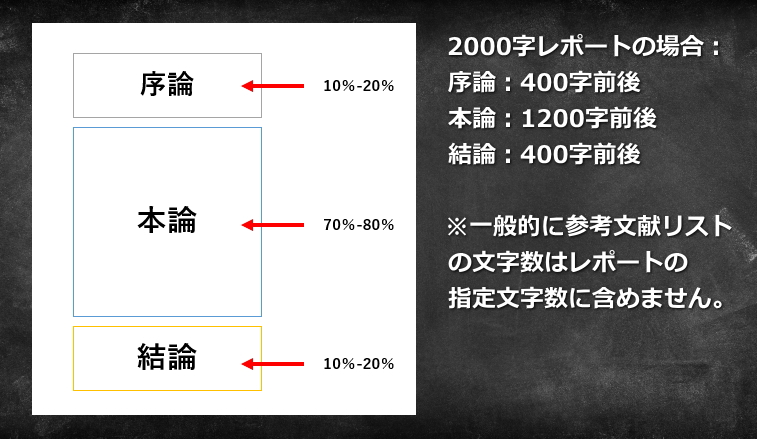
introduction
In the introduction, explain what will be examined and provide the background and purpose, while indicating how the answer to the problem will be developed in the main body. Specifically, identify the issue or theme and preview the direction of the answer. You should also confirm the required format, word count, deadline, and submission method. Types of reports include book reports, descriptive reports, assignment reports, and research reports.
main body
In the main body, present the grounds for why the answer to the question posed in the introduction leads to the conclusion you reach. This is usually the longest of the three sections and can be divided into chapters and sections to develop the argument clearly. The main body may rely on empirical data from surveys or experiments. Use facts and data as evidence, explain logically why the conclusion follows, and write in clear and concise language.
Conclusion
In the conclusion, provide the answer to the question presented at the beginning. The conclusion must follow logically from the evidence and reasoning developed in the main body. It should correspond directly to the problem stated in the introduction, briefly summarize the supporting argument, and leave the reader with a clear impression. The conclusion is one of the most important parts of a report and should be concise and unambiguous.
Note: For Science and Engineering Reports
In science and engineering courses, laboratory reports are often required. Although the basic structure is generally Introduction, Main Body, and Conclusion, laboratory reports usually divide this structure further Five-part structureinto five parts. Typically, the Introduction states the purpose and overview of the experiment; the Main Body describes the apparatus and principles, experimental method, and results; and the Conclusion presents the conclusions and discussion. Figures, equations, graphs, and other materials are often required so that others can understand the procedure, results, and conclusions. The key to summarizing an experiment or lecture is to identify its essential points accurately.References:“For Young People About to Write Reports and Undergraduate Theses”
Key Point: Building an Argument
When developing a report, you need to consider what counts as evidence and what is required to support an argument. The strength of an argument—within a paragraph and across the structure of the entire report or paper—can determine whether the work is convincing. Evidence may include facts, data, and expert opinions. Sound argumentation requires logical thinking and organization: define the issue clearly, present evidence accurately, and develop the reasoning coherently.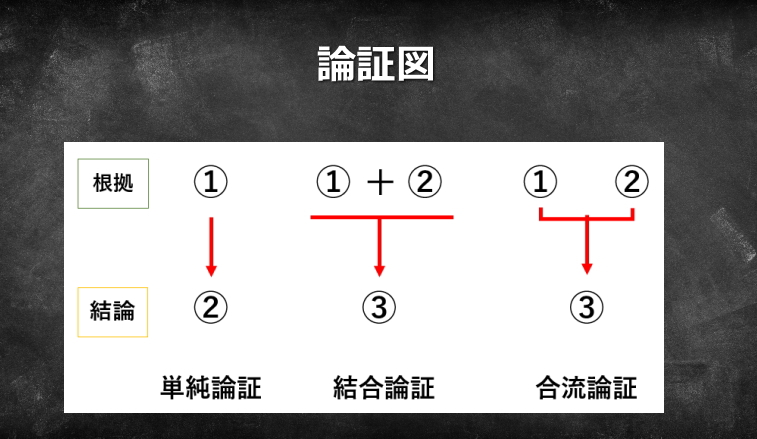
Evidence for an Argument
The kinds of evidence used vary by discipline and topic and may include facts, data, and documentary sources. However, you must verify whether those grounds are reliable.Only “facts” can serve as evidenceFor example, confirm whether survey or experimental data were obtained using appropriate methods that minimize bias. When citing data from other literature or websites, examine whether the underlying survey or experimental methods were appropriate and whether the data are still valid or may have changed over time. Strong argumentation requires logical reasoning and organization, and you should check for gaps or unsupported leaps in the argument.Are there counterarguments or exceptions?
When writing a paper or report, consider in advance whether there are counterarguments or exceptional facts that conflict with your claim. Addressing them can make the argument more persuasive because alternative possibilities have been considered explicitly. Claims also vary in certainty: some may be nearly certain, while others may be supported only to a more limited degree. Therefore, it is important to consider counterarguments and exceptions and to express the strength of claims appropriately.Contact
To date, we have supported clients throughout Japan and overseas.over 10,000 casesWe have supported a wide range of academic requests, including graduation/master’s thesis research and report/paper support. Our experienced consultants work closely with clients to meet their needs. We provide prompt and accurate support at reasonable prices, and our Ibooks team members throughout Japan take responsibility for assisting each client.
We send the profile of the responsible staff member when you apply.
For Undergraduate / Master's Thesis Research Support, Report Support, and Paper Support, choose iBooks Academic Support!
0476-85-7930
When orders are busy, phone lines may be difficult to connect.
We will reply in order; if urgent, please contact us byEmail please contact us by this method.
When orders are busy, phone lines may be difficult to connect.
We will reply in order; if urgent, please contact us by
