
How to Write a Graduation ThesisHow to write your graduation thesis
graduation thesisWhat is
An undergraduate thesis is a paper in which students in the final year of a university or college of technology summarize the results of research conducted over approximately one year and submit it for faculty review. Except in some faculties and departments, such as certain business, economics, and law programs, submission of an undergraduate thesis may be a graduation requirement. Because students often write their theses while also managing job-hunting activities, scheduling can be difficult, so it is important to begin early. Undergraduate theses may also require around 20,000 characters or more, a volume many students have never written before, making last-minute completion extremely difficult.Differences among undergraduate theses, graduation research, and graduation projects
An undergraduate thesis is a paper submitted mainly by final-year university or college-of-technology students as the outcome of research conducted during that academic year. By contrast, a graduation project in an arts program may involve producing work in the student's field, such as music or visual art. Graduation research can therefore broadly include both undergraduate theses and graduation projects.Differences between an undergraduate thesis and a report
Differences between an undergraduate thesis and a report include whether the topic is assigned, whether originality is required, and whether the student formulates and answers their own research question or responds to a question given by an instructor. An undergraduate thesis summarizes, in paper form, the results of graduation research conducted toward completion of a degree. A report, by contrast, usually summarizes content learned in lectures, seminars, experiments, or exercises. An undergraduate thesis generally requires more advanced research and a greater degree of originality than a course report.Process for preparing an undergraduate thesis
Work on an undergraduate thesis often begins around April of the fourth year. The general process of preparing a thesis isas follows. Choosing the topic is especially important; without a clear topic, it is difficult to know what materials to collect and the research may not progress. Students generally refine the content gradually while receiving guidance from the faculty member supervising their seminar or research group.
Step 1: Choose a Topic
When writing an undergraduate thesis, choosing an appropriate topic is extremely important. The topic indicates what question the paper will address and what it will demonstrate, and it has a major influence on the content of the paper. Originality is important: developing your own question and argument can allow you to explore issues that previous research has not fully addressed and give the paper academic value. However, a topic that is too broad may be impossible to complete and therefore needs to be narrowed. A topic that is too narrow may leave too little literature or source material. When choosing a topic, you may consult your supervisor, but you should at least be able to identify the general field in which you are interested.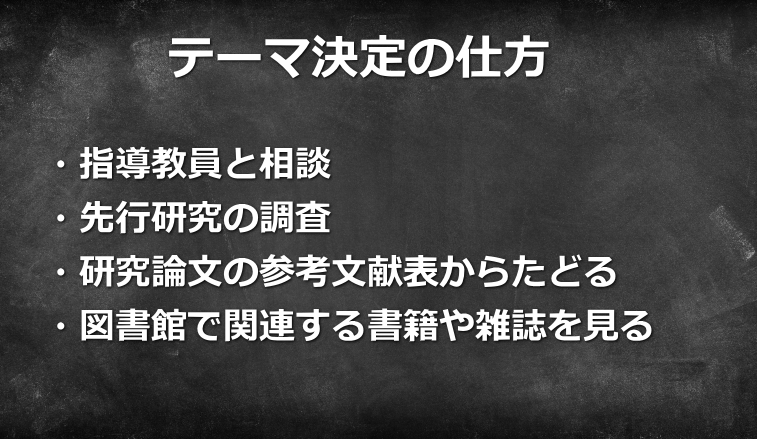
Consult Your Supervisor
It can be difficult to judge whether a topic you have developed is appropriate for an undergraduate thesis. Supervisors can advise you in such situations, so you should feel free to consult them. However, the initial topic candidates should be generated by you rather than simply assigned by the supervisor. Your supervisor can advise on the choice, but the final decision should be made by the student.Review Previous Studies
The next step is to review previous studies. If the topic you have chosen has already been discussed exhaustively, there may be little reason to address it again in an undergraduate thesis. On the other hand, a topic with almost no previous research can also be difficult because there is little scholarship to build on. Reviewing previous studies helps you understand what has already been established and what remains unresolved. Sources can be located through online databases, library catalogs, references cited in academic papers, and guidance from specialists.Follow references from papers you have read
When choosing an undergraduate thesis topic, it is useful to begin with an area that genuinely interests you. To find papers related to that area, start by checking the reference lists of papers that attract your attention. Following references from one relevant paper to another is an effective way to gather related studies. You can also seek advice from your thesis supervisor.Browse related books and journals in the library
Another method is to browse books and journals in the library, including back issues, that are closely related to your chosen topic and identify promising papers. For books, begin with the table of contents and index.Step 2: Collect Materials and Organize Previous Studies
Writing an undergraduate thesis requires collecting and carefully reading materials related to the topic, and reviewing previous studies is indispensable. This review helps establish what has and has not already been studied and allows you to show what is new or valuable about your own paper. A paper written without reference to previous research generally cannot be positioned properly as academic research.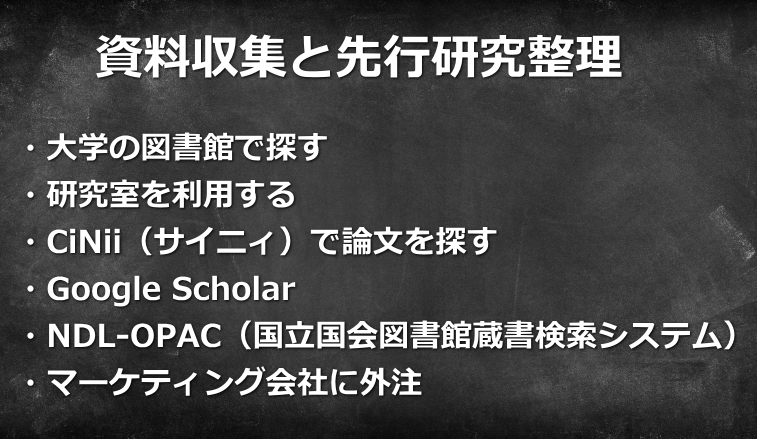
Search the University Library
University libraries provide access to large numbers of books and academic papers. Library search systems can help you quickly locate relevant materials, and some libraries can obtain materials that are not held locally. For example, universities may subscribe to electronic resources and databases that allow students to study and conduct research remotely. When writing an undergraduate thesis, collect historical sources and previous studies related to the topic and read and organize them carefully.Use Departmental Laboratories and Research Rooms
Highly specialized materials, such as research monographs and original academic papers, may sometimes be held in departmental laboratories rather than the main library. If you cannot locate a needed source, consider asking the relevant laboratory or department. Specialized dictionaries and reference works explaining technical terminology may also be available there.Search for Papers with CiNii
CiNii is a service for searching Japanese academic information. With CiNii Research, entering keywords allows you to search papers published in academic society publications, university bulletins, and other sources. Some papers can be opened directly as PDF files. If you cannot find the material you need, you can also search holdings in university libraries across Japan. Access procedures vary by institution, so check the relevant university website in advance.Google Scholar
Google Scholar is a service for searching scholarly literature and can be used in a way similar to CiNii. One difference is that it covers literature in many languages. Entering keywords displays information on related books and papers, and some materials can be downloaded as PDFs. It can therefore be particularly useful when searching for non-Japanese literature.NDL Search (National Diet Library Search and Request System)
Publications issued in Japan are subject to legal deposit with the National Diet Library. The NDL search system allows users to locate a wide range of materials, including books, journals, newspapers, doctoral dissertations, and audiovisual resources. In addition to keyword searches, detailed search options can narrow results by title, author or editor, year of publication, classification, material type, and other fields relevant to an undergraduate thesis topic.Outsource to a marketing company
Publications issued in Japan are subject to legal deposit with the National Diet Library. The NDL search system allows users to locate a wide range of materials, including books, journals, newspapers, doctoral dissertations, and audiovisual resources. In addition to keyword searches, detailed search options can narrow results by title, author or editor, year of publication, classification, material type, and other fields relevant to an undergraduate thesis topic.
Step 3: Write the Paper
After reviewing previous studies, organize the paper according to an appropriate academic format. Even when the content is strong, a poorly structured paper may be evaluated less favorably. The basic format and structure commonly required for an undergraduate thesis are introduced below.1. Cover Page
On the cover page, include the title of the paper, student ID number, and name.2. Table of Contents
An academic paper should include a table of contents showing its structure. It is often organized into an introduction, main body, and conclusion, with chapters and sections in the main body. A typical table of contents may list items such as “Introduction,” “Chapter 1,” “Chapter 2,” and “Conclusion.”3. Introduction
Here, we explain four important elements of a research paper: problem setting, previous studies, the paper's conclusion, and research method. First, clearly explain why the topic was chosen and what problem the study addresses. A vague problem awareness is not sufficient for an academic paper. State the specific question that led to the paper and what will be discussed. Then explain how previous research has developed, what issues remain, and what value or meaning your paper has within that research history. It is also useful to indicate the paper's conclusion or direction near the beginning so that the path of the argument is clear. Finally, state what research methods will be used to develop the discussion.4. Main Text
A paper needs to build a concrete argument and is often organized into two or three main chapters. Chapters and sections usually have subheadings, introduce and critically examine previous studies, and then develop the author's own argument. Depending on the topic, the paper may present cases, analyze them, discuss their significance, and build evidence toward the conclusion. When planning the structure, ensure that chapters and sections connect logically rather than appearing as isolated pieces.5. Conclusion
The conclusion should clearly state the paper's final answer while summarizing the main points developed in the body so that readers can follow how the conclusion was reached. It is also important to mention issues that could not be resolved within the paper and possible directions for future research. Identifying remaining questions can increase the value of the paper by linking it to subsequent research.6. Notes
When quoting sources in an academic paper, quoted text should be clearly marked, for example with quotation marks. Notes or citations should identify the source. Notes may also explain technical terms when necessary, although explanations of obvious terms should be avoided. Notes may appear at the bottom of each page or may be collected as endnotes at the end of the paper, depending on the required style.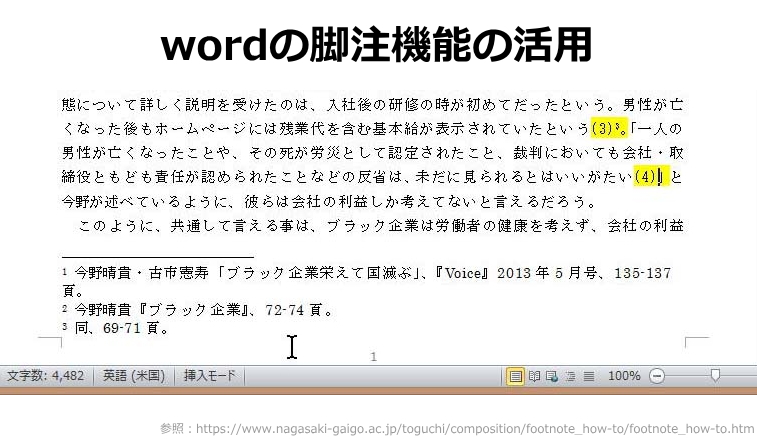
7. References
List all literature and other sources consulted in preparing the paper. Depending on the required style, sources that informed the work even if they were not directly quoted may also need to be included.References:“For Young People About to Write Reports and Undergraduate Theses”
Contact
To date, we have supported clients throughout Japan and overseas.over 10,000 casesWe have supported a wide range of academic requests, including graduation/master’s thesis research and report/paper support. Our experienced consultants work closely with clients to meet their needs. We provide prompt and accurate support at reasonable prices, and our Ibooks team members throughout Japan take responsibility for assisting each client.
We send the profile of the responsible staff member when you apply.
For Undergraduate / Master's Thesis Research Support, Report Support, and Paper Support, choose iBooks Academic Support!
0476-85-7930
When orders are busy, phone lines may be difficult to connect.
We will reply in order; if urgent, please contact us byEmail please contact us by this method.
When orders are busy, phone lines may be difficult to connect.
We will reply in order; if urgent, please contact us by
