
How to Cite Sources | Direct and Indirect Quotations & Attribution Rulesblog
How to Cite Sources | Direct and Indirect Quotations & Attribution Rules
Correct Methods for Quotation, Source Attribution, and Reference Lists
How to Cite Sources | Direct and Indirect Quotations & Attribution Rules
One essential topic when writing reports and papers isHow to Cite Referenceshow to cite references correctly. No matter how well organized the content is, improper quotation or reference formatting can seriously damage the credibility of the entire text. In university reports, graduation theses, and academic papers in particular, following citation rules is a basic requirement of academic integrity.
Citation means presenting another person’s wording or view, or objective data, in order to supplement, explain, or support one’s own claim by using prior research. If quoted material and one’s own writing are not clearly distinguished, however, the work may be regarded as plagiarism. It is therefore important to understandquotations, source attribution, and reference-list entriesthree basic elements correctly.
Why References Need to Be Cited
Research and report writing build on accumulated knowledge—that is, prior research. Rather than stating only personal opinions, constructing an argument on the basis of established theories and materials clarifies the reliability, novelty, and originality of one’s claims. Understanding how to cite references is therefore not a mere formatting task but a foundation of academic writing.
Clear citation and reference information is also necessary so readers can verify the original materials. If readers know which sources formed the basis of the analysis, they can examine the evidence. By contrast, writing with unclear sources is difficult to trust even when it appears correct. Therefore,How to Cite Sources in Reportsaccurately mastering citation and reference practices is also important for improving evaluation.
Basic Rules for Citing References
When citing references, first clearly distinguish quoted material from the surrounding text so that your own opinion is not confused with another person’s words. Next, always identify the source of the quotation. In addition, any source cited in the text must also appear in the reference list at the end.
In short, the basics of citation can be summarized as “Make it clear that the text is a quotation,” “show where the quotation came from,” and “include the source in the reference list.”these three points. If any of them is missing, even otherwise appropriate content may receive substantial deductions for formal deficiencies.
Difference Between Direct and Indirect Quotations
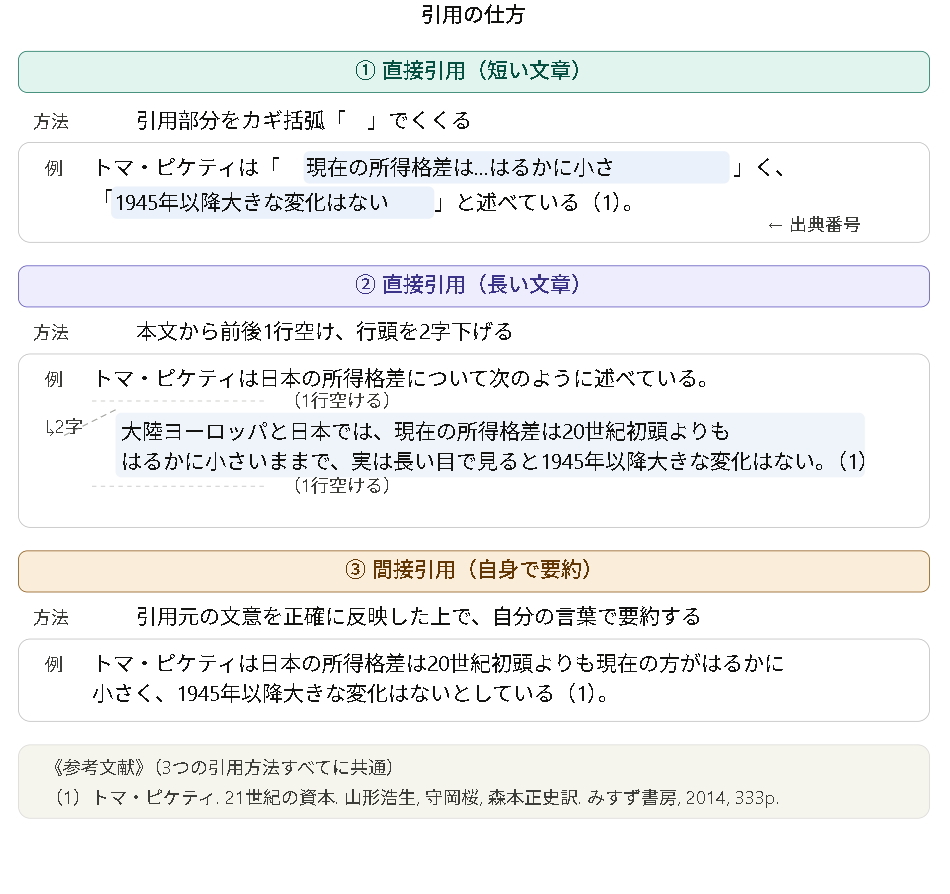
Direct QuotationA direct quotation reproduces the wording of the source exactly. A short quotation is normally enclosed in quotation marks in the body text. This method is useful when an important definition is being quoted or when the exact wording of the source itself matters.
For a long direct quotation, a block quotation may be used by separating it from the surrounding text with blank lines and indenting it. Long quotations should be visually distinguishable from the ordinary body text.
Indirect QuotationAn indirect quotation paraphrases or summarizes the source's argument accurately in your own words. It is easier to integrate into the flow of the text and maintain a consistent style, but care is needed not to change the original meaning. Even when paraphrasing, the source must still be cited.
How to Indicate Sources | Vancouver Style and Harvard Style
Representative methods of source attribution includeVancouver StyleandHarvard Style. In the Vancouver style, citations in the body are assigned sequential numbers, and the corresponding references are listed in numerical order at the end. This style is commonly seen in scientific and medical papers.
By contrast, the Harvard style gives the author's name and year of publication in the body and lists references alphabetically by author at the end. It is commonly used in the social sciences and humanities and social sciences, APA Styleand is also related to this citation principle. The style to use should follow the requirements of the course or the rules of the publication venue.
How to Write a Reference List | Commonly Used Styles
There are several styles for writing references, and the required format differs by field and submission destination. One style broadly referenced in Japanese reports and papers isSIST Styleand is organized as a format that can be used in both humanities and sciences.
In humanities fields such as literature and linguistics,MLA Styleis also widely used. MLA typically encloses article titles in quotation marks and italicizes journal titles. In social-science fields such as psychology and sociology,APA Styleis a representative style, with the year of publication normally placed after the author's name.
For example, an APA-style book reference is typically organized in the order of author, year of publication, book title, and publisher. For an academic paper, the usual sequence is author, year, article title, journal title, volume/issue, and page range. Even when the submission destination does not specify a style, it is important to use one style consistently throughout a report.
Points to Note When Citing Websites as References
When including websites in a reference list, even greater care is required than with books or academic papers. The internet contains a great deal of useful information, but it also includes content with unclear authorship or weak evidence. Check the author, publication year, page title, website name, URL, and other details, and select reliable sources.
In particular, it is better to avoid citing Wikipedia or summary websites directly as authoritative sources. Reports and papers should primarily rely on materials whose basis can be verified, such as primary sources, government agencies, universities, academic societies, specialist books, and peer-reviewed papers. How to Cite ReferencesLearning how to cite references also means developing the ability to judge which materials should be used.
Common Mistakes When Writing References in Reports
Common mistakes in student reports include quoting a source without identifying it, listing a reference that is never cited in the text, using an incorrect author name or publication year, and mixing citation styles within one paper. Even before the content is evaluated, these problems may be judged as inadequate academic practice.
It is also risky to copy bibliographic information generated by AI or displayed in search results without checking the original source. When preparing references, develop the habit of verifying the title, author, publisher, publication year, page numbers, and other details against the actual material. To improve the quality of a report, always review the reference list before submission.
Summary | Understand How to Cite References Correctly
Correct citation is a fundamental element that affects the evaluation of reports and papers. It is not enough simply to quote text; quotations must be clearly distinguished from the writer's own words, sources must be identified, and the reference list must be prepared consistently. Understanding the difference between direct and indirect quotations, as well as the methods and styles of source attribution, greatly increases the reliability of writing.
In particular, in university reports and graduation theses, How to Write ReferencesandHow to Cite Sourcesthis requirement cannot be taken lightly. If a format is specified, follow it. If no format is specified, choose one style—such as SIST, MLA, or APA—and apply it consistently. Correct citation is not merely a rule; it is an expression of academic integrity.
Points to Check to Improve the Reliability of This Article
When applying “How to Cite Sources | Direct and Indirect Quotations & Attribution Rules” to a report, paper, or assignment, do not simply copy the article's explanations. Verify the basis of your statements using primary sources, public materials, and academic literature, and reconstruct the content to fit the requirements of your own assignment.
| ConfirmItem | What to Check | How to Use It in a Report |
|---|---|---|
| Accuracy of Information | Check whether the concepts, figures, systems, and cited sources in the text actually exist and are consistent with the latest information. | Add references and footnotes so that the relationship between claims and supporting evidence is clear. |
| Consistency with Assignment Requirements | Check that the work complies with the course topic, word count, required readings, writing style, citation format, and submission format. | Use a structure in which the introduction presents the question, the body develops the evidence, and the conclusion answers the question. |
| Originality / Discussion | Check that the discussion goes beyond general explanation and connects to the course content or your own research question. | Add, in your own words, why you think so and what limitations remain. |
Reference Materials / Verification Sources
The following are public, academic, and official sources worth checking when using the content of this article in a report or paper. If you cite them, format the citation according to the requirements of the institution where you will submit the work.
- CiNii Research: a major search service for finding Japanese papers, doctoral dissertations, research data, and related academic materials across multiple databases.
- J-STAGE: a platform useful for checking journals and academic papers published by Japanese academic societies.
- APA Style「Reference examples」: provides examples of how to format references in APA style.
- Zotero Official Website: an official tool useful for reference management, citation organization, and PDF management.
- Ministry of Education, Culture, Sports, Science and Technology: “Information on the Use of Generative AI”: an entry point to public information on the use of generative AI in education.
- Google Search Central「SEO Starter Guide」: basic guidelines for communicating page content correctly to search engines.
Related Services / Internal Links
In academic writing, not only appearance but also citations, evidence, logic, and compliance with submission requirements directly affect evaluation. Please review the related pages as well.
Citation & Reference GuideWriting Reference ListsLiterature Search & ReviewUniversity Report SupportFree Quote & Consultation
Contact
To date, we have supported clients throughout Japan and overseas.over 10,000 casesof academic support requests. Experienced consultants carefully listen to your needs and provide prompt, appropriate support at reasonable fees.
Ibooks members across Japan will support you responsibly.
We send the profile of the responsible staff member when you apply.
When orders are busy, phone lines may be difficult to connect. We will reply in order, so urgent inquiries should be sent by
