![12 AI Tools for Research Papers | Choosing by Literature Search, Writing & Analysis [2026] | iBooks Academic Support](../../img/logo.png)
12 AI Tools for Research Papers | Choosing by Literature Search, Writing & Analysis [2026]blog
12 AI Tools for Research Papers | Choosing by Literature Search, Writing & Analysis [2026]
For research writing, it is more useful to choose AI tools by task—literature discovery, summarization, drafting support, analysis, or visualization—than to look for one universally “best” system. Features, pricing, and terms change, so verify current official information and retain human responsibility for checking every output.
Artificial intelligence is changing the entire research process, from developing a research idea and reading literature to writing papers and communicating findings. This article introduces selected AI tools that can support research while respecting academic integrity.
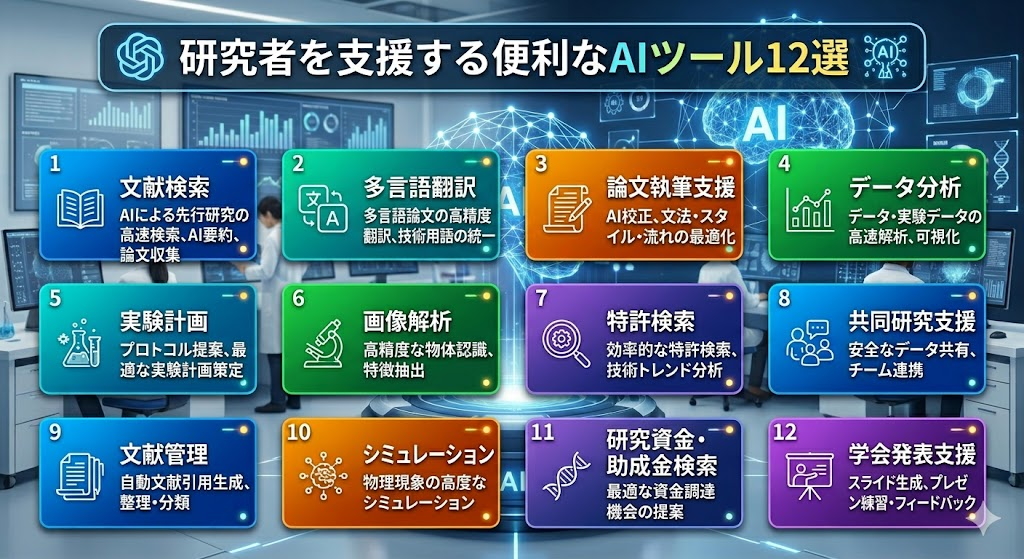
12 AI Tools for Research Papers | Choosing by Literature Search, Writing & Analysis [2026]
Artificial intelligence is changing the research process from conceptualization and literature review through paper writing and dissemination. Tasks such as literature search, summarization, data analysis, writing support, figure creation, and journal selection can often be performed more quickly and efficiently than before.
At the same time, many researchers are uncertain about questions such as “How far may AI be used?” “Can academic integrity be maintained?” and “May AI-generated content be used in an academic paper?” In graduation theses, master's theses, doctoral dissertations, and submitted manuscripts, evaluation extends well beyond natural-sounding prose to the consistency of the research purpose, previous studies, methods, results, discussion, citations, and references.
The important principle is not to position AI as a substitute for research, but as tools that support researchers' thinking and judgmentas a support for the researcher's own reasoning and judgment. Used carefully, well-chosen AI tools may do more than save time: they can support deeper literature understanding, clearer logical organization, and a more rigorous research process.
However, it is risky to trust AI-generated summaries, citation information, analytical results, or wording without verification. AI can be useful while still producing hallucinations, nonexistent references, inaccurate citations, or inappropriate interpretations. Therefore, AI output should always be checked by a human, and the researcher must retain responsibility for the final judgment.is necessary.
This article recommended AI for academic paper writing、AI Paper Writing、Literature Review AI、AI for academic paper writing、AI tools for researchWith search intentions such as these in mind, this article introduces 12 tools that can support major phases of research, including literature review, reference management, paper writing, data analysis, visualization, and journal selection.
AI Tools for Literature Review and Reference Management
Reviewing relevant literature before conducting a study is one of the most important parts of academic paper writing. Depending on the topic, however, the volume of previous research can be enormous, and simply identifying which papers to read, which studies are important, and how the field has developed can require substantial effort.
AI can support literature discovery, summarization, citation-network checking, and visualization of research topics at this stage. However, it is risky to treat an AI summary as a substitute for reading the literature itself.Use AI as an entry point for finding literature, and always verify important sources in the original text.is important.
R Discovery | An AI Tool for Finding Papers Related to Your Research Interests
R Discovery is described as a tool that collects academic content feeds based on a researcher's interests and helps users discover related papers. Functions such as recommended papers, new-paper alerts, and smart summaries can make it easier to monitor work being published in a research field.
Especially when a topic has just been selected or a literature review is beginning, researchers need to explore related work broadly. R Discovery can help identify papers close to the researcher's interests among a large volume of literature. The source also notes translation and audio options that may support checking literature information while away from a desk.
However, not every recommended paper will necessarily fit your study. Do not judge only from the title or abstract. Check the research purpose, methods, population, and conclusion to determine whether the source is genuinely necessary for your paper.
Consensus | An AI Tool for Understanding Patterns in the Research Literature
Consensus is described as an AI tool that summarizes evidence across multiple studies and helps users understand how the research literature addresses a particular question. It can be useful for seeing whether findings are broadly consistent, divided, or still uncertain.
For example, when organizing “how previous studies have discussed this issue” in a graduation or master's thesis, a tool such as Consensus may help identify broad trends in related research. It may also provide a starting point for understanding general positions in a field when drafting the introduction or discussion of a submitted manuscript.
However, AI summaries may not fully reflect the detailed conditions and limitations of individual papers. Use a Consensus summary as a starting point, read important papers in full, and base any citation in your manuscript on the original source.
Scite | An AI Tool for Examining How Papers Are Cited
Scite is described as a tool for examining not only how often a paper is cited but also the context in which it is cited. It can help users see whether later research cites a paper as supporting evidence, mentions it neutrally, or cites it in a critical context.
In academic paper writing, a highly cited source is not automatically the best source to use. What matters is how that work is positioned within the field. Scite can assist in examining the credibility and relevance of potential references.
Citation appropriateness may be scrutinized during peer review of submitted manuscripts. Scite may help researchers examine how a planned citation is currently treated in the literature. Final citation decisions, however, should always be based on the researcher's own reading of the original paper.
Litmaps | An AI Tool for Visualizing Connections Across a Research Topic
Litmaps is described as a tool that visualizes connections among papers and research topics as an interactive literature map. By examining networks of related papers, researchers can explore how ideas developed, identify key literature, and discover studies they may have missed.
A literature review should not consist only of reading individual papers; it should also establish how the broader field has developed. Litmaps can help users see which papers connect to which lines of research and which topics have developed in recent years.
It can also support narrowing a topic for a graduation or master's thesis and clarifying how a submitted manuscript fits within existing research.A literature map is a guide for understanding previous studies as a research trajectory rather than as a simple list.becomes
AI Tools for Academic Paper Writing
Academic paper writing requires more than polished sentences. It also requires an appropriate academic tone, logical consistency, accurate citations, alignment with the research purpose, and a structure that communicates clearly to readers. General-purpose tools such as ChatGPT or Grammarly may support writing, but academic publication and graduate-level work require more specialized checking.
The following tools can support academic writing. Regardless of the tool used, use AI to improve content you have written yourself rather than delegating the paper body entirely to AI.is important.
Paperpal | English-Language Editing and Writing Support for Academic Papers
Paperpal is described as a writing-support tool designed for academic authors. It can assist with grammar, wording, and readability while maintaining an academic tone. The source describes functions including English-language editing, plagiarism checking, research and citations, translation, paraphrasing, and interaction with PDFs.
In English-language papers, strong research content may still be difficult to understand if the wording is unnatural. Paperpal can be used from the draft stage through pre-submission review to improve clarity and naturalness.
Even when AI-based paraphrasing or English revision is used, researchers should verify that the meaning has not changed. In academic papers, accuracy of claims and evidence matters more than natural wording alone.
Jenni AI | AI Support for Outlining and Draft Development
Jenni AI is described as a tool supporting academic drafting and organization, with functions related to citation integration and paraphrasing. It may assist with outline creation, improving the flow of the writing, and building a coherent research narrative.
Trying to write highly polished prose immediately can cause researchers to get stuck. Using a tool such as Jenni AI to review the proposed structure or flow of an early draft may help organize the connection from the introduction through the discussion.
However, AI-generated suggestions will not necessarily match your own data or previous studies. Jenni AI should therefore be used as support for early drafting and flow checks, while the researcher verifies the final content, citations, and discussion.
SciSpace | AI Combining Literature Understanding and Writing Support
SciSpace is described as an AI tool combining literature search and literature-understanding functions with writing support. Its semantic-search and Copilot-style functions are designed to help users interact with PDFs and understand difficult papers.
Researchers working with large amounts of literature often need to identify a paper's background, methods, results, and limitations efficiently. SciSpace can help users navigate complex sections and extract points for closer examination.
Answers generated through PDF interaction should still be checked against the original paper. Especially when information will be cited or claims from previous studies will be incorporated into a manuscript, the researcher should write accurately from the original source rather than relying on the AI summary.
AI Tools for Data Analysis and Visualization
Research may involve questionnaires, experimental data, observational records, operational data, statistical materials, and many other forms of data. AI tools increasingly make it possible to explore, analyze, and visualize data even without advanced programming expertise.
AI-assisted data analysis still requires caution. A graph or statistical result generated by AI does not guarantee that the analytical method fits the research purpose. Scale level, sample size, missing data, assumptions, and the validity of the chosen test must be checked to avoid incorrect conclusions.
For that reason, data-analysis AI should be used as support for exploratory checking and visualization, while final statistical decisions should receive appropriate expert verification.this is important.
Julius AI | An AI Tool for Analyzing Data Through Natural-Language Interaction
Julius AI is described as a tool that allows users to upload data such as CSV, Excel, or Google Sheets files and analyze or visualize them through natural-language interaction. It can assist with tasks such as graph creation, statistical testing, and generating summary observations.
It may be useful for researchers who are less familiar with data analysis or who first want to understand overall patterns. As an exploratory tool, it can help identify notable variables, distributions, and items that may deserve closer examination.
However, a statistical test suggested by Julius AI will not always be appropriate. When using the results in a graduation thesis, master's thesis, or submitted manuscript, researchers should verify why the method was selected and whether its assumptions are met, and obtain specialist statistical review where necessary.
Tableau | A Visualization Tool for Communicating Research Data Visually
Tableau is a data-visualization tool widely used in research and business. It can transform raw research data into graphs, tables, and interactive dashboards that communicate complex trends and patterns visually.
Figures and tables in academic papers are not mere decoration. They present results clearly and support the evidence underlying the discussion. Tableau can help organize analyses involving multiple variables, time-series data, regional data, or comparative data in an accessible form.
Even an attractive graph is unsuitable if it does not serve the analytical purpose. The text should explain what the figure is intended to show, what data it is based on, and how it should be interpreted.
Powerdrill AI | An AI Tool for Data Visualization Through Natural Language
Powerdrill AI is described as a tool combining data visualization with natural-language processing. The source notes that it can generate relevant charts and automated insights from relatively simple questions.
It may be useful when researchers want to visualize raw data without coding or quickly explore possible analytical directions. At an early exploratory stage, AI-assisted visualization can help establish an overview of the data.
However, automatically generated insights should be treated as provisional interpretations. In an academic paper, the meaning of the data must be explained in relation to the research purpose and previous studies.The researcher should verify and interpret any pattern identified by AI.This attitude is necessary.
Other AI Tools Useful for Researchers
Academic paper writing involves not only literature review, writing, and analysis but also how research findings are presented and where the work is submitted. AI and related tools can support visual communication and the search for appropriate publication venues.
Mind the Graph | A Scientific Illustration Tool for Communicating Research Visually
Mind the Graph is described as a scientific illustration tool for creating graphical abstracts, posters, infographics, and figures for research presentations. It provides templates and illustrations intended particularly for fields such as biology, medicine, and the natural sciences.
Conference presentations and submitted manuscripts often require visual materials that communicate the core findings quickly. Graphical abstracts in particular are intended to convey an overview of the research intuitively. Mind the Graph can help researchers create figures even without advanced design skills.
Scientific accuracy is more important than visual attractiveness alone. Excessive simplification or diagrams that could mislead readers should be avoided.
Journal Finder | A Support Tool for Identifying Potential Journals
Journal Finder is described as a support tool that uses information such as a paper's title, abstract, or manuscript content to suggest journals that may fit the research topic. It can help researchers consider potential venues based on topical similarity, related papers, and publication patterns.
Choosing a journal that fits the research content is extremely important for a submitted manuscript. A paper sent to a journal outside its scope may be rejected before the substantive merits are considered. A Journal Finder tool can reduce the time needed to identify possible venues.
However, do not submit automatically to a journal recommended by AI. Check the author guidelines, scope, peer-review policy, patterns in published articles, fees, publication ethics, and open-access conditions yourself.
Try an AI Prompt
If you want to identify additional AI tools suited to your research purpose, giving an AI assistant specific requirements may help organize possible options. Rather than vaguely asking for “useful tools,” specify the tasks you need, such as literature review, citation checking, summarization, writing support, academic integrity, or plagiarism prevention.
For example, you could enter the following in Japanese.
“Please suggest reliable AI tools for academic researchers that support literature review, citation checking, summarization, and writing while respecting academic integrity and helping users avoid plagiarism.”
In English, a similar prompt can also be used.
“Suggest reliable AI tools for academic researchers that help with literature reviews, citation checking, summarization, and writing support—while respecting academic integrity and avoiding plagiarism.”
However, AI-generated information about tools may be outdated or unsuitable for your field. Always check each tool's official information, terms of use, data-handling practices, and the AI-use rules of your university or academic society.
Academic Integrity Checks When Using AI Tools
The most important requirement when using AI tools is to protect academic integrity. AI-assisted summarization, translation, outlining, writing improvement, data analysis, and visualization can be useful, but researchers should be clear about how the tool was used and what they personally verified.
Universities, graduate schools, academic societies, and journals may have policies on whether AI use is permitted and how it must be disclosed. Depending on the rules, AI use may need to be described in acknowledgments, methods, notes, or submission declarations.
Entering unpublished data, personal information, statements from research participants, or internal corporate or organizational materials into AI tools may create confidentiality and research-ethics concerns.Before using AI, distinguish between information that may be entered and information that must not be entered.This distinction is essential.
Support Available from iBooks Academic Support
iBooks Academic Support provides broad support for graduation theses, master's theses, doctoral dissertations, MBA papers, and submitted manuscripts, including topic selection, chapter planning, organization of previous studies, source verification, citation formatting, research planning, writing structure, deeper discussion, and pre-submission review.
AI-assisted writing and summaries can also be reviewed for misalignment with the research purpose, citation and reference problems, logical gaps, unnatural wording, and places where the underlying literature needs to be checked. Because AI-generated prose can look polished, problems may be difficult for the writer to notice.
For submitted manuscripts and graduate-level work in particular, polishing the wording alone is insufficient. The research purpose, previous studies, methods, results, discussion, and conclusion must be consistent with one another.Specialized review after using AI is an important stage that can materially affect the quality of an academic paper..
Summary | AI Does Not Replace Researchers; It Supports Research
AI does not replace researchers. Formulating the research question, interpreting results, and taking responsibility for the conclusion remain the researcher's tasks. AI's role is to accelerate parts of the thinking process, reduce workload, and create more room for researchers to focus on substantive judgment.
R Discovery, Consensus, Scite, and Litmaps can support literature review and reference management. Paperpal, Jenni AI, and SciSpace can support academic writing and literature understanding. Julius AI, Tableau, and Powerdrill AI can assist with data analysis and visualization. Mind the Graph and Journal Finder can support research communication and publication-venue selection.
Regardless of the AI tool used, however, final verification must be performed by a human. AI can be convenient, but it does not automatically guarantee accuracy, originality, appropriate citation, or research ethics. Therefore, use AI intelligently while protecting the reliability of the paper through human judgment.this is important.
If you are unsure whether AI may be used in academic writing, concerned about the accuracy of AI-assisted content, want literature or citations checked, or want to know whether a submitted manuscript has an appropriate structure, specialized review before submission can be useful. iBooks Academic Support provides literature checking, citation formatting, logical review, and structural checks that are particularly important in the AI era.
Last updated: September 4, 2026
Key Points at a Glance
| Literature discovery | Check coverage, citation metadata, and access to the original paper. |
|---|---|
| Writing support | Separate drafting assistance from evidence verification. |
| Analysis & visualization | Verify reproducibility, code or settings, and the resulting interpretation. |
Primary / Academic / Official Sources
Use the submission rules of your university, department, or target journal first. The sources below are verification starting points; read the original material before citing it.
- UNESCO, “Guidance for generative AI in education and research” (2023; updated 2026)
- ICMJE Recommendations, “Use of Artificial Intelligence in Publishing” (2026)
Frequently Asked Questions
Is the ranking of these 12 tools permanent?
No. Features and access conditions change, so compare tools by your task and current official documentation.
Can AI fully automate a literature review?
AI can assist with searching and summarization, but humans must control the search strategy, selection criteria, reading of original sources, and citation accuracy.
Can an AI tool be listed as an author?
Major publication guidance such as ICMJE does not treat AI as an author; humans remain responsible and accountable for the submitted work.
Related Articles
- AI Prompting for Research Papers
- Literature Search & Review
- How to Write References
- Thesis Research Support
Related Support
Contact
To date, we have supported clients throughout Japan and overseas.over 10,000 casesof academic support requests. Experienced consultants carefully listen to your needs and provide prompt, appropriate support at reasonable fees.
Ibooks members across Japan will support you responsibly.
We send the profile of the responsible staff member when you apply.
When orders are busy, phone lines may be difficult to connect. We will reply in order, so urgent inquiries should be sent by
