
AI Prompting for Research Papers | Responsible Use for Theses & Journal Manuscriptsblog
AI Prompting for Research Papers | Responsible Use for Theses & Journal Manuscripts
For research writing, a strong prompt is less about asking for polished prose and more about specifying the task, allowed evidence, output format, constraints, and verification steps. Do not ask the model to fill missing evidence with invented references; require claims to be checked against original sources.
When using generative AI for paper writing, results depend not only on which AI tool is used. Prompt design is also important because it determines what AI should output, within what scope, in what format, and on the basis of what evidence. This article provides concrete prompt examples for graduation theses, master’s theses, doctoral papers, submitted manuscripts, and research proposals, covering topic development, research questions, reviews of previous studies, summarization, structuring, methods, results, discussion, citation checks, English abstracts, and pre-submission review.
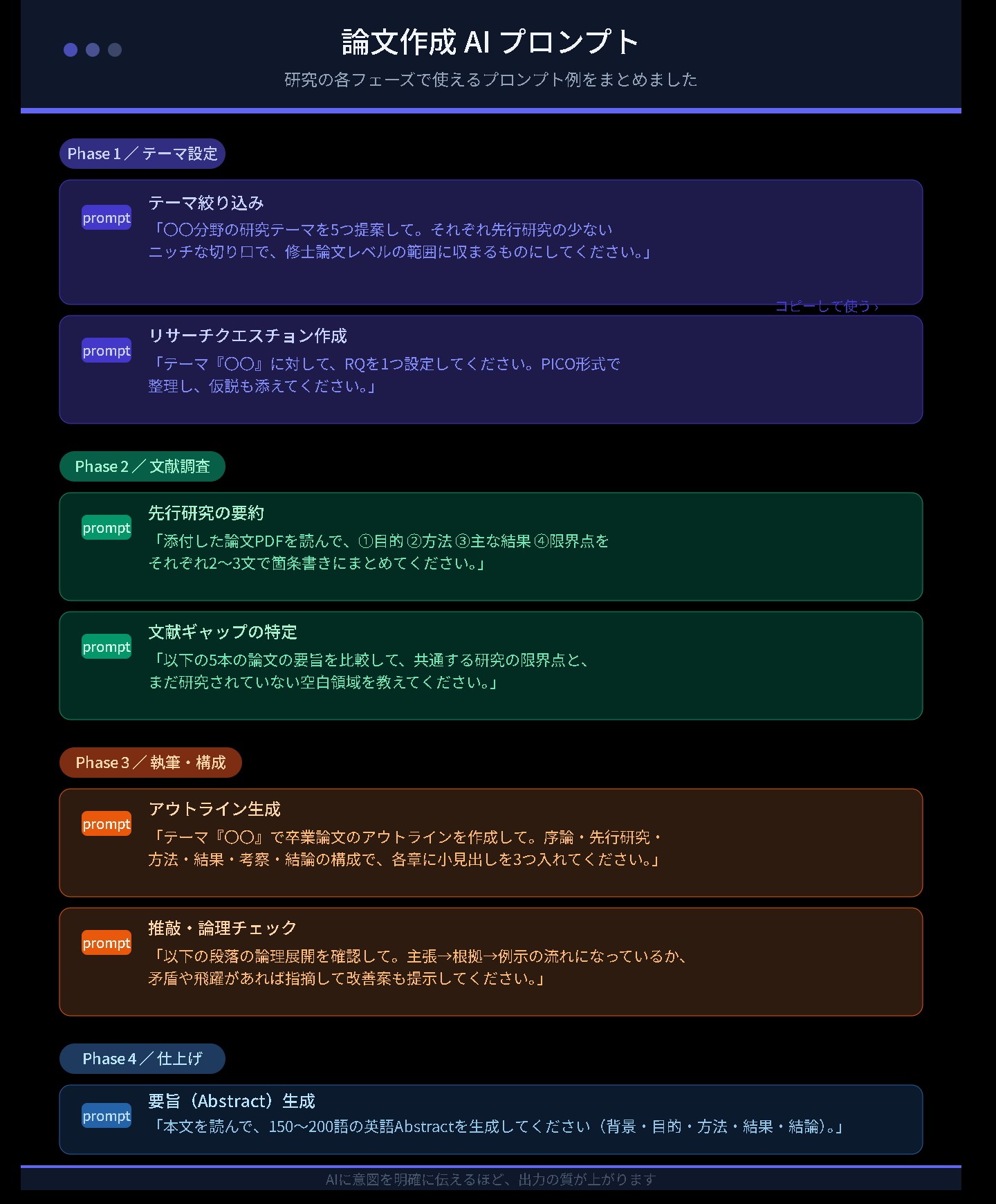
AI Prompting for Research Papers | Responsible Use for Theses & Journal Manuscripts
The spread of generative AI has significantly changed the paper-writing process. ChatGPT, Claude, Gemini, NotebookLM, Elicit, Perplexity, and similar tools can streamline organization of research topics, summaries of previous studies, planning of paper structure, prose revision, preparation of English abstracts, and pre-submission checking.
However, simply asking AI to “write the paper” will not produce a paper that can be properly evaluated. AI output may include generic discussion, insufficient evidence, fabricated references, misreading of literature, or misalignment with the research purpose. The important principle when using AI for paper writing is to use AI as a tool that supports the thinking of researchers and students, not as a substitute for the writer..
This makes prompt design important. A prompt is an instruction given to AI. For paper writing, specifying the discipline, intended reader, purpose, scope of materials, output format, length, source-verification requirements, and prohibited actions can make AI output more useful and safer.
Why AI Prompts Matter in Paper Writing
AI can be a useful aid in paper writing. It can help broaden a research topic, organize issues, identify perspectives for a literature review, reduce redundancy, and check English expression.
However, AI cannot determine truth in place of the researcher. Its explanations may sound natural while lacking sufficient evidence, failing to verify whether references actually exist, or deviating from conventions in the discipline.
When using AI for paper writing, prompts should specify not only what the AI should produce but also what it should not produce. In particular, Do not state unsupported content as fact; mark passages that require source verification; do not treat generated body text as a finished product.the following conditions are important.
Key points to understand
| Item | Good AI prompt | AI prompt to avoid |
|---|---|---|
| purpose | Limit use to a specific purpose such as topic development, structuring, literature organization, or revision | Delegating the task with “Write the paper” |
| Evidence | Ask AI to mark passages requiring source verification with [Verification required] | Adopting AI explanations directly as facts |
| Literature | Use AI to generate search keywords and review perspectives | Using AI-generated references without verification |
| Writing | Use for rough drafts, revision, and logic checking | Copying generated prose and submitting it |
| Ethics | Follow the AI-use rules of the university or publication venue | Concealing AI use or using it in violation of applicable rules |
Basic Structure of an AI Prompt for Paper Writing
Paper-writing prompts become more precise when the conditions are organized rather than entered as a simple question. A useful basic structure has seven elements: role, purpose, assumptions, input materials, output format, constraints, and points to check.
| Component | Example input | Purpose |
|---|---|---|
| Role | You are a graduate-school research supervisor. | Specify the expertise and perspective of the response. |
| purpose | Clarify the research question for a master’s thesis. | Limit the goal of the output. |
| Assumptions | The field is social welfare; the study is qualitative and uses semi-structured interviews. | Avoid irrelevant generalities from other disciplines. |
| Input materials | Use the following notes and summaries of previous studies. | Keep the response grounded in the materials provided. |
| Output format | Present the candidates, reasons, and cautions in a table. | Make the options easy to compare. |
| Constraints | Do not provide titles of sources whose existence cannot be verified. | Prevent fabricated references. |
| Items to verify | Do not state uncertain points as facts; mark them as [Verification Required]. | Reduce the risk of including misinformation. |
Check AI-Use Rules and Research Ethics
Before using AI prompts, check the AI-use rules of your university, course, laboratory, or target journal. Even when AI use is permitted, there may be rules on disclosure of the scope of use, handling of quotations, authorship, whether data may be entered, and prohibitions on entering personal information.
Particular care is required before entering unpublished data, personal information, interview transcripts, manuscripts under review, or collaborators' materials into an AI system. Distinguish information that may be entered from information that must not be entered, and anonymize or summarize material when necessary.
Practical AI Prompt Examples for Paper Writing
The following sections introduce AI prompts that can be used at each stage of paper writing. These are not intended to outsource an entire manuscript, but to help researchers and students think for themselves, verify information, and revise their own writing.
1. Prompt for organizing a research topic
When a research topic is too broad, asking AI to break it into subissues can make it easier to narrow the focus.
| Prompt examples | You are a university research supervisor. For the following research topic, identify aspects that are too broad for a paper and propose five narrower topics suitable for an undergraduate thesis or master's thesis. For each proposal, show the research target, analytical perspective, required materials, and cautions in a table. Mark points that require supporting evidence as [Literature Verification Required]. Research topic: XX |
|---|
2. Prompt for developing a research question or hypothesis
A paper requires not only a topic but also a research question that specifies what will be clarified. It can be useful to ask AI to compare candidate questions and their feasibility.
| Prompt examples | Create five research questions for the following research topic. Compare each question in terms of clarity, relationship to previous studies, research feasibility, likely method, and limitations. If the study is quantitative and requires hypotheses, also propose candidate hypotheses. Do not name previous studies whose existence cannot be verified. Research topic: XX |
|---|
3. Prompt for generating search keywords for previous studies
Before searching for previous studies, organizing search terms improves efficiency. Generating keywords in both Japanese and English makes it easier to search CiNii, J-STAGE, Google Scholar, PubMed, and similar databases.
| Prompt examples | For the following research topic, organize search keywords for finding previous studies in both Japanese and English. Divide them into major concepts, related concepts, population or target, methods, theoretical frameworks, and ambiguous terms that should be excluded, and present them in a table. Also provide example search strings. Research topic: XX |
|---|
4. Prompt for organizing a literature review
A literature review should do more than summarize papers one by one; it should organize commonalities, differences, and research gaps. It is safer to have AI compare only the literature information you provide.
| Prompt examples | Using only the notes on previous studies shown below as evidence, create an organizing table for a literature review. For each source, show its purpose, method, participants or target, main findings, limitations, and relationship to the present study. Then explain the commonalities, differences, and research gaps in prose rather than bullet points. Do not infer information that is not in the notes; mark it as [Outside Provided Materials]. Notes on previous studies: XX |
|---|
5. Prompt for creating a paper structure
When asking AI to create a paper outline, always specify the discipline, length, research method, and required format. A useful approach is to have it generate only the structure rather than too much of the manuscript itself.
| Prompt examples | Create a chapter outline for an undergraduate thesis on the following research topic. Do not write the body text. Show only the chapters, sections, content to be covered in each section, required literature, and cautions. Make the relationship among the introduction, main discussion, methods, results, discussion, and conclusion clear. Research topic: XX Research method: XX Length: XX characters |
|---|
6. Prompt for organizing research methods
The methods chapter should clearly state the research participants or target, data collection, analytical methods, and ethical considerations. Asking AI to check for omissions can be useful.
| Prompt examples | Review the following research plan and identify the items required for the methods chapter. Organize your comments under research design, participants, sampling, data collection, analysis, ethical considerations, and limitations, and point out missing information. Do not ghostwrite the chapter; provide only areas for improvement. Research plan: XX |
|---|
7. Prompt for connecting results and discussion
When results and discussion are mixed together, the persuasiveness of a paper decreases. Asking AI to separate factual findings from interpretation can help organize the manuscript.
| Prompt examples | For the following analysis results, separate the objective facts that belong in the Results section from the interpretations, relationships with previous studies, and limitations that belong in the Discussion section. Mark points that cannot be statistically concluded as [Cannot Be Concluded]. Output an organizing table for use before drafting the prose. Analysis results: XX |
|---|
8. Prompt for identifying passages that require citations
AI can be used to identify places in AI-generated or self-written text where citations may be needed. This is useful for preventing plagiarism and unsupported claims.
| Prompt examples | Read the following text and identify passages that require citation or source verification. Classify them as factual claims, statistical data, views from previous studies, technical concepts, explanations of systems or policies, or claims made by others, and explain why a citation is required. Do not invent references; display [Literature Verification Required] instead. Text: XX |
|---|
9. Prompt for prose revision and logic checking
When revising a paper, it is safer to ask AI to identify problems than to rewrite the entire manuscript. This allows you to preserve your own writing style and logic while making corrections.
| Prompt examples | For the following paper text, identify, without changing its meaning, logical leaps, subject-predicate mismatches, insufficient evidence, weak transitions between paragraphs, redundant expressions, and wording that is unnatural for academic prose. Do not rewrite the entire text; present the reason for each revision and an improvement suggestion in a table. Main text: XX |
|---|
10. Prompt for preparing an English abstract
An English abstract should concisely present the purpose, methods, results, and conclusion. Even when AI is used for translation, it is necessary to verify that the meaning of the original has not changed.
| Prompt examples | Translate the following Japanese abstract into natural English suitable for an academic paper. Follow the flow of Purpose, Methods, Results, and Conclusion. Do not translate technical terms mechanically, and mark any passage whose meaning may change as [Check]. At the end, identify in Japanese any expressions that could become ambiguous in English. Japanese abstract: XX |
|---|
Prompt Design by Type: Graduation Thesis, Master’s Thesis, and Submitted Manuscript
Even with the same paper-writing AI prompts, the priorities differ among undergraduate theses, master's theses, and journal submissions. Degree theses emphasize learning outcomes and the research process, whereas submitted manuscripts place greater emphasis on novelty, methodological validity, and persuasiveness to reviewers.
For a graduation thesis
For an undergraduate thesis, it is important not to broaden the research topic excessively and to connect previous studies with your own research question. AI can be useful for narrowing the topic, developing an outline, generating literature-search keywords, and checking a research plan for omissions.
For a master’s thesis
For a master's thesis, the theoretical framework, relationship to previous studies, methodological validity, and interpretation of results become especially important. Rather than asking AI, "Which theory should I use?", it is more useful to ask it to compare candidate theoretical frameworks and identify their limitations.
For a submitted manuscript
For a submitted manuscript, compliance with author guidelines, word limits, figures and tables, citation style, and the ability to explain the work to reviewers are important. AI can be used to check conformity with submission rules, clarity of the abstract, the research gap in the introduction, statements of limitations in the discussion, and draft responses to reviewer comments.
Commonly Unsuccessful AI Prompts and Improved Examples
AI prompts often fail when the conditions are vague. Appropriate output for paper writing varies greatly depending on the discipline, assignment requirements, methodology, source materials, and citation style.
Characteristics of poor prompts
| Poor prompt | Problem | How to improve it |
|---|---|---|
| "Write my undergraduate thesis." | This outsources the work and removes the research process. | Limit the request to an outline or organization of issues. |
| "Add references too." | Fabricated sources may be introduced. | Ask for search keywords and places where verification should be performed. |
| "Make it sound less like AI." | This can turn the goal into evading detection. | Check the logic, evidence, and connection to course content instead. |
| "Write the discussion." | This can produce generic statements that are not grounded in the results. | Provide the analysis results and notes on previous studies and ask AI to organize them. |
How to create improved prompts
A better prompt asks AI to provide information for judgment rather than a finished product. For example, instead of "Write this chapter for me," ask "Identify weak points in the logic of this chapter," "Show where citations are needed," or "Check whether the research question and conclusion correspond."
Prompts for pre-submission checking
| Prompt examples | Perform a pre-submission review of the following paper. Check whether the research question and conclusion correspond, connections to previous studies, places requiring citations, insufficient evidence, logical leaps, insufficient explanation of methods, overly general discussion, length, writing style, and reference format. Do not rewrite the text; show only the problems and recommended revision strategy. Main text: XX |
|---|
Tools That Work Well with Paper-Writing AI Prompts
Different AI tools are suited to different types of prompts. Using tools according to purpose—such as text structuring, long-document organization, analysis of your own materials, literature search, or source verification—can be effective.
| Tool | Suitable uses | How to use the prompt |
|---|---|---|
| ChatGPT | Outlining, revision, logic checking, and summarization | Specify the role, purpose, and output format, and use the tool to organize drafts or areas for improvement. |
| Claude | Organizing long documents, comparing multiple materials, and checking naturalness of prose | Use it to identify repetition across chapters, examine the logical flow, and organize a literature review. |
| Gemini | Web research, Google-linked research, and background-information organization | Use it as a starting point for research, and verify original sources separately. |
| NotebookLM | Organizing your own materials, lecture materials, and PDFs | Use it to organize issues based on the information in uploaded materials. |
| Elicit | Academic-paper search and literature review | Use it to find papers close to the research question, summarize them, and create comparison tables. |
| Perplexity | AI-assisted search while verifying sources | Use it to identify possible sources, then verify the original source before citing it in the paper. |
ChatGPT
ChatGPT is useful for tasks such as developing paper outlines, revising paragraphs, checking logic, organizing research questions, and reviewing English expressions. Prompts that ask it to identify problems and improvement options are generally more useful than prompts that ask it to complete the manuscript.
NotebookLM
NotebookLM is an AI research tool that summarizes and answers questions based on materials you provide. It is well suited to organizing issues using lecture materials, PDFs, assigned readings, and research notes.
Elicit
Elicit is an AI research-support tool suited to searching academic papers, summarizing them, extracting data, and supporting literature reviews. It can help compare previous studies and organize research gaps. However, decisions should not be based on summaries alone; the paper itself must be checked.
Perplexity
Perplexity can be useful for AI-assisted research that follows sources. However, accuracy cannot be ensured unless the linked sources are actually checked. It is safest to use it as an entry point for source verification.
Precautions When Using AI Prompts
Paper-writing AI prompts can be convenient, but misuse can create problems involving research ethics and academic evaluation. Particular attention is required for hallucinations, fabricated references, plagiarism, violations of AI-use rules, and entry of personal information.
Hallucinations and fabricated references
AI may produce nonexistent references, incorrect author names, fabricated statistics, or outdated information in fluent prose. In academic papers, do not trust AI output as-is; verify it using Google Scholar, CiNii, J-STAGE, PubMed, publisher websites, university-library OPACs, and other authoritative sources.
Plagiarism, copyright, and citation problems
Even AI-generated text may closely resemble existing expressions or other people's ideas. When materials have been consulted, appropriate citation is required. Rather than treating an AI-generated explanation as your own discussion, verify its basis and reconstruct the point in your own words.
Support Available from iBooks Academic Support
iBooks Academic Support assists with undergraduate theses, master's theses, doctoral dissertations, submitted manuscripts, research proposals, and university reports, including topic setting, outlines, organization of previous studies, literature verification, citation formatting, logic checks, prose revision, and pre-submission review.
For text drafted with AI, we can also check mismatch with assignment requirements, insufficient literature, citation problems, logical leaps, shallow discussion, generic AI-like statements, and unnatural wording. In particular: Reviewing AI-prompt-generated drafts and bringing them to an academically appropriate standard for submissionis important.
Summary | Use paper-writing AI prompts as tools to support thinking
Used appropriately, paper-writing AI prompts can improve efficiency in organizing research topics, clarifying research questions, reviewing previous studies, developing chapter structures, checking methods sections, separating results from discussion, checking citations, revising prose, and preparing English abstracts.
However, AI output is not a finished paper. The value of a paper lies in the researcher's or student's own question, evidence, analysis, discussion, and explanation of limitations. Even when AI is used, sources must be verified, university or journal rules must be checked, and the text must be reconstructed in your own words.
If you are searching for "paper-writing AI prompts," it is important not merely to collect convenient sample prompts but to adapt them to your own research purpose. By using AI appropriately while retaining human responsibility for final verification, you can improve both the quality and reliability of the paper.
Last updated: September 4, 2026
Key Points at a Glance
| Task | Define one concrete job for the model. |
|---|---|
| Evidence boundary | Specify allowed materials/data and prohibited assumptions. |
| Output constraints | Define format, length, and what to do when information is uncertain. |
| Verification | Human-check sources, numbers, and interpretations against originals. |
Primary / Academic / Official Sources
Use the submission rules of your university, department, or target journal first. The sources below are verification starting points; read the original material before citing it.
- White et al. (2023), “A Prompt Pattern Catalog to Enhance Prompt Engineering with ChatGPT”
- UNESCO, “Guidance for generative AI in education and research” (2023; updated 2026)
- ICMJE Recommendations, “Use of Artificial Intelligence in Publishing” (2026)
Frequently Asked Questions
Is “write my paper” an adequate prompt?
No. It leaves the task and evidence boundary too vague and increases the risk of generic or unsupported output. Break the work into smaller, verifiable steps.
Can AI search for references?
It can help generate candidates, but you must verify that each source exists and confirm its metadata and content in a scholarly database or the original paper.
Can prompting eliminate hallucinations completely?
No. Prompt design can reduce risk, but human verification is still required.
Related Articles
- AI for University Reports
- Generative AI for Reports
- AI Tools for Research Papers
- How to Write References
Related Support
Contact
To date, we have supported clients throughout Japan and overseas.over 10,000 casesof academic support requests. Experienced consultants carefully listen to your needs and provide prompt, appropriate support at reasonable fees.
Ibooks members across Japan will support you responsibly.
We send the profile of the responsible staff member when you apply.
When orders are busy, phone lines may be difficult to connect. We will reply in order, so urgent inquiries should be sent by
