![Generative AI for University Reports | Rules, Source Checks & Responsible Use [2026] | iBooks Academic Support](../../img/logo.png)
Generative AI for University Reports | Rules, Source Checks & Responsible Use [2026]blog
Generative AI for University Reports | Rules, Source Checks & Responsible Use [2026]
Generative AI can support brainstorming, organization, and revision, but the goal should not be to evade detection. Follow your institution’s rules, verify facts and citations, understand the final text yourself, and check whether confidential or unpublished material may be entered into an external AI system.
Generative AI can streamline research, outlining, rough drafting, proofreading, summarization, and English-language checking for university reports. However, submitting AI-written text unchanged can not only raise concerns about inappropriate AI use but also lead to misinformation, fabricated references, plagiarism, or violations of university rules. This article does not explain how to improperly evade AI detection; instead, it explains appropriate ways to avoid being suspected of misuse by following university rules, along with practical steps and recommended tools.
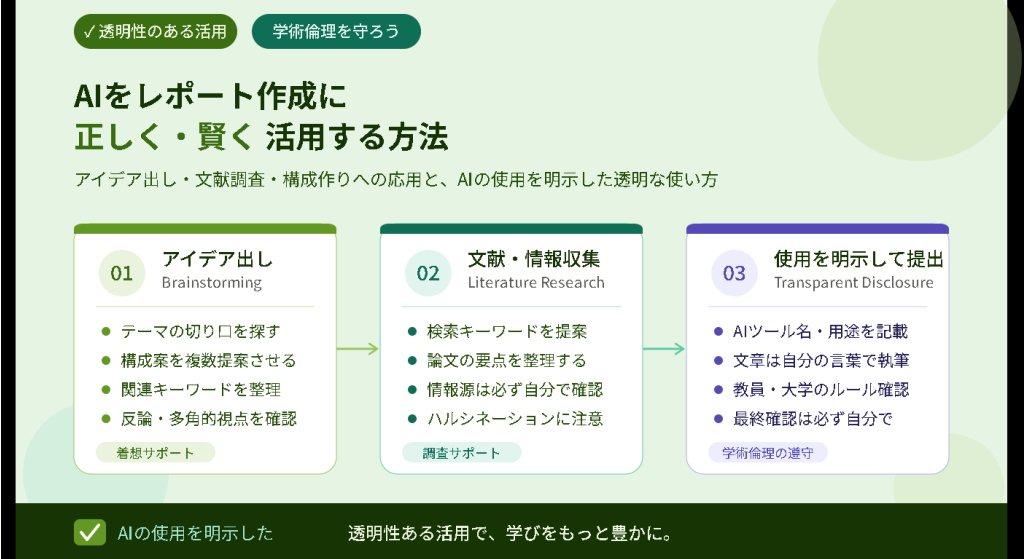
Generative AI for University Reports | Rules, Source Checks & Responsible Use [2026]
The spread of generative AI has significantly changed report writing for university and graduate students. ChatGPT, Gemini, Claude, NotebookLM, Elicit, Perplexity, and similar tools can accelerate information gathering, outline preparation, summarization, prose revision, and reference organization. Initial research or structuring that once took hours can sometimes be organized much more quickly with AI assistance.
At the same time, more students are asking, “Will it be obvious if I used generative AI for a report?” “Can I submit text written by ChatGPT?” or “Is there a way to avoid triggering AI-detection tools?” The important point is not to make evasion of AI detection the goal. What university reports actually require is not a technique for hiding AI use, but finishing the report on the basis of your own understanding, evidence, and analysis..
This article organizes a safe process for AI-assisted report writing, the proper meaning of avoiding misuse concerns, recommended AI tools, and methods for pre-submission review. Here, “avoiding detection” does not mean concealing misconduct. It means following university rules, using AI as an aid, rewriting in your own words, and verifying sources so that the report is not reasonably suspected of inappropriate delegation to AI.
Can Generative AI Be Used for Report Writing?
Generative AI can be useful at many stages of report writing: organizing major issues around a topic, generating related keywords, creating an outline, preparing a rough draft, revising prose, and checking for typographical errors. These are tasks that work well with AI assistance.
However, generative AI is not infallible. It can produce plausible prose containing incorrect information, nonexistent references, overly generic discussion, or unnatural wording. University reports require evidence-based analysis by the student, so submitting AI output unchanged is risky.
Generative AI should therefore be usedas a support tool for report writing, not a tool that writes the report in your place.as follows.
Key points to understand
| Point | Proper use | Use to avoid |
|---|---|---|
| Research | Use it to generate search keywords and organize issues | Do not insert AI-provided information into the report without verification |
| Creating the structure | Check the flow of the introduction, body, and conclusion | Do not use an outline unrelated to the assignment question without revision |
| Drafting the Manuscript | Use it as a rough draft and rewrite in your own words | Do not copy and paste AI-generated prose for submission |
| Proofreading | Check typographical errors, leaps in logic, and redundant expression | Do not accept AI revisions without checking their meaning |
| Avoiding misuse concerns | Check the rules, verify sources, and add your own analysis | Do not focus only on evading AI detection |
The proper meaning of “avoiding misuse concerns”
Many students may want to ensure that a report prepared with generative AI is not flagged as inappropriate. However, it is not appropriate to make evasion of AI-detection tools or concealment of AI use the goal. If the university or course requires disclosure of AI use, concealing it when submitting the report can itself become a problem.
Here, “avoiding misuse concerns” does not mean hiding misconduct. It means using AI as an aid, checking university rules, verifying sources, rewriting in your own words, and adding your own analysis so that the work is not reasonably suspected of being an improperly delegated AI report..
Instructors look at more than whether the wording “sounds like AI.” They also evaluate whether the student understands the course content, answers the assignment directly, provides evidence, and offers their own analysis. Strengthening the substance of the report is more important than trying to remove signs of AI use.
Check the AI-use rules for your university and course
Before using generative AI, always check the rules for your university and course. Some universities prohibit AI entirely, some allow only limited assistance such as outlining or revision, and some require disclosure of the parts in which AI was used.
Check the syllabus, course materials, LMS, institutional portal, instructions from the instructor, and guidance from academic-affairs offices. If the rule is unclear, ask a specific question such as whether AI may be used for creating an outline, revising prose, or whether disclosure is required.
Using AI without checking the rules can unintentionally be judged as academic misconduct. Whether AI is permitted may depend not only on university-wide policy but also on the individual instructor.
A Practical Process for Report Writing with Generative AI
Order matters in generative-AI-assisted report writing. Rather than asking AI to write the body immediately, proceed through research, outlining, rough drafting, reconstruction in your own words, and final checking. This is more likely to produce a high-quality report.
Step 1: Use generative AI as an entry point for research
Begin by gathering information about the topic. You can ask generative AI to “Organize the main issues in this topic,” “List arguments for and against it,” or “Suggest Japanese and English keywords for searching.”
However, do not treat AI-provided information as established fact. Use AI as an entry point for information gathering, and verify anything used in the report through academic papers, specialist books, government materials, university-library databases, or other reliable sources.
Step 2: Create an outline and heading options
After research, create an outline. Asking generative AI to “Create an introduction-body-conclusion outline,” “Suggest approximate lengths for each section of a 2,000-character report,” or “Include an objection and rebuttal” can make it easier to design the overall flow.
When preparing the outline, check that it still answers the assignment question. AI-generated structures can become generic. Revise them to fit concepts covered in class, assigned readings, and the instructor’s evaluation criteria.
Step 3: Prepare a rough draft for each heading
If AI is used to prepare body text, it is safer to work one heading at a time rather than generate the entire report at once. Specify conditions such as “Write a 300-character introduction centered on the problem,” “Organize previous studies in Body Section 1,” and “Develop my own analysis in Body Section 2.”
Generated body text is not a finished product; it is only a rough draft. Even fluent AI prose may have unclear evidence, lack your own perspective, or connect weakly with course content.
Step 4: Rewrite it in your own words
Always rewrite AI-generated prose in your own words. This is not simply a matter of substituting synonyms. Explain the content in language you understand, connect it with course content and references, and make your own claim clear.
To rewrite in your own words, read the AI text sentence by sentence and ask, “What is the evidence for this sentence?” “Could I explain this content myself?” and “Does this connect to a concept learned in class?” Delete sentences you cannot explain, or verify the evidence and rewrite them.
Step 5: Conduct final proofreading by a person
Finally, conduct a human final review. Check typographical errors, logical connections, citation accuracy, reference-list format, word count, assignment requirements, AI-use rules, and plagiarism risk.
Reading aloud can make unnatural expression and leaps in logic easier to notice. If time permits, leave the report for a while and then reread it with fresh eyes. Skipping the pre-submission review can substantially reduce the quality of an AI-assisted report.
Where Generative AI Fits in Report Writing
Generative AI is not a tool for delegating every stage of report writing. Limiting its role to appropriate stages makes it possible to combine efficiency with academic integrity.
Research and information gathering
Generative AI is well suited to preliminary research for understanding the overall shape of a topic. It can quickly organize related concepts, major issues, opposing views, and search keywords. Search-oriented AI such as Perplexity or Gemini can make it easier to investigate while tracing information sources.
However, AI research results are only an entry point. Any information used in the report should be supported by primary materials or academic literature.
Generating outline and heading ideas
Many students struggle with report structure. Generative AI can assist with the flow of the introduction, body, and conclusion. Providing the topic, length, course requirements, and issues you want to include can help generate heading options.
However, an AI-proposed structure is not necessarily optimal. Check whether it fits your own claim, answers the assignment question, and connects with content covered in the course.
Preparing a rough draft
Generative AI can also help prepare a rough draft of body text, particularly when you are unsure how to begin or want to improve transitions between paragraphs. However, AI prose tends to become generic and may weaken the student’s own perspective.
If you use AI while drafting, always add your own opinion, course content, assigned literature, and concrete examples. Without your own analysis, AI-generated prose can turn the report into something that could have been written by anyone.
Proofreading, revision, and pre-submission checking
Proofreading is a stage where generative AI can be particularly useful. It can help identify typographical errors, grammar mistakes, redundant wording, leaps in logic, and awkward conjunctions. Asking AI to “Point out problems only; do not complete the writing for me” can reduce excessive automatic rewriting.
However, there is no need to accept every AI proofreading suggestion. Revise while checking that the meaning has not changed and that your own claim has not been weakened.
Recommended Generative-AI Tools for Report Writing
Many generative-AI tools can be used for report writing. The important point is to choose tools according to purpose. Different tools are suited to drafting, information gathering, literature reviews, PDF organization, English editing, and citation management.
| Tool | Best-suited stage | Recommended Use |
|---|---|---|
| ChatGPT | Outline preparation, prose revision, and logic checks | Use for chapter structure, rough drafts, and identifying points that need improvement |
| Gemini | Information gathering and Google integration | Use for organizing recent information and background knowledge |
| Claude | Long-text organization and natural prose generation | Use for longer reports and organizing multiple materials |
| NotebookLM | Cross-Document Organization of Local Materials | Use for organizing key points from lecture materials, PDFs, and assigned readings |
| Elicit | Academic-paper searching and literature review | Use for comparing previous studies and organizing research gaps |
| Perplexity | AI search with source links | Use for background research and checking information sources |
| DeepL and Grammarly | Translation and English-language editing | Use for reading English literature and checking expression in English reports |
ChatGPT | Useful for outlines, prose revision, and logic checks
ChatGPT is a central tool for generative-AI-assisted report writing. It can be used for outline preparation, rough drafting, prose revision, checking leaps in logic, and improving prompts, among many other tasks.
However, delegating the entire report to ChatGPT tends to produce generic content. Safer uses include creating an outline, identifying missing issues, checking unnatural wording, or pointing out passages that appear to need citations.
Gemini | Strong for web research and Google integration
The source describes Gemini as easy to integrate with Google services and suited to information gathering and background research. It can be useful as an entry point for reports on social issues, economics, education, healthcare, tourism, IT, and other topics affected by recent developments.
However, web information varies in reliability. Do not insert content obtained through Gemini directly into the report; verify it using government materials, academic papers, specialist books, or university-library resources.
Claude | Suited to long-text organization and natural prose generation
The source describes Claude as suited to organizing long materials and producing natural prose. It can summarize multiple notes, check the logical structure of a long report, and identify duplication across chapters.
For graduate-level reports or longer assignments that include a literature review, Claude can help organize commonalities, differences, and research gaps. However, sources and specialist judgments must still be verified personally.
NotebookLM | Can organize information from course materials and PDFs
NotebookLM is an AI research tool that can summarize and answer questions based on uploaded materials. Loading lecture materials, PDFs, assigned readings, and your own notes can make it easier to organize information in relation to course content.
For report writing, you can ask, “Organize the key concepts in these materials,” “Show common points across multiple materials,” or “Extract issues that could be used in the report.” Because its answers are more closely grounded in materials you provide, it can make the connection to course resources easier to maintain than a general AI chat tool.
Elicit | Strong for academic-paper searches and literature reviews
Elicit is an AI tool suited to academic-paper searching, summarization, data extraction, and literature reviews. It can be particularly useful for graduate students, graduation and master’s theses, and literature-review reports.
For example, it can assist with finding previous studies related to a research topic, creating a comparison table of purpose, methods, results, and limitations, or organizing research gaps. However, do not cite Elicit’s summary directly; always check the paper itself.
Perplexity | AI search that makes source-linked investigation easier
Perplexity combines search with AI-generated answers. Because it often presents sources alongside its responses, it can make source verification easier to keep in mind than a conventional AI chat tool.
However, accuracy cannot be established unless you also check the content of the linked sources. Use Perplexity as an entry point for locating trustworthy information, and verify the original source before citing it in the report.
DeepL and Grammarly | Useful for English literature and English reports
DeepL can help translate English literature, while Grammarly can help check grammar and expression in English reports. These tools can be convenient for graduate students who need to read English literature and students writing reports in English.
However, translation and English editing can change meaning. Technical terms, statistical expressions, legal terminology, and medical terminology should be checked against the original text or authoritative specialist materials.
Will a Generative-AI Report Be Recognized? The Proper Response
If AI-generated prose is submitted unchanged, there is a substantial possibility that its use will raise concerns. This may occur not only because of AI-detection tools but also because an instructor notices inconsistencies, weak connections to course content, unnatural citations, or a lack of concrete examples.
Why AI-assisted reports may raise concerns
Reasons an AI-assisted report may raise concern include highly polished prose without the student’s own perspective, excessive generic discussion not covered in class, unnatural citations or references, unnecessarily difficult vocabulary, and too few concrete examples or personal observations.
AI-generated prose can also repeat similar expressions, use conjunctions mechanically, end paragraphs weakly, or make unsupported assertions. These patterns can create a sense of inconsistency when read by an instructor.
Six measures for avoiding reasonable suspicion of misconduct
| Measure | What to do specifically | purpose |
|---|---|---|
| 1. Check university rules | Check the syllabus, course materials, and the instructor’s instructions | Prevent unauthorized use and rule violations |
| 2. Keep a record of how AI was used | Note the stages in which it was used, such as research, outlining, or revision | Be able to explain its use if required |
| 3. Verify sources | Check AI-provided information against academic literature and official materials | Prevent fabricated references and misinformation |
| 4. Rewrite in your own words | Remove sentences you do not understand and rewrite them in a form you can explain yourself | Produce writing that does not look like an assignment delegated wholesale to AI |
| 5. Connect the report to course content | Reflect lecture concepts, assigned readings, and wording from the assignment question | Produce a report that goes beyond generalities |
| 6. Add your own analysis | Explain why you think as you do and where the limitations lie | Show the student’s own thinking |
Prompt examples for producing a more natural, course-specific report
When using generative AI, prompt design matters. Do not simply ask it to “write a report.” Limit the scope of the requested assistance and specify the conditions clearly.
| purpose | Prompt examples | Points of caution |
|---|---|---|
| Research | For this topic, organize the main issues and search keywords that should be checked before writing the report. | Use the information in the body only after checking the original sources. |
| Outline | For the following assignment question, create an Introduction-Body-Conclusion outline. Do not write the body text; show only headings and key issues. | Revise it to fit your own claim. |
| Drafting assistance | Create a rough draft of about 300 Japanese characters for this heading. Mark any passage that requires supporting evidence with [Source needed]. | Do not submit it unchanged. |
| Revision | For the following passage, identify generic AI-style discussion, leaps in logic, insufficient evidence, and unnatural wording. | Do not have AI rewrite the entire text excessively. |
| Pre-Submission Review | For the following report, check whether it answers the assignment question, identify passages that need citations, and check correspondence with the conclusion. | Make the final judgment yourself. |
Precautions When Using Generative AI for Report Writing
Generative AI is convenient, but misuse can negatively affect academic evaluation and learning outcomes. Particular concerns include hallucination, plagiarism, copyright, AI-use rules, and reduced development of your own thinking skills.
Risks of Hallucinations and Fabricated References
Hallucination is the phenomenon in which generative AI presents information that is not factual as though it were correct. Examples can include nonexistent papers, incorrect statistics, fabricated author names, or incorrect names of laws.
Citing a fabricated source in a university report can become a serious problem. Always verify AI-provided information through Google Scholar, CiNii, J-STAGE, PubMed, a university-library OPAC, government materials, or other appropriate sources.
Risks of Copyright Infringement and Plagiarism
Even AI-generated prose can resemble expressions found in existing web articles or papers. Using another person’s ideas or wording without citation can create a risk of being judged as plagiarism.
Do not assume that AI-generated text is entirely your own original work. If you rely on literature or materials, cite them appropriately and explain the ideas in your own words.
Risk of Failing to Develop Your Own Thinking Skills
Overreliance on generative AI can make it harder to develop the ability to think independently, structure writing, and interpret source materials. A university report is not merely a submission task; it is a learning opportunity for developing thinking and expression.
Use AI not to avoid thinking but to organize material that supports thinking. Including your own question, evidence, and analysis improves both the quality of the report and the learning benefit.
Support Available from iBooks Academic Support
iBooks Academic Support provides support for university reports, graduate-level reports, graduation theses, master’s theses, doctoral papers, and submitted manuscripts, including topic development, outline preparation, source verification, citation formatting, revision, and pre-submission review.
For reports prepared with AI assistance, it is still necessary to check alignment with the assignment requirements, gaps in the literature, citation problems, leaps in logic, shallow discussion, generic AI-style content, and unnatural wording. AI-generated prose may look polished, but university-level evaluation requires connection to course content and the student’s own analysis.
Professional pre-submission review can be useful if you want to check whether AI-assisted writing sounds unnatural, whether the references are correct, whether the report appropriately reflects your own work, or whether it meets the level expected of a graduate assignment.Human verification after AI use is an important step in protecting the reliability of a report..
Summary | Use generative AI as an aid and have a person take responsibility for the final work
Generative AI can substantially streamline report writing. It can assist with research, outlining, rough drafting, proofreading, summarization, and English-language checking. Useful tools include ChatGPT, Gemini, Claude, NotebookLM, Elicit, Perplexity, DeepL, and Grammarly.
However, submitting a report delegated entirely to generative AI is risky. Concerns may arise from AI-detection tools, an instructor’s sense of inconsistency, unnatural citations, or shallow content. The proper response is not to evade AI detection but to follow university rules, verify sources, rewrite in your own words, and add your own analysis.
What matters in report writing in the generative-AI era is Use AI as an aid and have a person take responsibility for the final work.the following. Use AI to reduce routine work, then spend the saved time on your own understanding, evidence verification, and deeper analysis. This is more likely to produce a report that can be properly evaluated.
If you are concerned that a generative-AI-assisted report sounds unnatural, want to revise AI output into your own words, need to verify citations and references, or want professional review before submission, you can consult iBooks Academic Support. We support report writing in the AI era through source verification, citation formatting, logic checks, and structural review.
Last updated: September 4, 2026
Key Points at a Glance
| Before input | Check institutional rules, confidentiality, and assignment conditions. |
|---|---|
| During use | Use AI as a support tool; do not treat model output itself as evidence. |
| Before submission | Verify facts and citations against original sources and confirm your own accountable analysis. |
Primary / Academic / Official Sources
Use the submission rules of your university, department, or target journal first. The sources below are verification starting points; read the original material before citing it.
- UNESCO, “Guidance for generative AI in education and research” (2023; updated 2026)
- ICMJE Recommendations, “Use of Artificial Intelligence in Publishing” (2026)
- Rasul et al. (2024), “Enhancing academic integrity among students in GenAI Era,” DOI:10.1016/j.ijme.2024.101041
Frequently Asked Questions
How can I evade AI detectors?
This article does not provide methods for evading detection or concealing prohibited use. The focus is compliance with institutional rules and responsible disclosure and verification.
Can I upload unpublished research data to an AI system?
Potential confidentiality, personal-data, contractual, or ethics restrictions may apply. Check your institution’s rules and the AI service’s data handling before uploading anything sensitive.
Can I cite an AI answer as evidence?
Normally you should verify and cite the underlying original or scholarly source that supports the claim, rather than treating model output itself as evidence.
Related Articles
- AI for University Reports
- AI Prompting for Research Papers
- How to Write References
- University Report Support
Related Support
Contact
To date, we have supported clients throughout Japan and overseas.over 10,000 casesof academic support requests. Experienced consultants carefully listen to your needs and provide prompt, appropriate support at reasonable fees.
Ibooks members across Japan will support you responsibly.
We send the profile of the responsible staff member when you apply.
When orders are busy, phone lines may be difficult to connect. We will reply in order, so urgent inquiries should be sent by
